A plane seat is a peculiar piece of inventory. It can be sold months early or seconds before departure. Its value changes with the route, the day, the connection, the competition and the likelihood that a richer customer will appear tomorrow. Then the cabin door closes and an empty seat becomes worth precisely zero. PROS built a company around that countdown.
The story began in Houston in 1985, when a major airline faced the luxurious but dangerous problem of heavy demand and severe overbooking. Mariette and Ron Woestemeyer combined computer science, forecasting and Ron's 14 years of airline sales and marketing experience. Their algorithm helped decide which demand to accept and which seats to protect. A project became a product; the product became a category.
Four decades later, the category has acquired fashionable language - predictive AI, neural networks, agentic workflows - but the wager underneath remains recognizable. PROS software predicts demand, recommends or generates prices, controls inventory, assembles offers and helps airlines sell them. In its former B2B life, it performed related work for manufacturers and distributors: set a defensible price, configure a complicated product and get an accurate quote out before the buyer wanders away.
The mechanismSmall percentages, repeated an absurd number of times
Revenue management is not simply “raise the price when demand is high.” The software estimates demand and price sensitivity, then weighs the value of accepting one booking against the opportunity cost of losing a later one. On a hub-and-spoke network, it must also understand that one seat can serve several possible itineraries. PROS says its current airline product forecasts at 11 dimensions and uses a five-step optimization process to calculate passenger mix, bid prices and inventory controls.
The advertised outcome is restrained by software-marketing standards: an average 2% to 3% revenue lift, more than 25% better forecasting accuracy and 30% higher analyst efficiency. These are PROS's figures, not guarantees. Yet a sliver of improvement across an airline network is the point. Optimization software becomes valuable when a modest edge is applied to millions of shopping requests.
That helps explain why customer longevity matters more here than launch-day sparkle. Lufthansa Group describes a 37-year relationship with PROS, spanning revenue management, real-time pricing and newer demand forecasting. The customer is not merely renting a dashboard; it is trusting software embedded in a commercial nervous system.
The expensive middleThe cloud bill arrived before the payoff
PROS went public in 2007. Its offering priced 6.8 million shares at $11, and the company itself reported $56.3 million in gross proceeds. It then widened its range: Cameleon added configure-price-quote software in 2013; Vayant expanded airfare shopping in 2017; EveryMundo added airline fare marketing in 2021. The old airline brain was becoming a broad commerce platform.
Then the business model had to be rebuilt. Beginning around 2015, PROS shifted from perpetual, installed software toward cloud subscriptions. The first thing to fail was not the core math. It was the comfort of recognizing a large license payment upfront. Maintenance revenue from old installations began a managed decline while subscription revenue took time to accumulate. PROS's own investor history labels 2015 through 2019 the “subscription transition.”
Pre-separation company totals. Subscription revenue rose from $178 million in 2021 to $266 million in 2024 as legacy maintenance continued to shrink.
Just as the recurring model matured, COVID-19 flattened aviation. Historical demand - the raw material of airline forecasting - suddenly became a bad guide. Airlines stopped flying, budgets tightened and the industry's planning assumptions broke at once. PROS retained its travel customers and kept broadening the platform, but total revenue stayed near $250 million in 2020 and 2021.
By 2024, the recovery was visible. Revenue reached $330.4 million, up 9%. Subscription revenue was $266.3 million. Gross margin improved from 62% to 66%, operating cash flow rose to $27.4 million and the net loss narrowed from $56.4 million to $20.5 million. The platform processed a company-reported 4.4 trillion transactions, 29% more than the prior year. It was scale with a lingering asterisk: PROS still had not produced GAAP profit.
“Over our 37-year partnership, Lufthansa Group and PROS have co-innovated advanced solutions that have transformed revenue management and pricing across our network.”Lufthansa Group, in a customer statement published by PROS
The splitOne platform story became two sharper companies
Thoma Bravo changed the ending. The software investor agreed to pay $23.25 a share in cash and completed the acquisition in December 2025, valuing PROS at approximately $1.4 billion. The price was public. What customers pay for PROS was not: enterprise subscriptions remain quote-based, with the bill determined by products, scale, transaction volume, integration and services.
The buyer's first strategic move was unusually legible. Travel would remain a standalone PROS. The B2B pricing and CPQ operation would join Conga, another Thoma Bravo company with contract lifecycle and document-automation products. That transfer closed in February 2026. PROS, led by 20-year company veteran Sunil John, now calls itself a dedicated travel technology company.
What changed their mind about the broad platform? No executive has described it as a repudiation, and the B2B products did not disappear. The more useful reading is structural. Airline retailing has its own data, standards, distribution pipes and unusually perishable inventory. B2B quoting connects more naturally to Conga's contracts and documents. The same optimization heritage can compound faster on two roadmaps than it can under one corporate story.
The current portfolio follows the traveler's commercial journey: forecast demand; decide what inventory to protect; generate a continuous or request-specific price; assemble fares and ancillaries; distribute the offer; market it directly; handle groups and corporate agreements. In August 2026, TAP Air Portugal advanced its work with PROS Continuous Pricing. Cyprus Airways adopted airTRFX for direct digital sales in July, while SriLankan Airlines extended its partnership in May. Those are incremental deals, which is how embedded travel infrastructure usually grows.
The transferable bitCopy the decision system, not the neural-network label
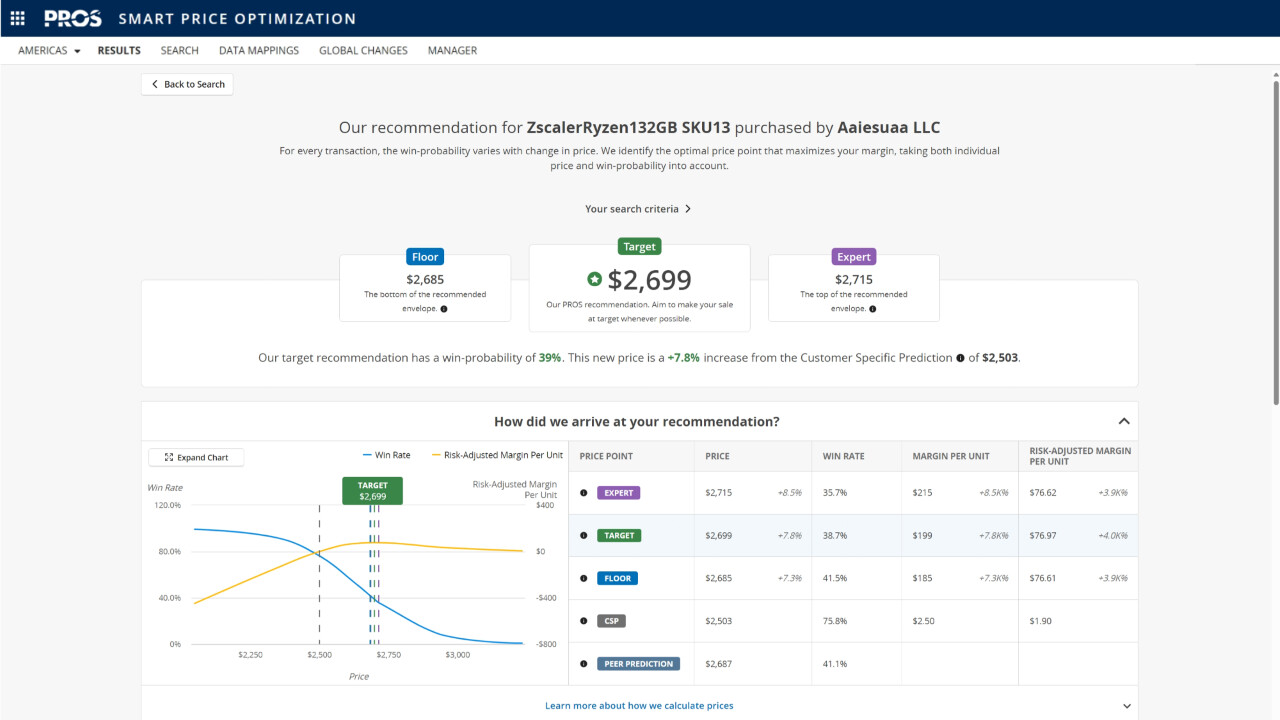
A pricing team does not need airline complexity to borrow the PROS method. One company case study describes an office-products distributor that abandoned slow spreadsheet quotes, email approvals and paper contracts after revenue began declining in 2014. It used a pricing model with floor, target and maximum prices and reported a $74 million revenue uplift. Another anonymized manufacturer cut quote time from seven minutes to under three and expected $6 million in added annual profit. These are vendor-published results, best read as evidence of possibility rather than a universal return.
The repeatable five-step play
- Find an expensive decision made frequently enough for a small improvement to compound.
- Establish the baseline: current margin, win rate, forecast error and decision time.
- Unify the transaction, customer, product, cost and capacity data that actually shapes the choice.
- Put the recommendation inside the seller's or analyst's existing workflow, with reasons and an override.
- Prove lift in one market, product line or route before adding channels and autonomous actions.
This is also where “AI-powered” stops being a useful buying criterion. The screen matters. The integration matters. The latency matters. The analyst's ability to interrogate a recommendation matters. PROS has accumulated airline knowledge since before the modern web, and that is harder to reproduce than a model architecture.
The open questionCan going home count as moving forward?
PROS spent years arguing that pricing, quoting and digital selling belonged together across industries. Its new owner has made a different organizational bet: let Conga carry that B2B thesis while PROS concentrates the old airline advantage. There is wit in the symmetry. The company that broadened from one overbooking algorithm has returned to travel just as airlines try to replace static fares with living offers.
The risk is concentration. Airlines are demanding customers with legacy systems, powerful technology suppliers and thin margins. A forecast can be precise and still meet a strike, a war, a pandemic or a sudden capacity change. PROS must also prove that “agentic” products do more than decorate established optimization with a new vocabulary.
The opportunity is equally plain. More than 150 airlines already use the company's technology. Every search, seat, bag, upgrade and corporate agreement creates another decision. PROS does not need each one to be dramatic. It needs them to be slightly better, quickly, over and over - before the cabin door shuts.