The trouble with a legal document is that uploading it does not put it in anyone’s hands. Somewhere beyond the polished case-management screen is an address, a door, and a person who may have moved. Between the file and the doorstep sits a small industry with a large responsibility. Proof has built its business in that distance.
- Proof arranges service of process through a nationwide network of independent servers.
- Legal teams can upload papers, communicate with the server, follow attempts, and receive affidavits.
- Customers pay for services; an account is free. Location and urgency affect the quote.
- Its recent work tackles two stubborn chores: retyping documents and untangling repeated attempts.
A client lost at the doorstep
Eric Voogt knew the problem from practice. His paralegal spent time checking availability, faxing papers, and chasing updates. The company’s origin story turns on a service error that, Voogt says, cost him a client. An adverse ruling made the weakness painfully visible. A routine administrative task had consequences well beyond the administrative budget.
“After losing a client due to a process serve error”Eric Voogt · Co-founder and Executive Chairman
Voogt founded Proof with Matt Jaffe and Mark Kreloff. The useful insight was modest enough to be credible: people arranging delivery should be able to see what is happening. A lawyer could already follow a pizza toward a front door. The documents attached to a lawsuit were, in his account, harder to follow.

The knock needs a record
Proof connects law firms, government agencies, and people handling their own matters with independent process servers. A customer uploads legal papers and submits a request. A server performs the field work. The platform supplies communication and tracking, then brings back the documentation. Summonses, complaints, and subpoenas are the kind of cargo involved.
That last step explains the name. A delivery notification is useful; an affidavit belongs to the legal workflow. Proof combines information from the case with material recorded during attempts, including locations, times, photographs, and notes. Its automation tools pre-populate affidavits, which its in-house team reviews before delivery to the customer. The value extends beyond getting the envelope out of the office.
For a paralegal managing many cases, communication is a product in its own right. Proof places the customer, server, and a Proof Specialist in a shared conversation. A question about access or an attempt can sit beside the work it concerns. The alternative is familiar office archaeology: an email here, a voicemail there, a colleague who remembers something but is at lunch.
A marketplace with shoes on
This is a business that joins software to physical work. Proof’s marketplace depends on independent professionals who travel to addresses and make attempts. Its server application asks applicants for identification, insurance, relevant licensing or registration, and experience. The company says its network is vetted for qualifications and background checks. An app cannot supply those qualifications by wishing very hard.
The customer base makes sense in that light. Litigation teams need papers delivered beyond their own neighborhood. Collection firms and property managers have recurring volume. Government agencies use the service, while individuals can submit their own requests. Proof’s website now reports more than 10,000 firms. That is a company-reported customer measure, rather than a count of successful deliveries.
Local servers and regional agencies remain alternatives. Someone with an established relationship and a small geographic footprint may prize that relationship. Proof’s case becomes more persuasive when the work crosses locations or when several people need to see the same status. Its competitive proposition is the combination of nationwide coordination, direct conversation, and a usable record of what happened.
The cheapest minute is the one you stop typing
Proof Autofill attacks the start of the job. Names, addresses, and court details already appear in uploaded documents. Asking a paralegal to type them again adds another opportunity for an error. Autofill extracts those details into a request that the user reviews and can edit. Proof markets the flow as a way to create a serve in 60 seconds.
Its engineers describe a revealing compromise. For machine-readable PDFs, conventional text extraction ran in about a second; their tested language model took about 20 seconds. Scans benefited more from the model. They routed documents accordingly, kept an OCR fallback, and introduced the feature gradually. The lesson for another product team is practical: choose the tool according to the input, and make corrections easy.
These are internal engineering results, not an independent performance test. They are useful because they show a decision changing under measurement. The glamorous option was slower on a common task. Proof kept the less glamorous one where it worked. Anyone automating document intake can copy the discipline without copying the whole stack.
One wrong address, several right-looking screens
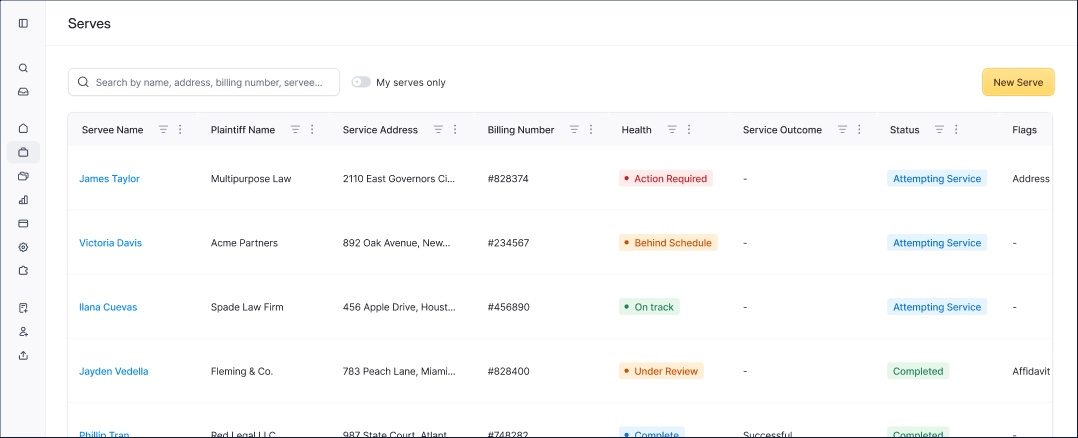
The January 2026 redesign moves deeper into the awkward middle of service. Jobs can require another server, another address, and additional attempts. Proof now consolidates those conversations and records under a serve-level history. A customer can follow the sequence instead of treating every redispatch as a fresh mystery.
of first attempts end at a bad address, according to Proof’s January 2026 product update.
The same update adds address checks, including flags for missing unit numbers. This is prevention at an unromantic scale. A beautifully extracted name does little good if the apartment number is absent. Proof also distinguishes jobs that are on track, behind schedule, or awaiting action. A status earns its keep when it tells the office what to do next.
That makes the redesign instructive beyond legal services. If a job changes hands, its history should travel with it. A fresh assignment need not force the customer to reconstruct the story. The system should retain the first attempt precisely because the first attempt may have failed.
Pay for the job. Read the clock.
Proof’s pricing is transaction-based: create an account, then pay for the services needed. Its quote depends on the physical address, speed, defendants, and case numbers. A state-level price is an estimate. Rural or difficult-to-serve locations can change the cost. The address-based quote is the useful figure for an actual job.
Timing deserves the same precision. Proof offers service speeds with stated attempt windows, some measured from the server’s acceptance. Its own help center explicitly says it cannot guarantee the desired outcome. It supplies an affidavit per defendant regardless of outcome. A request for fast service is therefore something to read carefully before planning around it.
Those conditions shape where the product helps. Good documents, usable recipient information, and enough time for the selected service are sound starting points. A person who cannot be located may require further investigation. Proof offers skip tracing, but knowing where someone might be and completing service are separate accomplishments. The platform makes the work visible; real circumstances still govern the result.
Stay inside the case file
Proof’s integrations help keep the administrative burden from returning through a different door. It connects with platforms including Clio, Filevine, Litify, and MyCase, and supplies an API. Its July 2026 SmartAdvocate integration lets teams initiate and track service from their existing case file. The practical attraction is fewer places to re-enter information and retrieve documents.
Investors have backed that position in the litigation workflow. Proof announced a $7 million Series A in March 2022, followed by a $30.4 million Series B in January 2024 led by Long Ridge Equity Partners. It also won Clio’s Best Practice of Law App integration award in 2024. In 2025 it announced completion of a SOC 2 Type II examination, relevant to firms entrusting a provider with sensitive records.
The interesting thing about Proof is how much of its promise is ordinary. Know who has the job. Know what happened. Preserve the evidence. Avoid typing the same address twice. Those are small ambitions when written on a whiteboard. At the moment a legal team needs an answer, they become quite substantial.