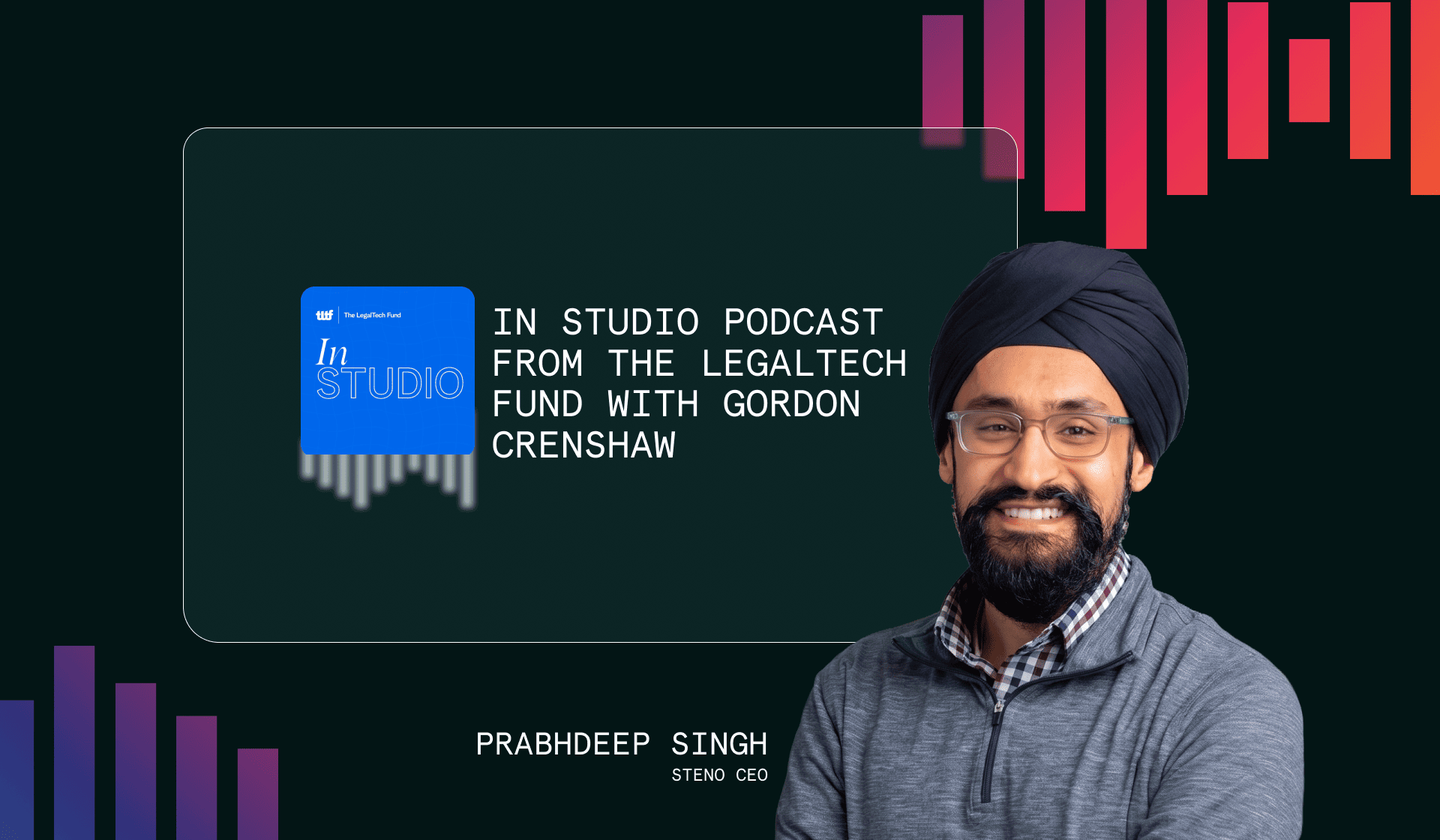
Prabhdeep Singh took over as CEO of Steno on June 9, 2026, twenty months after he arrived as chief operating officer. That is not the usual arc. Typically the COO stays the COO, or the board runs a search, or the founder waits until year seven to gracefully step aside. Here, co-founder Greg Hong moved to the board, Singh moved into the corner office, and the company closed a $49 million Series C in the same season - the kind of choreographed handoff that only happens when the board has already decided who is running the next chapter.
The next chapter is court reporting. This is a business most people encounter twice in their lives, both times in a deposition room, and the business behind it is bigger than the ambient prestige. Steno employs roughly 400 people, has raised $156.5 million total, and sells lawyers a stack of things they historically bought from four different vendors: a certified court reporter, a Zoom-integrated video platform, an exhibit annotation tool, and - the cleverest of them - a way to defer paying for any of it. The deferred payment product is called DelayPay. It is what Steno was originally built around. The origin story, which Singh tells now that he runs the place, is that co-founder Dylan Ruga, a litigator, got tired of inflexible court reporting invoices and asked his tech-side friends if they could fix it. "Both Dan and Greg, who both came from the tech space, said, look, deferring payments is a really interesting idea," Singh has recounted. That interesting idea grew a company around it.
Singh did not build it. He was hired to scale it. His resume is unusually clean about what "scaling" means. Before Steno, he was Operating Partner at Armory Square Ventures, a B2B SaaS-focused fund, where he sat on boards and did the investment committee work. Before that, he was Chief Growth Officer at Clover Health, which is where he learned - the hard way, in an industry that regulates every keystroke - that healthcare digitization is slower than founders believe. Before Clover, he was Global Head of Marketplace at WeWork, running the digital platform through a period that most of the tech press would rather not revisit. Before WeWork, he ran the Enterprise organization at Uber Eats, and before that a series of GM roles across Uber Eats markets. It is a marketplace operator's resume, applied - and this is the point - to a category that has never really thought of itself as a marketplace.
Court reporting is a marketplace. There are lawyers on one side, court reporters on the other, and a set of platforms in the middle trying to coordinate calendars, exhibit files, Zoom links, invoices, and increasingly, AI-generated summaries. Singh has run every side of a marketplace at scale. In depositions, he is doing the same thing, only the reporters are aging out, the venues are hybrid, and the customer wants a transcript summarized by an LLM three hours after the deposition ends. Steno's product for that is called Transcript Genius. That is Singh's mandate: turn a court reporting company into an AI-forward litigation infrastructure company, without losing the lawyers who still fax exhibits.
His theory of how to do it is, by his own account, patient. "We might want the industry to change at a hundred X speed, but it's going to change at ten X speed," he told The LegalTech Fund in a podcast recorded shortly after taking over. And: "You have to think about how do you meet people where they are versus trying to jump ahead to the future." A CEO whose growth resume includes Uber Eats saying that legal tech will only move ten times faster is a small piece of honesty that a lot of legal tech investors probably needed to hear.
His operating philosophy is less patient. Asked how he intended to run the company, he offered a line that could easily be printed on a Steno all-hands mug: "Delegating out decisions is what makes companies slow and clunky - you need to be able to make decisions fast." Read that carefully. It is not the standard-issue "empower your people" talking point. It is closer to the opposite. He is saying that if the CEO is not the one making the call, the company gets slower. Which is one way to describe a growth-stage company that just raised $49 million and needs to hit the AmLaw 200 before the check runs out.
The other thing worth noting about Singh, which he does not put in his LinkedIn bio, is that he is not a Silicon Valley figure. He grew up in Saratoga Springs, New York, went to Boston College, started his career at Morgan Stanley, moved to the Partnership Fund for New York City - a $170 million venture fund - then GLG, then co-founded a startup called LatticeWorks that eventually turned into Sallie Krawcheck's Ellevest. He lives in Brooklyn with his wife and two children. His companies are in Los Angeles, San Francisco, and New York, but the operator himself is a New York operator. Which is a specific breed. It is the breed that thinks of court reporters, insurance defense lawyers, and AmLaw 200 partners as a market to be served, not a joke to be disrupted.
He also has a public thesis about leadership shape. He calls it T-shaped: broad enough to run across functions, deep enough on unit economics inside each one. It sounds like an interview cliché. In his case it maps to the resume - marketplace, growth, enterprise, operations, investing - and to Steno's actual pain points, which are cross-functional in a way that the industry has not caught up to. Reporting, video, exhibits, payments, and AI all sit in different departments at most legal tech companies. At Steno they sit under one CEO who has, empirically, run each of them somewhere else.
The last analogy Singh has been floating publicly is between legal tech and healthcare. He spent enough time at Clover Health to know that a regulated, relationship-driven, paper-heavy industry does not digitize because Silicon Valley wants it to. It digitizes when the incumbents themselves feel the friction. Court reporting has that friction now. Reporters are retiring, hybrid depositions are permanent, AI summarization is real. Steno is trying to be the platform that ages with them.
There is a version of this profile that would end with a prediction. That version is uninteresting. The interesting version is that Prabhdeep Singh, who has scaled marketplaces at three companies most people have heard of, is now running one at a company most people have not. That gap - the delta between his personal name recognition and the size of the industry he now runs - is the most useful thing to know about him.