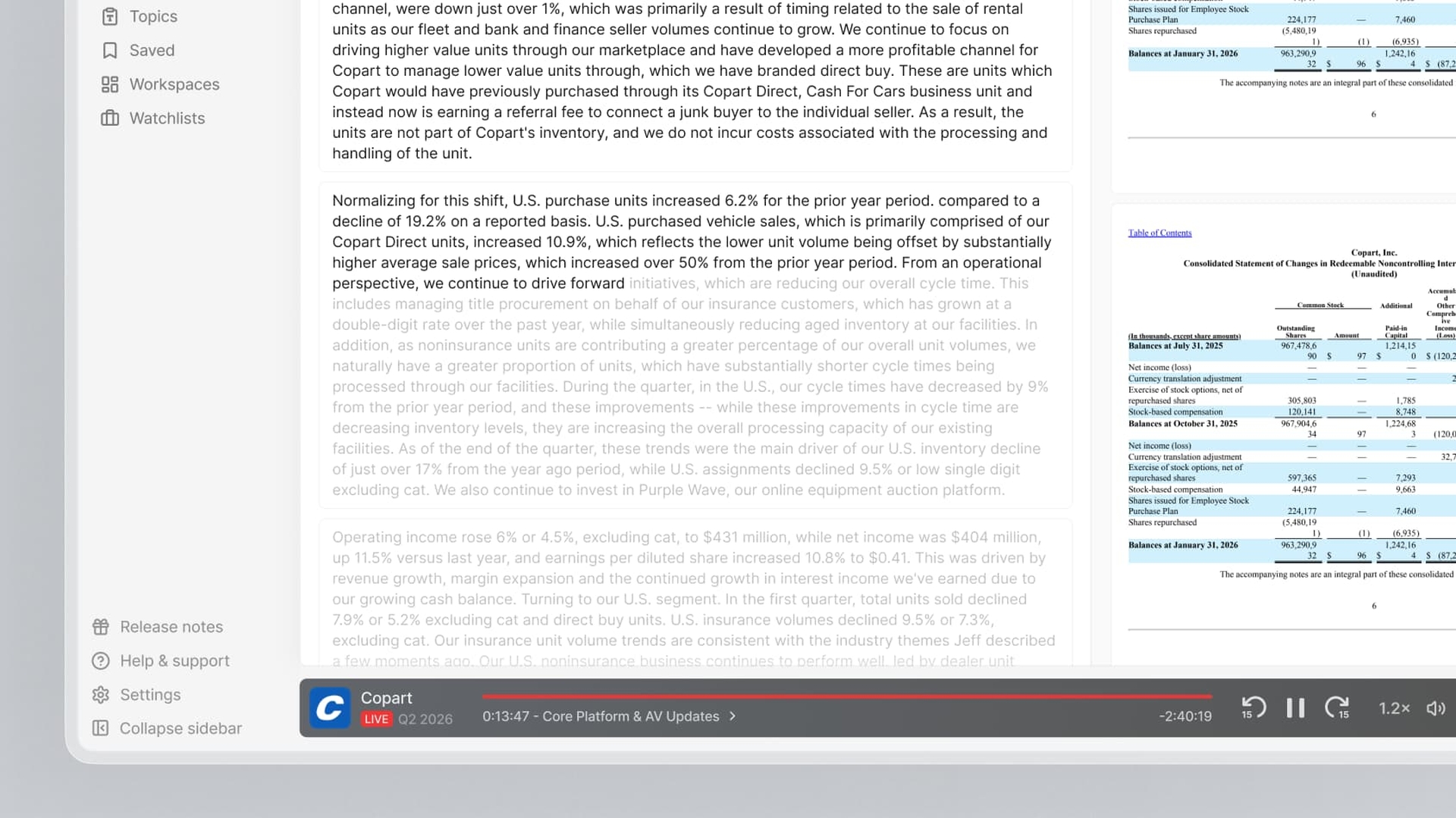
The first clue that Quartr understands its audience is the play button. Public-company research usually begins with a scavenger hunt: find the investor-relations page, surrender an email address to a webcast form, locate the right PDF, then discover the replay link has aged like supermarket sushi. Quartr collects that mess and gives it the manners of a modern media app. Follow a company, tap its event, listen live or later, read along, jump to Q&A, save a line, and keep moving.
That simple act remains the best reason to try it. The free iOS and Android app turns earnings season into a queue you can handle on a commute, a walk, or a suspiciously long lunch. Behind it sits a more ambitious business: Quartr Pro for finance teams, an API for builders, and MCP connections that carry the same investor-relations corpus into compatible AI tools. What started in Stockholm in 2020 as relief for retail investors now sells research infrastructure to hedge funds, asset managers, banks, platforms, and AI companies.
Who should put this in the research stack?
Start with the listener. If you own a handful of public companies and believe management tone matters, Mobile is a low-friction upgrade over browser tabs and podcast feeds. It covers live and recorded calls, filings, press releases, presentations, estimates, transcripts, watchlists, calendar events, and keyword alerts. The App Store listing shows a 4.7 rating from 481 ratings at the time of review. One reviewer praised the ability to skip directly to Q&A. Reddit users repeatedly describe Quartr as their earnings-call podcast player, which is both affectionate and accurate.
Pro is for people whose coverage list has stopped being charming. A buy-side analyst may need to compare the language around pricing across twenty peers. A sell-side team may need the reported figures checked against its preview before a morning note. An investor-relations officer may want to see which KPI competitors quietly removed from their decks. Those jobs involve too many calls and too much copying for a phone workflow. Pro adds broad search, AI chat, uploads, reusable prompts, multiple watchlists, slide-history comparison, structured exports, daily recaps, summaries, and Automations.

The product is at its best when a number sends you hunting for the sentence that explains it.YesPress assessment
The product has three very different front doors
| Door | Best for | What you get | The catch |
|---|---|---|---|
| Mobile | Individuals and on-the-go professionals | Calls, transcripts, IR documents, AI chat, alerts, calendar, estimates | Free, but a phone remains a phone when the work gets dense |
| Quartr Pro | Analysts, funds, banks, and IR teams | Cross-company research, uploads, exports, slide comparisons, Automations, MCP | Contact-sales pricing and an enterprise buying process |
| Quartr API | Platforms, brokers, media, and AI builders | Live and archived audio, transcripts, filings, slides, summaries, linked entities | Built for integration teams, with pricing scoped by use case |
The segmentation matters because Quartr's pricing page publishes no dollar figure for Pro or API. Mobile is free. Everything professional asks you to contact sales, with multi-seat and enterprise options. That makes a clean personal recommendation easy and a company purchase more procedural. Before a demo, bring a sample coverage list, two recurring research questions, a required document history, export needs, and a clear view of who needs seats. Ask for a pilot using a recent earnings cycle. A polished canned demo can hide coverage gaps that your own awkward small-cap ticker will expose in thirty seconds.
The clever bit is provenance
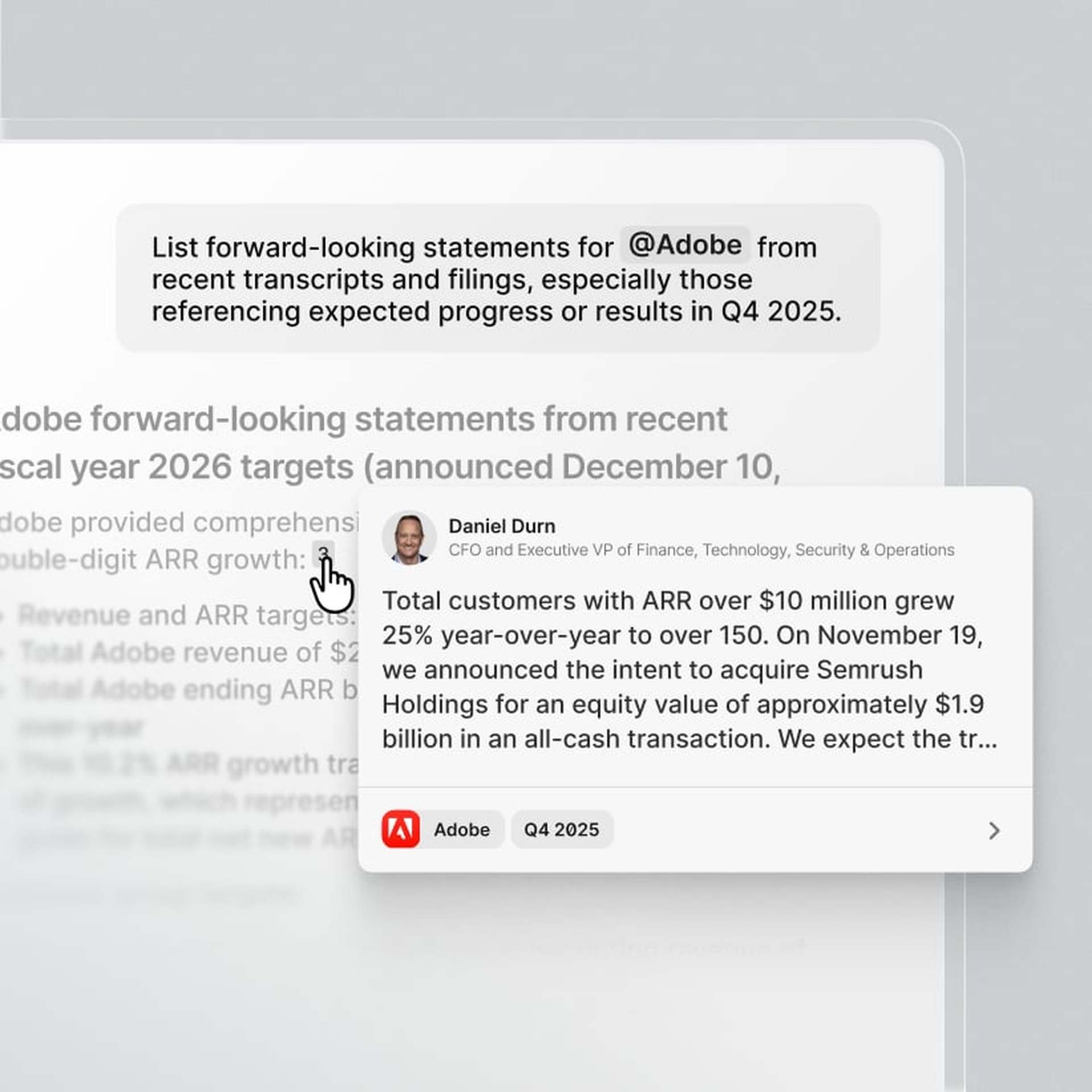
Quartr's AI pitch is deliberately narrow. Its chat works across first-party material such as company filings, earnings reports, transcripts, and slide decks. Findings can be opened beside the source, and the product says every output is traceable. This focus does not make an answer infallible. Transcription can mishear, filings can be amended, and management can frame bad news with the verbal equivalent of mood lighting. It does make checking the answer much less annoying.
The strongest prompts ask for change rather than summary. Try: Which revenue KPIs appeared in this quarter's deck but not the prior four? How has management's description of demand changed since the last capital-markets day? List guidance statements, include the speaker, and cite the exact passage. Ask the system to separate a reported fact from management's explanation. A generic “summarize the quarter” prompt usually produces information you could collect from the first page of the release.
Automations move the work before the coffee
Launched in August 2026, Automations let Pro users save a prompt and run it on a schedule or the moment a company publishes. Results can arrive in chat, email, the activity feed, or a mobile push. The obvious template compares a fresh call with the prior one and flags changes in language, tone, or KPIs. A sector analyst can also request a weekly read-through across a watchlist, or track a theme whenever a company speaks between earnings.
This is useful precisely because monitoring is repetitive. It is also where discipline matters most. An automation that asks a vague question can manufacture a dependable stream of vague answers. Keep prompts versioned, require citations, define the comparison period, and review misses after each cycle. Treat the output as an alert that points toward work, not a tiny analyst who has been left alone with your portfolio.
Where Quartr fits, and where it does not
Quartr competes with different products depending on the job. AlphaSense, Bloomberg, FactSet, and S&P Capital IQ enter the enterprise conversation. Fiscal.ai, Koyfin, TIKR, and Seeking Alpha overlap more with independent-investor budgets and workflows. A feature-count contest misses the point. Quartr's center of gravity is the public company's own narrative, delivered live and made searchable. It does not replace a broad market terminal for trading, pricing, portfolio analytics, news, screening, or every licensed research source.
Choose Quartr when calls, transcripts, decks, filings, and comparison of management language dominate the week. Choose a broader terminal when market data and portfolio tooling dominate. Choose a retail research service when you want outside opinions, ratings, or stock ideas. Many professional teams will pair Quartr with another system because qualitative primary research is one layer of an investment process, not the entire building.
What actual users keep noticing
The public review pool for Pro is small, so the praise needs context. G2 showed two reviews and a 5.0 average when checked. A financial analyst emphasized real-time transcripts during earnings season; an investor liked having “everything ready in just one app” and identified the laptop experience as a premium feature. Product Hunt reviewers praised the mobile-native reading experience. App Store criticism included privacy concern and the desire for a reasonably priced personal desktop option. On Reddit, the 2025 retirement of the retail desktop Core product frustrated users who preferred a larger screen, while Quartr staff stressed that the free mobile app would continue.
That desktop gap is the sharpest caveat for serious individual investors. The free app is unusually capable, but long filings, peer tables, and multi-year comparisons benefit from a keyboard and monitor. An individual may love the mobile experience and still find the jump to a sales-led Pro plan awkward. Quartr should make the boundary explicit during onboarding and buyers should ask what persists across devices, what works offline, what can be exported, and which features belong to Mobile versus Pro.
Try Mobile tonight. Make Pro prove itself on your ugliest research day.
The free app solves a plain problem with unusual grace: it makes company events easy to find and pleasant to follow. Pro has a credible professional thesis around first-party search, source-linked AI, and automated change detection. Its value rises with the number of companies you cover and the cost of being late. The absent public price means the buying decision must rest on a scoped pilot, coverage checks, saved analyst hours, and better research output.
A five-minute buying checklist
Test the mobile app with three companies: one mega-cap, one foreign listing, and one obscure name you genuinely follow. Play an archived call, tap from transcript to audio, find the Q&A, search a product name, open the corresponding deck, and set a keyword alert. For Pro, test cross-company search, historical depth, speaker labels, export quality, user permissions, document uploads, source links, and one real automation. API buyers should add latency, identifiers, licensing rights, parsed-document quality, service levels, backlog coverage, and support to the list.
Quartr's backstory gives the product a pleasant symmetry. The company began because retail investors deserved a sane way to hear executives speak. It discovered that professionals had the same irritation at greater scale, then built the data layer beneath the interface. Even the 2026 logo contains the argument: a square for numbers, a circle for narrative, and an open quarter suggesting that one reporting period belongs to a longer story. A little earnest, perhaps, but finance could use a symbol that remembers the next quarter is not the whole company.