MarketMuse is for the meeting where six smart people have 43 article ideas and nobody can explain why number seven should ship before number thirty-eight. The browser-based platform reads a site as a body of work, compares it with the wider web, and tries to turn editorial instinct into an order of operations. Its ideal customer already has content, writers, traffic, and a slightly haunted spreadsheet.
That distinction matters. Plenty of software can decorate a draft with related terms. MarketMuse earns attention earlier, when a team must choose between updating an aging winner, filling a cluster gap, challenging a weak rival, or shelving a glamorous keyword it has no authority to own. The product’s answer comes from topic models, site inventory, competitive coverage, and a metric called Personalized Difficulty. In plain English: the same keyword should not look equally hard to a hospital, a cookware blog, and a telescope shop.
Why it exists: the calendar is lying
A content calendar looks decisive because dates are tidy. The thinking underneath may be a stew of executive requests, search volume, competitor envy, and whatever somebody found in a keyword tool before lunch. MarketMuse attacks that mess with an automated inventory of published pages and the topics attached to them. It tracks where a site has coverage, where that coverage performs, and where authority could make the next piece easier to win.
The company started in 2013, the year Google’s Hummingbird update pushed search further toward meaning and intent. Its origin predates the current parade of chat boxes. Founder Aki Balogh began the project, Jeff Coyle later joined as co-founder after piloting it across 55 B2B lead-generation sites at TechTarget, and Richard Mallah is also listed as a founder. MarketMuse received a patent for semantic keyword analysis in 2019, acquired the six-billion-keyword Grepwords database in 2021, and was acquired by Siteimprove in October 2024.
The clever number is not a content score
Content Score is the familiar part: paste or write a page in Optimize, compare its coverage with a model, and watch recommendations change as concepts are added. Useful, yes. Also easy to misuse. A writer chasing every suggested term can produce a casserole of nouns. MarketMuse’s more interesting measures sit above the draft.
Topic Authority considers the breadth and quality of a domain’s coverage, plus performance and room to improve. Personalized Difficulty runs from 1 to 100 and estimates difficulty for that particular site. Competitive Advantage is the difference between generic difficulty and personalized difficulty. Together they help answer a sharper question than “Is this keyword popular?” They ask whether this team has earned a plausible opening.
“We see 4x-10x more traffic with pieces we optimize with MarketMuse.”Zoe Hawkins, Principal Content Manager, Sumo Logic - testimonial published by MarketMuse
Treat that as a customer result, not a laboratory guarantee. MarketMuse publishes case studies reporting a 1,570 percent blog-traffic increase for monday.com, a 92 percent organic-traffic increase for Kasasa, and 266 percent growth in first-page keywords for ManyChat. The numbers show what committed teams have done alongside the software. They do not isolate the software from stronger writers, higher publishing cadence, links, brand demand, or a dozen other variables that make SEO gloriously inconvenient.
The useful loop
What you can actually do on Monday
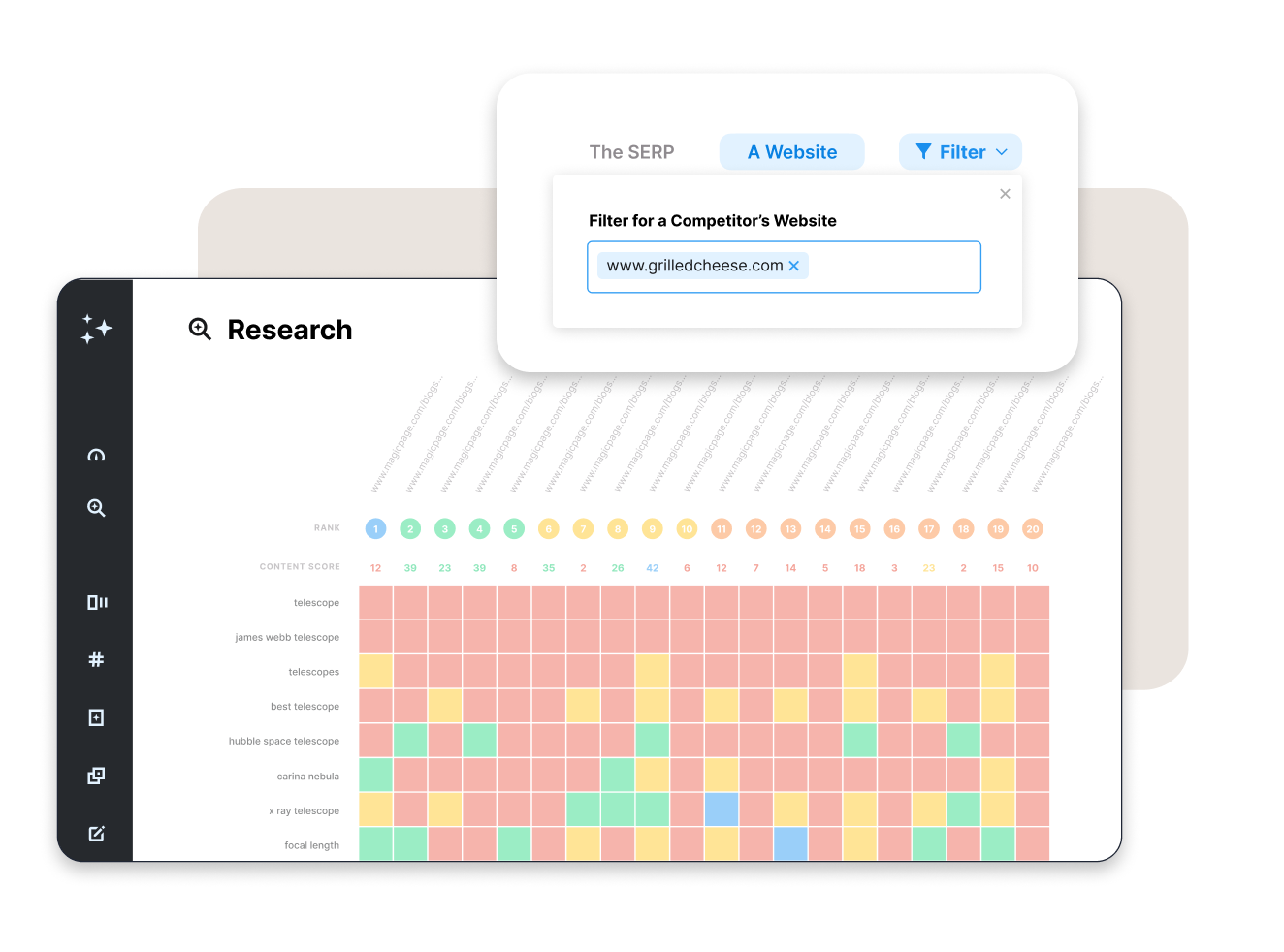
Start with Inventory if you have a mature site. Filter for pages sitting near page one, low Personalized Difficulty, useful search volume, and meaningful authority. Those are potential quick wins. Then inspect the topic in Research, where a model surfaces 50 semantically related concepts, questions, volume, cost-per-click, and trends. SERP X-Ray and Heatmap show how ranking pages cover those concepts. Connect proposes links and anchor text so the new work has somewhere to live.
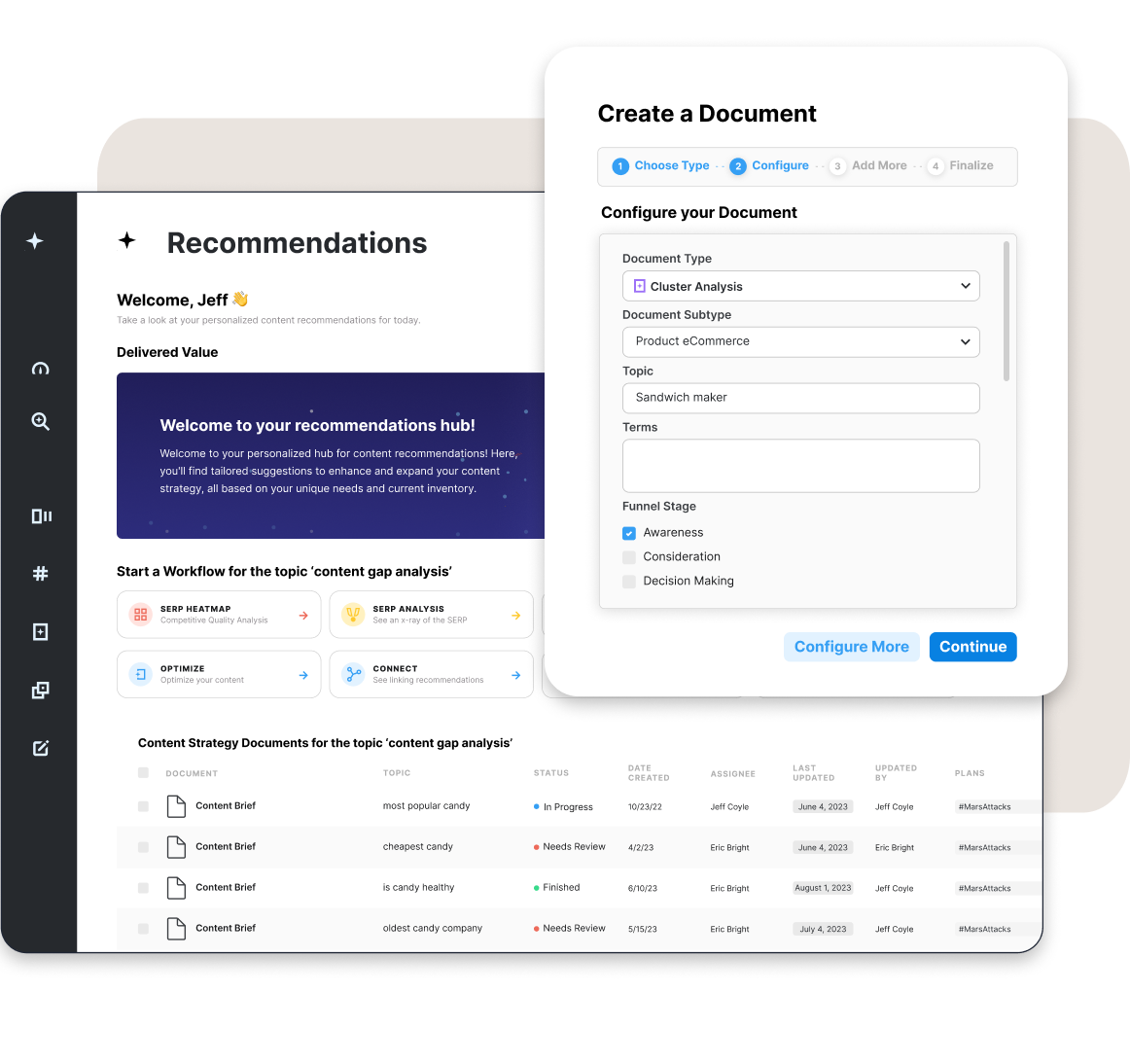
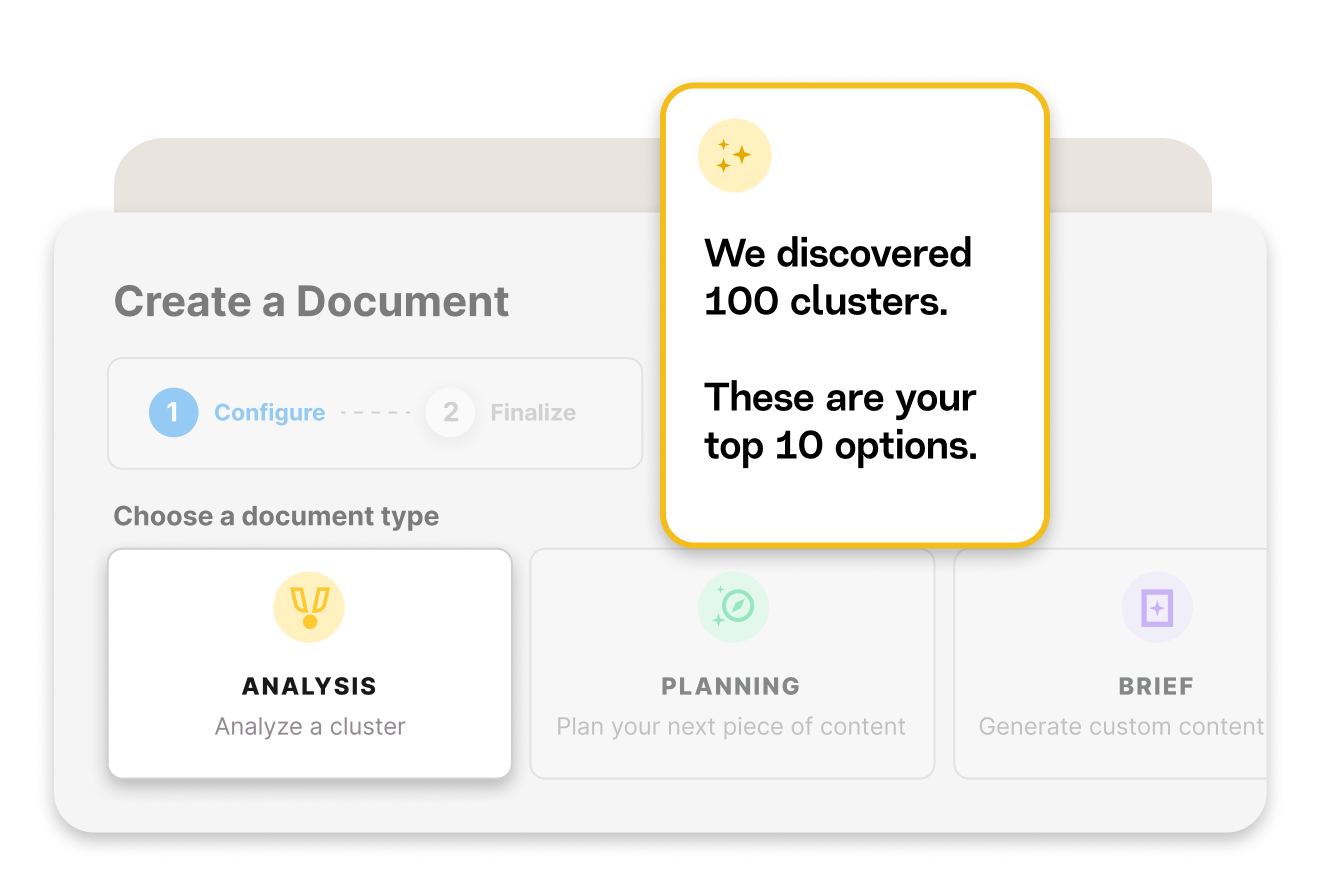
For a larger project, Content Strategy Documents organize cluster analysis, content plans, keyword and audience-intent analysis, and quality recommendations. A plan can include an executive summary, recommended creates and updates, cluster details, competitors, personas, funnel stages, questions, and content groups. Briefs turn that map into a working assignment. Strategy customers get nine brief types, including structures for comparisons, lists, how-to pieces, and other common jobs.
The AI writer is the side dish
MarketMuse added a ChatGPT connection in 2023, then launched MarketMuse AI as an LLM-agnostic assistant. Inside Optimize it can create an outline, expand a concept, continue a passage, shorten, summarize, change tone, and fix American English spelling and grammar. Generated text appears for review before a user replaces a selection or inserts it below.
The restraint is welcome. MarketMuse explicitly says it does not write content for customers and is not a CMS. Its AI assistant can move the cursor, but the durable value is the evidence around the cursor: which subject fits the site, what the competitive pages omit, how a cluster should hang together, and what an expert still needs to contribute. In 2026, when fluent paragraphs are cheap, deciding which facts and experiences deserve a paragraph is the scarcer job.
| Need | MarketMuse fit | Also compare |
|---|---|---|
| Portfolio planning across many existing pages | Strong. Inventory and personalized metrics are the point. | BrightEdge, Semrush |
| Fast, focused optimization for individual drafts | Capable. Optimize scores coverage and guides revision. | Clearscope, Surfer SEO |
| Lower-cost briefs and AI drafting | Potentially excessive. The planning layer may go unused. | Frase, Dashword |
| Technical SEO crawling and accessibility | Adjacent. Siteimprove’s broader suite covers more of this territory. | Siteimprove, Semrush |
Pricing: the free audition and the real commitment
The free plan gives one user 10 monthly queries, limited applications, and no site inventory. It is enough to understand the interface, not enough to run an editorial operation. Optimize adds one inventory, 100 tracked topics, 100 monthly queries, five briefs, and one strategy document. Research moves to three users, 1,000 topics, ten briefs, three strategy documents, and unlimited queries. Strategy allows five users, 10,000 topics, 20 briefs, five strategy documents, and all nine brief types.
MarketMuse’s official pricing page currently sends buyers to a demo rather than printing dollar amounts. A February 2026 TechRadar review reported monthly starting prices of $99 for Optimize, $249 for Research, and $499 for Strategy, with annual totals of $999, $2,499, and $5,499. Confirm the quote before building a budget around it. Old Reddit threads discuss far higher enterprise quotes from earlier packaging; they are useful evidence of historical sticker shock, not current price cards.
Who should buy it - and who should keep walking
The clearest fit is a content-heavy brand, publisher, or agency with enough history for the inventory to reveal something. SEO directors can use the scoring to justify priorities. Strategists can build clusters. Editors can standardize briefs. Writers can research and optimize without opening twelve SERP tabs. Marketing leaders can connect planned work to estimated traffic and value. The product makes more sense when a bad assignment costs hundreds or thousands of dollars.
A solo blogger with twenty posts and a small monthly budget should be skeptical. So should a team shopping mainly for an automatic article generator. The same goes for anyone unwilling to learn the metrics or change the calendar when the evidence is inconvenient. TechRadar called out the learning curve, and G2’s review summary likewise notes that the breadth can feel overwhelming at first. The interface is orderly, but the underlying decisions remain strategic.
“MarketMuse makes it much easier to find out what questions people are asking about a topic.”Verified G2 reviewer, August 2025
Reviews are broadly warm. G2 showed 4.6 out of 5 from 216 reviews when checked, with praise clustering around actionable optimization, topic discovery, and a simpler research process. Complaints cluster around cost, the learning curve, and dashboard complexity. That combination rings true: this is a tool that becomes more valuable as the content problem becomes more expensive, but more difficult to justify when the operation is small.
Buy the decision engine, not the robot pen
MarketMuse is distinctive when it compares an opportunity with what your site has already earned. Its inventory, topic authority, personalized difficulty, competitive gaps, and plan-to-brief workflow can give a busy content team one defensible queue. Test the free tier, price the hours currently lost to audits and briefing, and ask whether the team will use the inventory every week. If the answer is yes, the serious plans deserve a demo. If all you want is faster first drafts, spend less.
A sensible trial checklist
- Run three real topics: one established strength, one weak cluster, and one tempting moonshot.
- Compare Personalized Difficulty with the generic difficulty your team already uses.
- Give one brief to a writer who did not build it. Ask what was missing, distracting, or unusually helpful.
- Optimize one near-page-one article, then record what changed. Do not confuse a higher score with a business result.
- Calculate the monthly value of saved research, audit, and briefing time before choosing a tier.