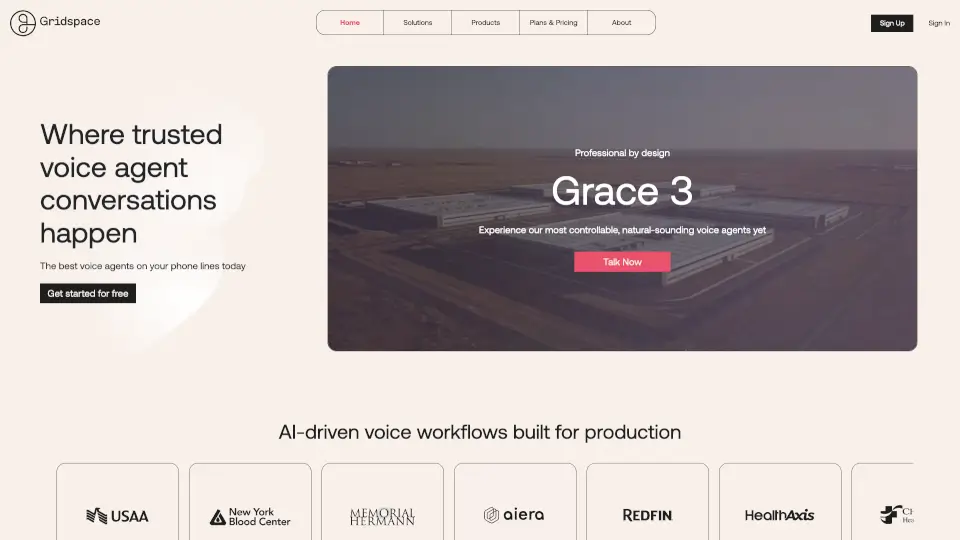
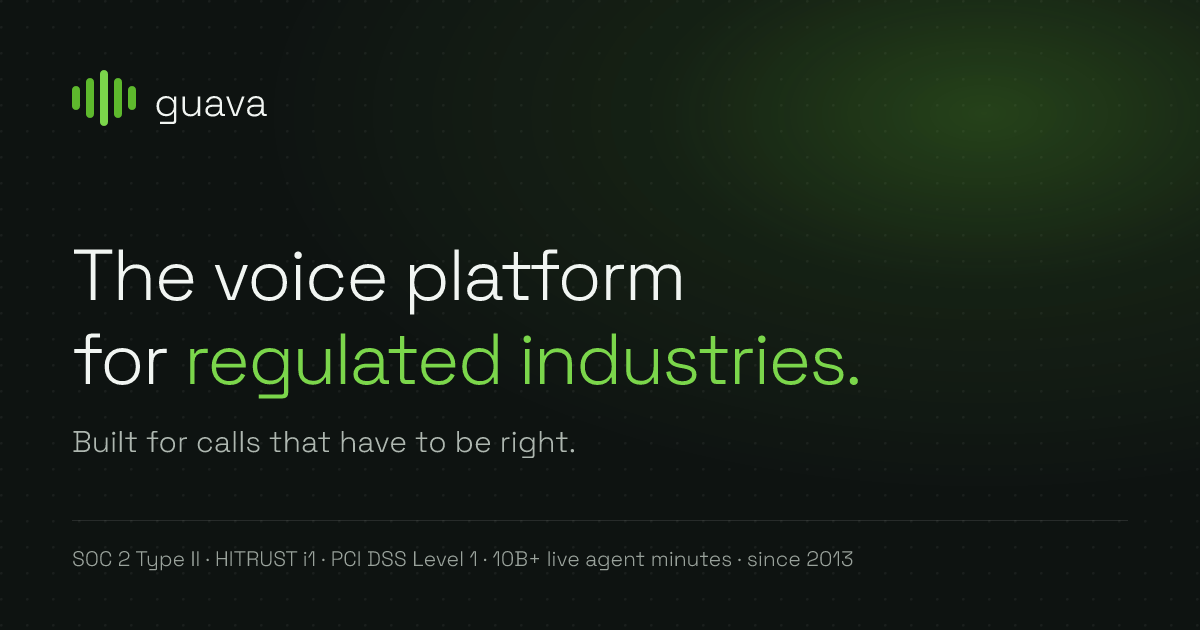
If your mental picture of a voice agent is a chirpy demo ordering pizza, Gridspace would like a word. The company learned its trade in the calls where small mistakes become expensive: a patient needs a follow-up, a bank needs a disclosure read correctly, an insurer needs information captured without inventing anything. Its original answer was Grace, a task-oriented agent backed by Sift, the system that listened, transcribed and measured. The new answer is Guava, a developer platform built from the same obsession with what happens between “hello” and a clean handoff.
That history matters because voice AI is a physical comedy of tiny delays. A person interrupts. A mobile line clips a consonant. An IVR demands keypad tones. A caller asks a question nobody put in the script. Every extra vendor in the chain adds another place for the conversation to wobble. Gridspace’s bet was to own more of the chain: telephony, recognition, language, synthesis, dialog management, monitoring and analytics. In 2023, the company described itself as a full-stack provider running neural networks on its own softswitches. In 2026, Guava packages that engineering into an API, CLI and SDKs.
Why it exists, and who should care
Gridspace is for organizations whose phone operation is a workflow, not a novelty. Think appointment scheduling, post-discharge outreach, prior authorization, donor recruitment, insurance intake, collections, KYC checks and airport questions. These jobs have known goals, known fields to collect and clear moments when a human should take over. That makes them good candidates for controlled automation and bad candidates for a model encouraged to riff.
The buyer is usually a contact-center leader, operations executive, clinical administrator or engineering team with enough volume to justify integration work. The current Guava product also courts developers at smaller teams: its free plan, quickstart and local test loop make a first agent accessible without a procurement committee. A restaurant waitlist demo in the documentation shows the basic pattern. Assign the agent a checklist, collect a name, party size and phone number, read the number back, then end the call or move to another task.
“Short form command speech is very different compared to natural conversations.”Evan Macmillan, speaking to Voicebot.ai in 2019
Skip Gridspace if all you need is a lightweight website chatbot, a one-off audio generator or a generic transcription box. It is also more system than a tiny business needs for answering a handful of calls. The value appears when the conversation must touch software, obey rules and produce a measurable outcome. The practical question is not whether the voice sounds uncannily human for thirty seconds. It is whether the hundredth strange call is logged, recoverable and routed correctly.
These are current company figures, useful as scale signals rather than a substitute for a buyer’s own load test.
How the machinery is different
Guava splits each call between two systems. Its hosted Dialog System handles the impatient work: audio in, transcription, response synthesis and audio out. The customer writes an “Expert,” code that connects by persistent WebSocket and steers the conversation. That Expert can query an EHR, CRM or database, call another API or use a specialized reasoning service. Because those requests are asynchronous, the voice layer can keep the call moving while slower business logic does its job.
This is a sensible separation of duties. The voice system owns rhythm; the customer’s application owns truth. Guava recommends tasks and fields instead of one enormous prompt. Callbacks fire when a caller asks an outside question, requests an action, presses a key, completes a task or needs escalation. Developers can transfer, hang up, switch tasks, set a persona, send DTMF tones and read a fixed script. The design makes the approved workflow visible in code review, which is particularly useful when compliance staff would prefer not to audit a four-thousand-line prompt.
Runs structured, multi-turn calls, collects information, books, reminds, transfers and follows up.
Captures, transcribes and analyzes conversations for QA, coaching, compliance and operational signals.
Exposes the voice layer through CLI, API and Python, TypeScript, Java/Kotlin and Elixir SDKs.
Adds sensitive-field redaction, DNC handling, audit trails, transfers, tenant isolation and compliance controls.
The product spans SIP and WebRTC, inbound and outbound calls, campaigns, SMS and text chat. Developers can run an agent locally without opening a public tunnel, then deploy it to their own infrastructure or through Guava hosting. Recent releases added simulated role-play, mock calls, audio previews and pronunciation tools. Those features sound small until a medical surname, street name or brand acronym is mangled on every call.
Evidence from the phone lines
The most persuasive Gridspace stories are specific. Memorial Hermann used the technology for post-discharge engagement, with Gridspace reporting task completion above 90 percent. A national healthcare provider case study says Grace handled more than 200,000 monthly calls across follow-ups, wellness reminders, billing, medication adherence and screening. That deployment reported 220 full-time employee hours saved. New York Blood Center work was credited with helping secure more than 500,000 pints of blood.
There are less grand but equally revealing numbers. The Medicare Club said 78 percent of answered calls were handled in under two minutes. Diabetic Insurance Solutions reported a 60 percent increase in lead connections. Incept’s Betty Blood, developed with Gridspace, makes donor reminder calls, answers routine questions and transfers interested people to scheduling specialists. The recurring pattern is narrow competence at volume, with a person available beyond the boundary.
Independent review depth is thin. G2 shows one validated review for Gridspace Contact Center AI, rated five stars. The reviewer called the solution innovative and the team collaborative, while asking for better management tools, production stability and post-release monitoring. One review cannot establish a market consensus, but its criticism points directly at the hard part of this category: operating agents after the launch party. Buyers should demand references for a use case and scale resembling their own.
Price check and the shortlist
Legacy Gridspace deployments were quote-led. Guava’s public menu is clearer, though the included minutes are annual, an easy detail to skim past. Starter costs $0 per month with 500 minutes per year and $0.15 per additional minute. Build costs $149 per month with 1,500 annual minutes and $0.14 overage. Scale costs $499 per month with 7,000 annual minutes and $0.13 overage. Enterprise pricing is custom. The free tier is useful for a prototype; even modest production volume will require arithmetic.
| Option | Start here when | Watch closely |
|---|---|---|
| Gridspace / Guava | Calls are regulated, task-based and integrated with your own systems. | Young public SDK ecosystem; verify support and deployment fit. |
| PolyAI / Parloa | You want enterprise contact-center automation and broad managed delivery. | Compare control model, language coverage and implementation cost. |
| Vapi / Retell / Bland | You favor developer speed and flexible component choices. | Count every vendor, latency hop and compliance responsibility. |
| Twilio | You already own the conversation logic and need communications primitives. | You may assemble more of the speech and agent stack yourself. |
Run the comparison with ugly calls, not polished demos. Use accents, speakerphone noise, interruptions, voicemail, silence, wrong answers and a request to opt out. Confirm how recordings and transcripts are redacted, where data lives, what a “minute” means and which party owns carrier reputation. Measure transfer accuracy and task completion alongside latency. Ask to see the conversation log after a failure. If an agent sounds wonderful but leaves no forensic trail, the operations team inherits a mystery.
The YesPress take
A compelling fit when the phone call is part of the product.
Gridspace’s advantage is accumulated scar tissue. Grace proved the company could automate bounded work; Sift made the calls inspectable; Guava now lets developers keep business logic in code. The transition also creates a diligence question: buyers should confirm how existing Gridspace products, contracts and support map to Guava. For teams that need regulated voice with hands-on engineering control, it belongs on the shortlist. For a simple receptionist, bring a smaller wrench.
A decade, compressed
Gridspace forms with SRI Speech Labs roots and founders Evan Macmillan, Anthony Scodary and Nico Benitez.
Sift is publicly described as a real-time engine for turning contact-center conversations into structured data.
Grace expands through healthcare and finance workflows; emotion detection and more expressive responses arrive in 2024.
Betty Blood launches with Incept, while call.chat tests a lighter personal and small-business direction.
Guava debuts as the developer-facing voice platform. By August, release 0.40.0 adds PCI-safe card capture and phoneme controls.
There is a charmingly nerdy footnote to the new name. Guava is a backronym for Generative, Universal, Agentic, Voice and API. The “universal” claim refers partly to carrier support and 16 kHz wideband audio where available. The “agentic” part means persistence: re-ask, try another path, escalate, and pass the context. It is a better definition of agency than letting a bot chatter indefinitely.
Gridspace’s story is therefore less about replacing the person who answers the phone than replacing the dead zones around them: hold queues, repetitive outreach, missed follow-ups, manual data entry and calls that disappear into recordings nobody reviews. The product is at its best when automation has a job description and an exit door. That is not the loudest vision for voice AI. It may be the one a caller notices least, which is usually the point.