Every company eventually grows a haunted wing in its data warehouse. The tables have sensible names, until they do not. Three dashboards report revenue. Two are right, depending on whom you ask. The analyst who knows why left six months ago. CastorDoc was built for this familiar mess: give the organization one searchable place to learn what a data asset means, where it came from, who owns it, and whether anyone still trusts it.
The product is now called Coalesce Catalog after Coalesce acquired CastorDoc in March 2025. The old name still matters because customers, documentation, web addresses, and years of reviews continue to use it. The useful shorthand is simple: CastorDoc is the approachable catalog; Coalesce is the larger data transformation company now building around it.
Who actually needs this?
Start with the why. A catalog earns its keep when people repeatedly ask the same questions: Where is the approved customer table? What feeds this dashboard? Will changing this column break finance? CastorDoc is meant for mid-market and enterprise organizations with a modern warehouse, several BI or transformation tools, and enough users that oral tradition has stopped scaling.
Data engineers and analysts get lineage, query history, popularity, ownership, quality context, and dependency clues. Data stewards get classifications, glossary terms, certification, and review controls. Business users get the gentler proposition: type a question, find a metric, inspect a dashboard, and see enough context to decide whether it is useful. The product offers little to a tiny team with one warehouse, a disciplined dbt project, and three people who sit together. In that office, a catalog can become an expensive second documentation system.
A search box with institutional memory
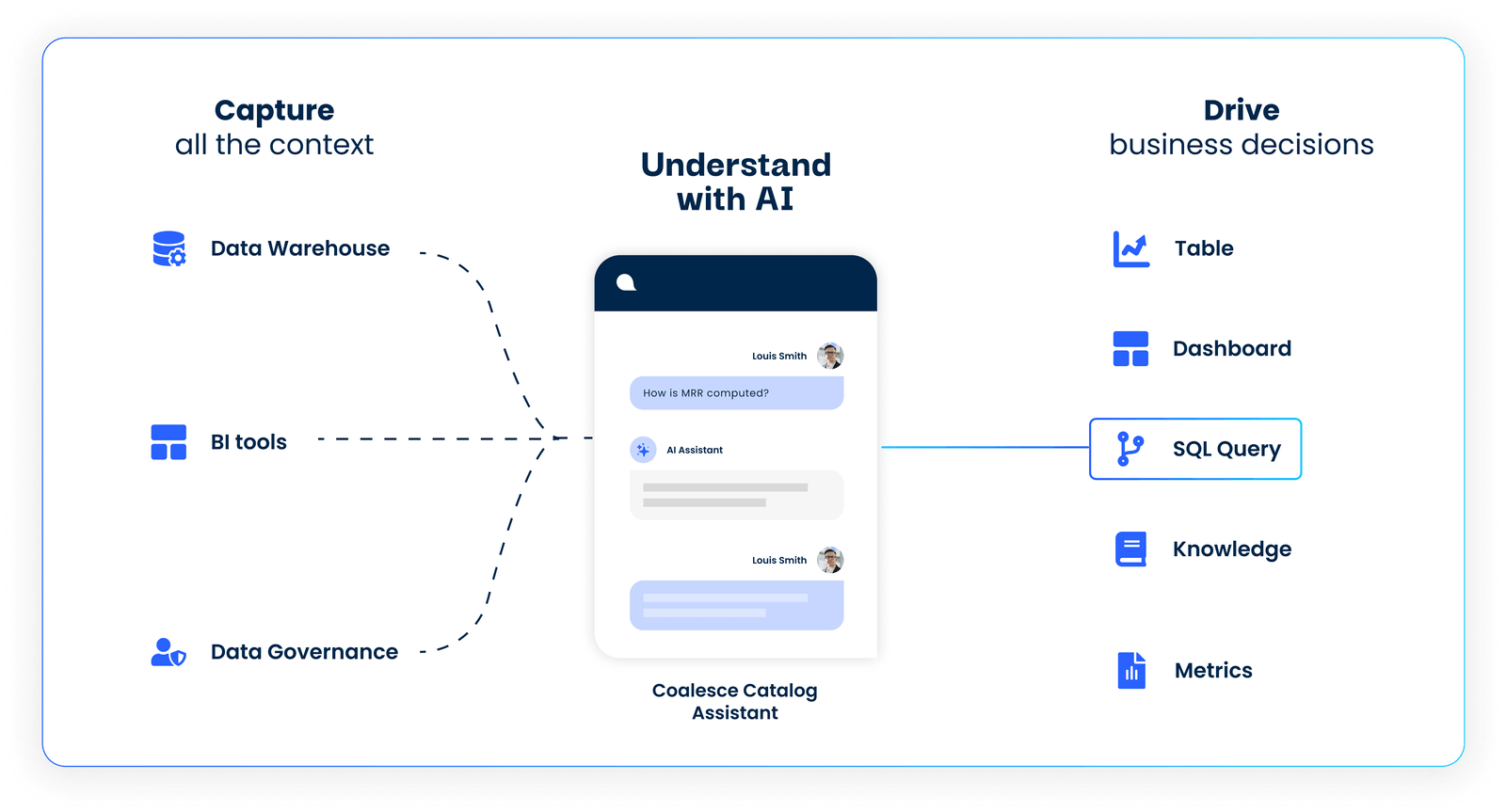
CastorDoc connects to warehouses, BI applications, transformation tools, and other parts of the stack, then collects metadata into a shared inventory. Search can span domains, metrics, dashboards, tables, and columns. An asset page can show descriptions, tags, owners, frequent users, popularity, related queries, quality signals, comments, and the dashboards where that asset appears. This is the mundane detail that makes the product useful. A bright AI button cannot rescue a catalog with thin context.
Discovery
Search, filters, facets, popularity, and usage clues help separate the useful table from its six abandoned cousins.
Lineage
Table and column maps trace data from source through transformations into BI, useful before migrations and deprecations.
Documentation
Descriptions, knowledge pages, glossary terms, owners, tags, comments, and sync-back keep context close to the work.
Governance
Classifiers, certification, PII tagging, access context, quality signals, and metadata rules turn policy into visible routines.
Assistant
Natural-language answers point back to catalog assets. It can also explain SQL and help draft queries and documentation.
In the workflow
Chrome, Slack, Teams, Notion, Confluence, APIs, and MCP reduce the need for everyone to remember another destination.
The lineage view is the recurring favorite in public reviews. One G2 reviewer called it “a lifesaver” when changing core tables. Others praise the interface and fast search, especially for onboarding and migration work. The complaints are revealing too: requests for deeper customization, more connectors, better handling of certain downstream column dependencies, and more detailed exports. Those are not cosmetic grumbles. Catalogs live or die on coverage. The missing edge case is always the one attached to tomorrow's risky change.
The useful loop
AI that knows the local dialect
The assistant uses the organization's own knowledge pages, descriptions, dashboards, tables, lineage, and prior SQL context. That gives it a better chance of understanding that “margin” means your company's margin, not a textbook formula. It can answer questions in the web app, Slack, and Microsoft Teams, and it links users to the assets behind an answer. Current documentation also states boundaries. Some lineage questions and asset-counting requests are not handled by the conversational assistant itself.
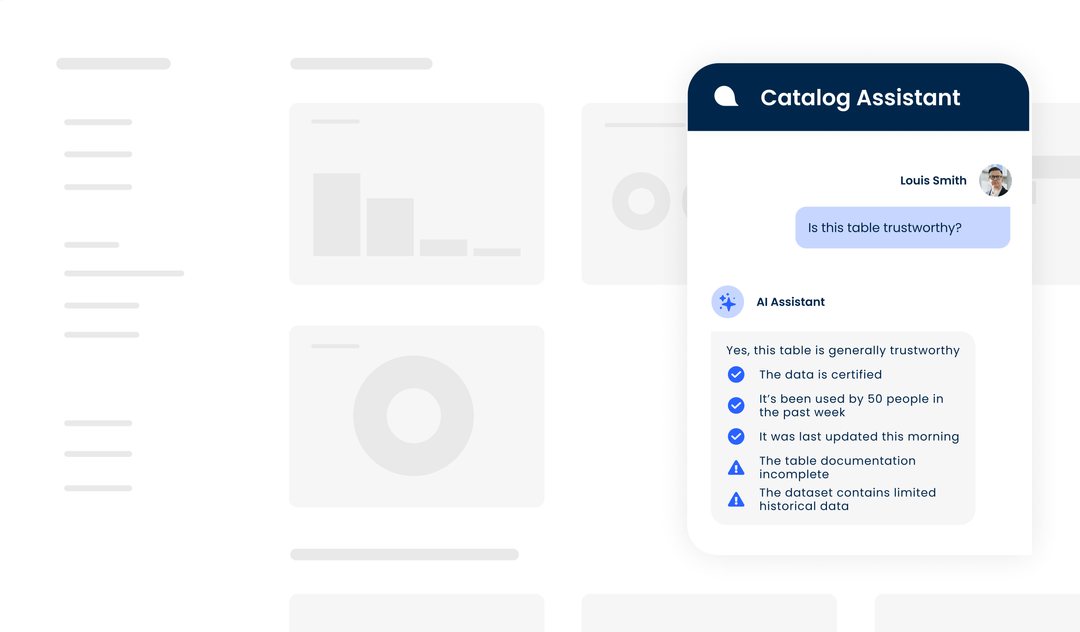
This matters because the honest unit of value is not the number of AI features. It is the number of questions answered correctly without dragging an analyst into the thread. Buyers should ask the assistant vague questions, use company acronyms, request an unpopular metric, and inspect every supporting link. A confident answer with weak provenance creates faster confusion.
Four founders and a useful rejection
The company began in France in 2020. Tristan Mayer and Xavier de Boisredon, a former Ubisoft data scientist, first tried selling their catalog idea to data leaders at PayFit and Qonto. The prospective buyers, Arnaud de Turckheim and Amaury Dumoulin, understood the problem well enough to join as co-founders. It is a tidy origin story for a collaboration product: the sales meeting became the team.
CastorDoc borrowed its north star from the internal discovery systems built by companies such as Uber, Airbnb, Lyft, and Spotify, then packaged the idea for organizations without an internal platform department. In 2022, it raised a $23.5 million Series A led by Blossom. An Eckerson Group profile later put total funding at $25.5 million and named Deliveroo, Veolia, Panasonic, TaylorMade, and the ACLU among marquee customers. The same profile noted an implementation spanning more than one million assets and one thousand users. Those figures help explain the product's balancing act: it has to feel simple at the search box while digesting a thoroughly unsimple estate behind it.
The Coalesce chapter
Coalesce bought CastorDoc for an undisclosed sum and renamed it Coalesce Catalog. The strategic logic is coherent. Transformation creates and changes data assets; governance explains and controls them. Joining the two makes it possible to capture policy and context closer to the moment data is built, rather than sending stewards in later with labels and a clipboard.
The acquisition has produced visible movement. Coalesce said more than 10 percent of its existing customers added Catalog within two months. By roughly the first anniversary, CEO Armon Petrossian reported almost 100 joint customers and catalog-related annual recurring revenue rising from about $2 million to almost $5 million. In product terms, the 2025 and 2026 changelog shows an MCP server, metadata history, an API playground, ownership labels, cross-warehouse lineage, expanded Power BI support, daily Snowflake documentation sync-back, and metadata automations.
There is also integration risk. Acquired products sometimes spend a year changing logos while the seams remain visible. CastorDoc still appears in domains and endpoints, which is harmless but noticeable. Prospective customers should ask which capabilities work across Coalesce Transform and Catalog today, which require separate setup or contracts, and which remain roadmap language.
Price, setup, and the awkward questions
Current public pricing is quote-based. Historical material describes Premium and Enterprise plans, a 14-day trial, and a third-party listing places an old Starter offer at $10,000 per year. Treat that figure as context, not a quote. G2 reports an average implementation time of one month and an average return on investment of 11 months, based on reviewer data. Your result will depend less on clicking “connect” than on permissions, source coverage, ownership, and whether anyone is responsible for the catalog after launch.
| Shortlist | Natural fit | Question to press |
|---|---|---|
| CastorDoc / Coalesce Catalog | Adoption, search, lineage, AI-assisted discovery, and a path into Coalesce transformation | How complete is lineage across our messiest tools? |
| Atlan / Alation / Collibra | Broad enterprise governance programs and established operating models | What administration and services will adoption require? |
| Select Star / Secoda | Modern data teams comparing approachable discovery and automation | Which connectors and workflows are deeper for our stack? |
| DataHub / OpenMetadata | Teams that value open source, extensibility, and internal engineering control | Do we truly want to operate and customize the platform? |
Trial plan · Do this with real data
- Connect one warehouse, one transformation layer, and one BI tool. Pick the pipeline everyone fears changing.
- Check column lineage against an engineer's manual trace. Record gaps instead of admiring the diagram.
- Give five non-technical users ordinary questions and no training beyond a five-minute introduction.
- Test permissions with sensitive assets. Confirm what search, AI answers, and browser extensions expose.
- Edit a definition in both directions. See where sync-back works, who approves it, and how history is preserved.
- Price the connectors, users, implementation help, and adjacent Coalesce products you actually need.
Buy it for repeated questions, not catalog envy.
CastorDoc works especially well when a growing organization needs ordinary people to navigate a complicated data estate. Its friendly discovery layer, useful lineage, and workflow integrations address the adoption problem directly. Teams wanting open-source control, transparent entry pricing, or extremely bespoke governance should compare carefully.
The verdict
CastorDoc's good idea was never merely to inventory the warehouse. It was to make the inventory pleasant enough that someone outside the data team might open it voluntarily. The public customer results are company-selected, so read them as examples rather than universal promises. Still, a 90 percent drop in data-related Slack pings at Printify and a 20 percent productivity increase reported by Vestiaire Collective describe exactly what a catalog should be measured against.
Now inside Coalesce, the product has a plausible route from passive map to active control: metadata can inform how data is transformed, governed, reviewed, and served to AI tools. The buying decision comes down to fit. If your data team is functioning as a human search engine, CastorDoc deserves a trial. Bring the ugliest lineage graph, the disputed metric, and the colleague who never reads documentation. They will tell you more than the demo can.