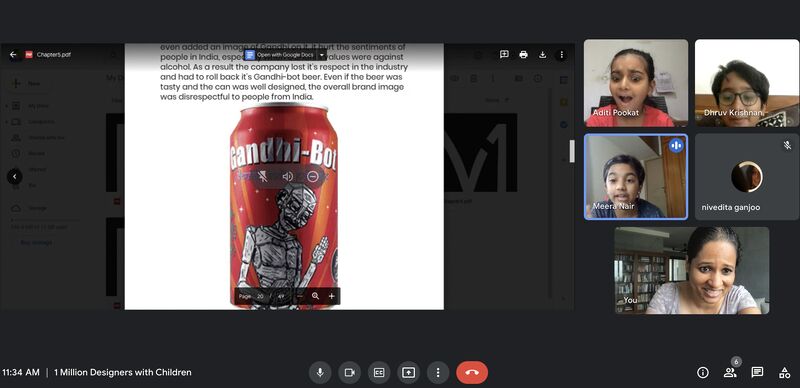
The grown-ups had made their case. The examples belonged in the book precisely because they were bad designs: a cola can that mocked Gandhi, a doormat printed with the Indian flag. The children were unimpressed by this adult logic. On a Saturday video call, three young critics named Dhruv, Aditi, and Meera reviewed the pages and delivered the clearest verdict in publishing. Thumbs down.
Priya Sathiyam and the other designers listened. The examples came out. A screenshot from one of those sessions catches Aditi wearing what Sathiyam later called an “unbelievable” expression. It is a small, funny scene, and it contains almost everything worth knowing about Sathiyam’s work. The audience is allowed into the room. The people affected by a choice get to alter it. Expertise does not lose authority by listening; it becomes useful.
The eventual book, Dear Children, Enter the Wonderful World of Design, ran to 200 pages. Sathiyam led a team of adult designers and child collaborators through more than a year of work. They wanted to show young readers that the shoes on their feet, the apps in their hands, and the objects around their homes all arrived by way of decisions. Every object has a design story. The book’s own story supplied the best lesson of all.
The useful advantage of arriving late
Sathiyam did not begin as a designer. She studied at the Birla Institute of Technology and Science, Pilani, from 1998 to 2002, then built her early career in software engineering. In a later essay, she placed her turn toward design in 2008. She was 25, an age she teased as “ripe” when describing the discovery years later. The joke masks a productive irritation: once she found design, she wanted younger people to encounter it before adulthood.
Engineering never vanished from her work. At SAP she helped lead the design and engineering of products across mobile, analytics, and cloud. The Industrial Designers Society of America described her software background as an advantage, a way to connect the people who shape an experience with the people who make the system function. Her career became a translation practice between disciplines that often share a project plan and little else.
Her research from that period already insisted on context. A 2012 case study co-authored with Muktha Hiremath examined business software for small and midsized enterprises in India. It argued that affordability alone was an inadequate design brief. Sustainability for the business, local variation, and infrastructure all mattered. A year later the pair published a practical guide to coaching design thinking inside software organizations. Sathiyam was also named among the inventors on SAP patent applications involving document generation and extensible interfaces. The technical and human threads were being woven together in public.
“Design is a core skill that everyone in a company should have.”Priya Sathiyam, speaking on design at scale
Spreading the design fire
Inside SAP, the translation became an education project. Sathiyam worked on Design Whizz, a global initiative intended to bring design into the working vocabulary of non-designers. The premise was mildly subversive for a large company: design was too consequential to remain the private property of a design department. Engineering, product management, quality, and sales all made choices that changed what customers experienced. They needed a common language for those choices.
There were courses for employees, introductory “Eye Opener” sessions, Design Talks, Women in Design conversations, and compact publications called Design Nuggets. Sathiyam also created a program through SAP YoungThinkers that taught children of employees in India, China, and France. Elsewhere she ran workshops for children, companies, startups, and nonprofits, reaching learners from six to 60. The range matters. She was not presenting design as a priesthood with special robes. She treated it as a way of paying attention.
Her essays made the same case in another register. For YourStory she assembled a bookshelf for founders, wrote about overlooked women in design, profiled the peculiar vocation of the design evangelist, and surveyed a discipline spreading through Indian schools, colleges, businesses, and media. Her prose liked the everyday object and the lightly comic consequence. She imagined design becoming a school subject so that future door handles would not break and Indian roads would cause fewer headaches. It is difficult to improve a curriculum proposal with a door handle.
She was also studying how ideas travel. In her essay on design evangelists, Sathiyam noticed that the people who widened the public conversation did more than publish a single manifesto. They curated for years, connected design to current affairs, and chose accessible media. Intriguingly, several influential figures she examined had never attended design school. The outsider could see habits that insiders had stopped explaining. That observation doubled as a description of her own route. An engineer who arrived at design later could speak to engineers without treating them as the enemy, then speak to children without pretending a professional title settled the argument.
In 2019, after moving to Fractal, she helped lead a DesignUp masterclass for students aged 14 to 18. The published guide described her as a Design Director learning how to humanize artificial intelligence and technology through design. By then the two ambitions had become inseparable: teach people to recognize the choices around them, and make emerging technology answer for those choices.
Designing beneath the chat window
Artificial intelligence is unusually good at making the visible part look like the whole. A chat window appears. An answer arrives. The smoothness encourages us to forget the decisions underneath: what the system understood, which behavior it rewarded, how it dealt with uncertainty, and whether a person could interrupt it. Sathiyam’s writing at Fractal pushed the designer’s attention below that polished surface.
She argued that AI changes the old exchange of input and output into a more difficult relationship between intent and outcome. The job is to understand needs that people may not state neatly, along with their aspirations, beliefs, and values. Human oversight belongs inside the system. So does social connection. An AI product earns its place by helping people exercise judgment and mastery, not by performing novelty on command.
“If AI is not connecting to people and meeting their needs, it is simply a novelty and will fade away as a fad.”Priya Sathiyam on purposeful AI
At the 2024 Bologna Children’s Book Fair, this concern met her work with young readers. Her talk, “In the AI of the Beholder,” considered children growing up amid abundant information, incomplete understanding, social validation, and hyper-personalized content. The title was witty; the design problem was severe. How should technology behave when its users are still learning how to read the world?
Sathiyam’s answer was not nostalgia. Her own career has been too entangled with software, analytics, and enterprise AI for a retreat into simpler machinery. She asked for an ethical and responsible human approach, one that preserves agency while taking the technology seriously. This is harder than adding a friendly tone to an automated system. It requires choices about control, explanation, pace, and the right to say no.
The Sathiyam test for a useful system
- Begin with a human need, not a technological performance.
- Look beneath the interface at intent, values, and consequence.
- Give the people affected a meaningful way to judge and alter the result.
- Keep human oversight and the ability to interrupt within reach.
The old spinning wheel, wearing an AI badge
Her recent criticism has grown sharper as AI has become more agentic. In 2026, Sathiyam compared long, opaque waits for an agent to finish with the spinning wheel of the 1990s. Users could not see progress, estimate the delay, or interrupt the tool. Decades of technical change had brought back an old frustration with a more expensive vocabulary. Her conclusion was characteristically grounded: performance is the first bottleneck for user experience.
The observation reveals the continuity in her work. Enterprise design programs, papers about local infrastructure, a book reviewed by children, and criticism of AI latency may look like separate rooms. The same question is written on every door. Who must live with this decision, and have they been allowed into the process?
Her public profile now places her work under Conscious Design. She continues to write about AI progress and responsibility, including essays on the shape of technological power. Meanwhile, the children’s book has been shared freely online after its self-published run. Sathiyam has said she wants an international publisher and illustrators for more books. The ambition remains pleasantly specific: introduce children to design early, while they still assume they are entitled to ask why an object works the way it does.
Adults learn to tolerate a great deal of bad design. We rename confusion as complexity, delay as intelligence, and exclusion as expertise. Children are less diplomatic. They look at the page, register the choice, and turn a thumb toward the floor. Priya Sathiyam has built a career around taking that gesture seriously. The future might do well to submit a draft.