There is a peculiar injustice in advertising. Millions of people can know the commercial, repeat the line and imitate the dance while having no idea who made any of it. The campaign becomes famous. Its makers remain names in a credit block. Powell Communications has built a company inside that gap.
Founded by Rachael Powell in New York in 2000, the firm represents the businesses behind advertising, marketing, media, technology and design. These are not consumer brands seeking a louder megaphone. They are agencies, studios and specialists trying to be noticed by the people who can hire them: chief marketing officers, chief executives, communications chiefs, editors, conference programmers and award juries.
That difference sounds small until you try to pitch an agency. Its product is not a shoe or a subscription. It is judgment. The inventory goes home every evening. The evidence arrives in scattered form - a smart campaign, an unusual process, a founder with a useful opinion, a result buried on slide 47. Powell’s work is to assemble those fragments into a reputation.
“We interview you like a therapist, PR you like a publicist, and plan like a strategist.” Powell’s operating line
The product is coordinated recognition
Powell begins with positioning. The interviews are meant to locate a difference that a competitor cannot casually borrow. Then that idea is sent through several channels: news and commentary for media; proposals for conference stages; cases for awards and juries; executive posts for social platforms; preparation for the interview that finally lands.
The Powell visibility loop
One point of view, adapted for the press, the stage, the jury room and the feed.
The clever part is not that Powell offers five services. Plenty of firms do. It is that each service supplies the next one. A conference appearance creates an argument worth turning into an article. An article gives an awards submission outside validation. An award gives an executive something credible to discuss. Social distribution keeps the work alive long enough for a prospect to encounter it twice. Recognition compounds when the pieces agree.
The current roster makes the specialization visible: DAVID, GUT, McKinney, Quad, Barbarian, Good Apple, Cheil Agency Network, Betty, Iris, Verb and others. Powell speaks to people who already understand reach, brand and culture. The problem is more intimate. These clients spend their days making other companies distinctive and can struggle to perform the same operation on themselves.
A calendar disguised as a consultancy
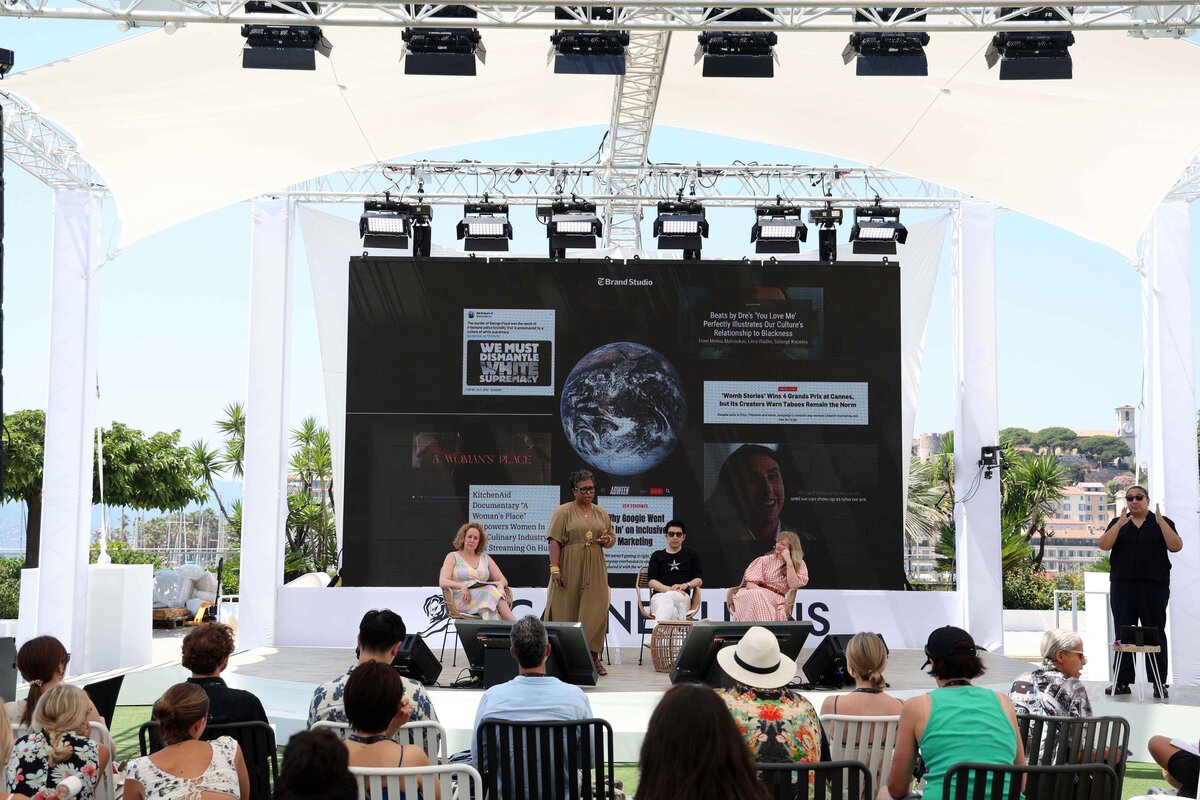
The unglamorous hero of this business is the calendar. Powell says its events team manages more than 150 global events, and a recent team update described tracking more than 320. Every conference has a submission window. Every award has rules, jurors and an appetite for a certain kind of evidence. Every publication has its own rhythm. Miss the window and even the best story becomes next year’s story.
This is why Powell treats awards as a year-long practice. The day a prize is announced is also the day to begin preparing for the next cycle. That means choosing recognition that prospective customers actually respect, collecting proof while it is fresh and resisting the narcotic appeal of entering everything. The award is not the product. The commercial use of the award is the product.
Powell has also added its own evidence. Powell Pulse surveys senior brand marketers and translates their answers for agencies and technology companies. The Fall 2025 study questioned more than 150 marketers about how they choose advertising partners. The Spring 2026 edition asked more than 120 senior marketers how they discover and evaluate AI tools. For a firm paid to interpret buyers, owning a small but current window into buyer opinion is useful twice: it informs client counsel and creates something original to talk about.
The office that lost the argument
In 2020, Powell went fully remote. Many companies describe that year as an interruption followed by a return. Powell treated it as a trial, saw that the work travelled, and made the decision permanent. Founder Rachael Powell now serves as Principal and Founder; Lisa Chiovaro, whose path ran through finance and operations, is CEO. Katy Hendricks is CMO. The succession is revealing: a creative-industry specialist handed day-to-day leadership to operators who could preserve the idea while making the system sturdier.

Remote culture here is not presented as a mood. It has props and rituals: mentorship, leadership training, wellness days, parental leave, a year-end shutdown, virtual cooking classes, an excitable food channel and a book club that once specialized in the magnificently imprecise category of “goth-girl books.” The firm still keeps a New York gathering base at NeueHouse Madison Square. Remote, in this arrangement, means the office is a tool rather than a command.
The outside validation followed. Inc. named Powell a Best Workplace in both 2024 and 2025. WorkLife listed it as a 2024 finalist for Best Employer for Remote Employees. Those honors do double duty. They help recruit people, and they tell prospective clients that the small distributed team making promises about culture has managed to build one of its own.
What to steal - and what to leave alone
The copyable idea is not “hire a publicist.” It is to build one durable narrative and make every channel perform a different job for it. Start by interviewing customers and colleagues until the familiar language falls away. Name the thing the company does differently. Then map the audiences that can convert that difference into consequence: a buyer, an editor, an organizer, a juror, a future employee.
The model is also a poor fit for a company seeking only consumer reach, a one-day launch or guaranteed coverage. Earned attention is negotiated, not purchased. Powell’s system asks clients to make executives available, state a real opinion, prepare months ahead and accept that the best crisis may be the one prevented before anybody notices.
In 2019, the firm’s work on #RunawayTrain25 with M/H VCCP and the National Center for Missing & Exploited Children won two inaugural PRWeek Purpose Awards. Powell reported that four children had been recovered after the initiative launched. It is an unusually serious reminder of what sits beneath all the calendars and clever positioning. Publicity is a system for directing attention. The moral quality depends on where the attention goes.
Most days, Powell directs it toward the people behind the work - the strategist whose idea became a campaign, the technologist who changed the process, the creative director whose name the audience never learned. Twenty-five years in, that remains a modest, durable proposition: fame is not distributed according to contribution. Someone has to fix the credits.