Pony Ma had a successful messaging service. Then the telephone changed its mind about being a telephone. By the end of 2010, the internet was moving into people’s pockets, and Tencent’s familiar desktop products faced an awkward question: would their users come along, or would they leave with somebody else?
Ma let competing teams inside his own company work on an answer. The group that emerged came from QQ Mail in Guangzhou, led by Zhang Xiaolong, also known as Allen Zhang. Its product became Weixin, known internationally as WeChat. The chairman who had helped build QQ was making room for a service that could upset its comfortable position. Corporate succession rarely arrives with such an innocent-looking chat icon.
That decision offers a useful way into Ma Huateng’s life. His public manner is reserved; his products have made themselves thoroughly at home. Across messaging, games and payments, his career keeps returning to the same problem: what people will do next, and how to build something they will keep using once the novelty wears off.
The astronomer takes a practical turn
Born in 1971 in Shantou, Guangdong, Ma came of age with an interest in space, physics and science fiction. When university beckoned in 1989, he considered where that interest might lead. Teaching physics seemed a likely destination. He preferred the subject to that particular career prospect and chose computer science instead.
He graduated from Shenzhen University in 1993. Before Tencent, he worked at China Motion Telecom Development, where his responsibilities included research and development for internet paging systems. The pager now looks like a prop from a detective film. For a young programmer, it meant working on the practical business of getting a message to another person.
Shenzhen supplied the setting for his next move. In November 1998, Ma and four co-founders established Tencent. Zhang Zhidong, Xu Chenye, Chen Yidan and Zeng Liqing shared the undertaking. Computers and telecommunications were converging; the founders brought experience from both. Their ambitions began with making a useful product, before anyone needed a diagram to explain the eventual company.
A penguin learns to pay the bills
The first chat service arrived in February 1999. Initially called OICQ, it drew on the model of the Israeli messenger ICQ and later became QQ. Tencent’s beginnings belong to the messy history of adapting an existing idea, finding an audience and working out how to support it. A familiar concept can still demand years of unfamiliar work.
By the end of 1999, OICQ had more than a million registered users. Registration was encouraging, but it did not settle the business model. A service has to keep running after people have finished admiring its growth chart. Tencent developed paid extras around communication, giving users reasons to spend while keeping the social activity at the centre.
QQ Membership followed in 2000. QQ Show, an avatar product, and the QQ Games platform arrived in 2003. Here was an early lesson in the commercial importance of apparently small things: how a person appears online, what friends do together, and which extras make an ordinary session more enjoyable. Tencent listed in Hong Kong in June 2004.
establish Tencent
begins connecting users
in Hong Kong
for the mobile era
A penguin became the company’s recognizable companion. The business around it grew to encompass entertainment as well as conversation. Ma remained an engineer by training, but the job increasingly involved organizing people, allocating money and deciding which unfamiliar project deserved a chance.
The challenger came from the mailroom
Weixin launched in January 2011. Its origin matters because it complicates the neat idea that a founder personally invents everything a company produces. Zhang’s team built the service. Ma’s contribution included backing the experiment and permitting alternatives to develop inside an organization that already had a messaging franchise to defend.
Internal competition could be untidy. It also gave Tencent more than one response to a changing market. In Ma’s later account, QQ helped promote WeChat through its existing connections. An older product could lend the newcomer an audience, even while the newcomer changed what that audience expected from messaging.
The app gradually took on other jobs. Text and voice messages sat alongside professional networking, shopping, ticket purchases and taxi services. Payments joined the conversation. Opening a messaging app could become the first step in getting something done outside it. For users, that convenience mattered more than which department had won the original contest.
The two messengers continued side by side. QQ retained an audience with its own habits, including younger users who wanted a different social space from their parents. Ma understood that a person’s choice of app could be a choice of company. Family togetherness has its limits, especially when somebody is about to post a photograph.
By June 2026, Tencent reported 1.439 billion combined monthly active accounts for Weixin and WeChat, and 520 million mobile monthly active accounts for QQ. The measures describe accounts, with possible overlap between services. Even so, they show how long the older product has remained part of the story.
A quiet chairman gets difficult questions
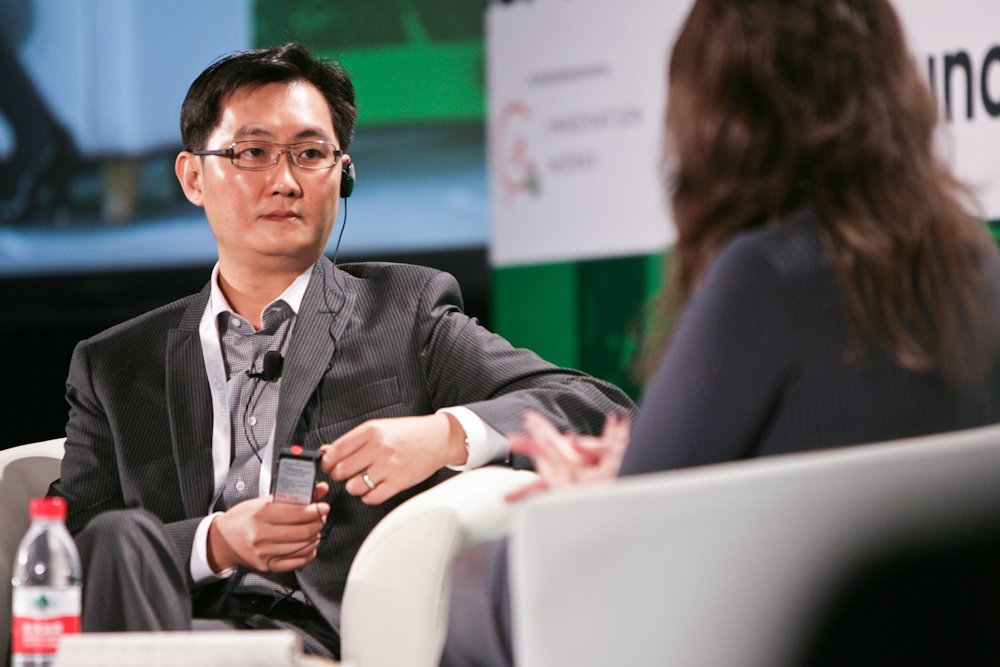
Ma’s low public profile has never made Tencent’s influence quiet. At a Beijing conference in 2011, Sarah Lacy confronted him with criticism that Tencent could copy young businesses and overwhelm them with its existing audience. The question went straight to the tension in his success: the network that helps a product spread can look formidable from the other side.
Ma’s answer emphasized opening Tencent’s platforms to outside developers. He acknowledged that specialized businesses could serve needs his company could not cover itself. Backstage, discussing entrepreneurship, he described the importance of reacting to users and maintaining the pace of product changes. A promising beginning offered little protection if a team stopped responding.
His account of founding also included an unglamorous advantage: the early team got along. He had seen disagreements break other groups apart. As a company grew from a program into an organization, relationships with colleagues, shareholders and partners became part of the work. The code might compile perfectly while the partnership fell to pieces.
“first, listen; then navigate.”
Pony Ma, discussing leadership at Tsinghua, 2016
At Tsinghua, Ma described a preference for influencing direction while leaving more conspicuous administration to others. The remark fits his public reputation for restraint. It also explains why a profile of him needs other people in the frame. Tencent’s development involves co-founders, product leaders, developers and partners whose decisions cannot all be folded into the chairman’s name.
Jack Ma, QR codes and the cost of convenience
In 2017, Ma discussed his long acquaintance with Alibaba’s Jack Ma and the spreading competition between their companies. The two businesses kept encountering each other in fresh markets. Pony’s reaction carried a trace of weary amusement: even for someone who understood competition, finding it everywhere could become tiresome.
Payments made the rivalry tangible. Tencent’s digital red envelopes brought an established gift-giving custom into an app. QR codes connected the phone to people and services around it. Mini Programs reduced the need to install a separate application for every small task. A square of printed pattern could become a shop’s modest front door.
Ma presented this as a way for other businesses to develop customer relationships of their own. The arrangement also left Tencent operating the platform through which those relationships moved. Both facts belong in the picture. Convenience draws people in; sustained dependence gives the platform decisions consequences well beyond its own offices.
Room for questions without a product launch
The student’s interest in science survived the executive’s calendar. In 2016, Ma announced plans to donate 100 million Tencent shares to a professionally managed charity fund. Its stated purposes included education, environmental protection, basic science and technological innovation. He described a wish to organize giving over a longer period.
In 2018, he joined 14 scientists in initiating the Xplorer Prize. At the first ceremony the following year, 50 researchers were selected, each receiving an award of RMB3 million over five years. The prize’s remit included fundamental science and frontier technology, with room for work whose value would take time to establish.
In July 2021, Ma announced a collaboration with China’s National Astronomical Observatories to use AI in searching for pulsars. Computing could help sort the signals collected by telescopes. For someone whose university choice had taken him away from physics, the connection had a pleasing shape: software had supplied a route back to the sky.
The next message is already arriving
Artificial intelligence now gives Ma another version of the question that preceded WeChat. In January 2026, he acknowledged Tencent’s slow progress in parts of its AI work and outlined investment priorities. In August, his stated agenda covered models, applications and computing infrastructure, with WorkBuddy and CodeBuddy among the company’s newer products.
Second-quarter capital expenditure reached RMB52.8 billion. Spending can supply capacity, but it cannot settle whether people will adopt a service. That judgment arrives in repeated use, a territory Ma has been studying since the pager business. The historical parallel is useful without offering a prediction: Tencent has adapted before; each new transition still requires decisions that can go wrong.
Ma remains Tencent’s chairman and CEO, responsible for its strategic direction and management. His career has accumulated enough products to fill a phone, yet its more revealing moments are often decisions to make space: for another team, another business model, another field of inquiry. The astronomy enthusiast may appreciate the scale of the undertaking. A great deal remains outside the frame.