A hotel room has a peculiar flaw as a product: at midnight, yesterday’s unsold inventory is gone forever. A mobile game has almost the opposite problem. Its inventory can keep expanding, but its players can disappear with a thumb swipe. PLAYSTUDIOS put those two problems in the same room. The result was myVEGAS, a virtual casino whose loyalty points could lead somewhere considerably less virtual.
- Free games draw the audience; optional purchases and advertising pay the bills.
- playAWARDS connects participating games to real-world rewards through myVIP.
- The difficult part is keeping players and partners interested at a sustainable cost.
A hotel room with a clock on it
The idea suited Andrew Pascal’s background. Before co-founding PLAYSTUDIOS, he had run Wynn Las Vegas as president and chief operating officer. He understood the machinery behind the velvet rope: rooms, restaurants, entertainment, and the work of persuading someone to visit. In 2011, he joined Paul Mathews, Katie Bolich, Nicholas Koenig, Chad Hansing, and Monty Kerr to build games for social platforms.
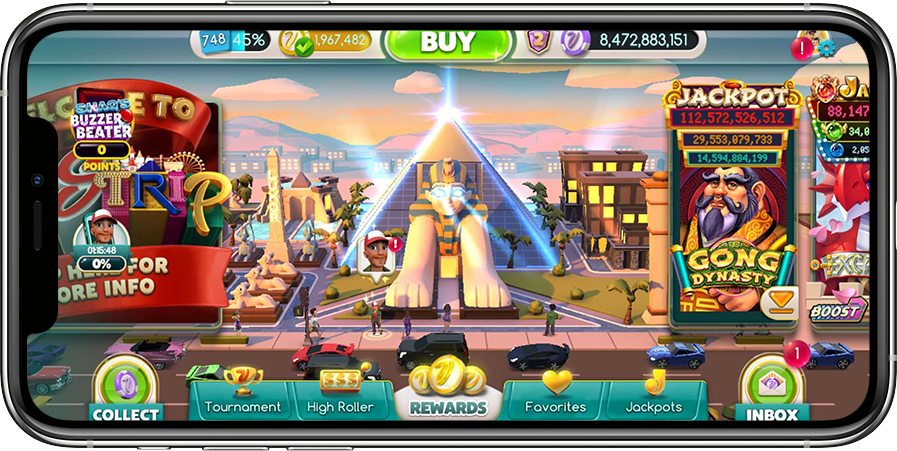
Their first myVEGAS appeared on Facebook in August 2012. Players built a version of the Las Vegas Strip and played casino-style games. MGM Resorts supplied recognizable properties and rewards. The mobile version followed in November 2013. Here was a little piece of hospitality logic tucked inside a social game: a reason to return that could eventually become a reason to travel.
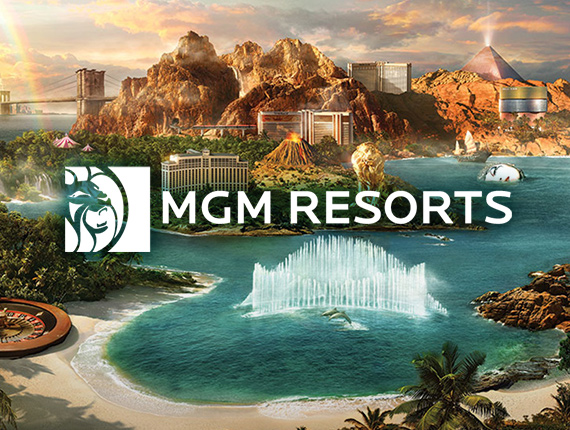
The company’s MGM case study explains the practical attraction. Promotional offers could use surplus resort capacity and inventory that would otherwise expire. Players earned access through participation. MGM received a channel for reaching new visitors, reactivating former customers, and encouraging existing ones. The case study reports incremental revenue, without publishing enough detail to calculate an independent return.
Two currencies, three customers
Understanding the product requires keeping two balances separate. Virtual chips make the ordinary social casino games work. Loyalty points connect eligible play with partner offers. A large chip balance is not a bank account. The rewards catalog is a separate system, with availability and offer conditions determining what a player can actually use.
- 01Play a game
- 02Earn loyalty points
- 03Choose an offer
- 04Go do something
There are three audiences here. Players want entertainment and worthwhile perks. Advertisers want attention. Hospitality and entertainment partners want customers who show up. PLAYSTUDIOS serves all three, earning its money mainly through optional virtual-currency purchases and advertising. Its expertise spans game design, live operations, licensed brands, partner relationships, and the unglamorous business of making an offer redeemable.
playAWARDS is the platform behind the exchange; myVIP is the consumer-facing rewards program. Partners listed in recent company releases include MGM Resorts, Norwegian Cruise Line, Royal Caribbean, Virgin Voyages, Topgolf, and Cirque du Soleil. For a player, the sensible starting point is the catalog: find an offer you can use, read its terms, and treat the game as entertainment.
Buying an audience beyond the casino
Against social casino alternatives such as Slotomania or Hit It Rich!, the external rewards network provides a distinct hook. But PLAYSTUDIOS also went looking for people who preferred falling blocks to spinning reels. It acquired specified Tetris rights in 2021 and bought casual-game developer Brainium in October 2022 for $70 million upfront, plus adjustments and contingent consideration.
Brainium brought Solitaire, Spider Solitaire, Sudoku, and Mahjong. The acquisition announcement said it more than doubled average daily active users. This was diversification by habit: familiar games, played repeatedly, with advertising as an important revenue source. Tetris mobile now offers Marathon and Adventure modes alongside myVIP rewards. The portfolio stretches from social casino spectacle to the quiet satisfaction of clearing a row.
An audience, however, does not spend uniformly. In March 2026, management said casual card and puzzle titles represented roughly 75% of the company’s audience and about 20% of revenue. The distinction matters. A publisher can gain millions of sessions without gaining the same purchasing behavior. Each genre brings its own arithmetic.
The price of another player
The earlier expansion had financial backing. A $20 million Series C in 2014 was led by Jafco Ventures, now Icon Ventures. The 2021 Acies transaction took PLAYSTUDIOS public. Yet access to capital could not settle the recurring question of what it costs to attract and retain the next player.
−18.8% year over year · Reported revenue, rounded
Revenue fell from $289.4 million in 2024 to $235.1 million in 2025. The company reported a $28.6 million net loss for 2025, with $55.5 million in selling and marketing expense and $58.4 million in research and development. Pascal pointed to platform privacy changes that had made acquiring and retaining players harder. Rewards supplied differentiation; they did not remove the cost of distribution.
A smaller company, a sharper question
The response became concrete. In March 2026, management announced plans to close four of nine studios and eliminate 177 positions, targeting another $33 million to $39 million in annualized savings. By August, second-quarter revenue was $55 million and the net loss was $13.3 million. Management was reassessing investment in Tetris Block Party and playSWEEPS, its promotional sweepstakes initiative.
“We are therefore reassessing the scale and duration of investment in Tetris Block Party and playSWEEPS.”Andrew Pascal · August 2026 results
The useful lesson is conditional. Pair an enjoyable habit with a reward whose economics make sense for its supplier. Then measure whether people return, redeem, and become valuable customers. The arrangement weakens when offers are unusable or acquisition costs outrun spending. Dependence matters, too: the annual filing says MGM supplied the majority of rewards redeemed in 2025.
PLAYSTUDIOS’s proposition remains easy to understand: a game session can point toward an experience outside the game. Its reset asks the harder question every loyalty business eventually faces. How much can you afford to spend making someone want to come back?
PLAYSTUDIOS · playAWARDS · myVIP rewards · Tetris mobile · Company news
LinkedIn · X · Instagram · Facebook
▶ Watch: the MGM / playAWARDS case study