A youth soccer match can be called off by one dark cloud. The administrative weather arrives more slowly: a payment missed in one system, a roster edited in another, a field change buried in an email chain, a coach working from yesterday's spreadsheet. By Saturday morning, nobody is holding the same version of reality. PlayMetrics, a software company founded in North Carolina in 2017, is built around a deliciously unglamorous promise: put reality in one place.
Its users are not only coaches with whistles. They are executive directors, registrars, finance staff, volunteers, board members and parents. Their work begins before a player reaches a field. Programs must be published. Families register and choose payment plans. Staff verify forms, build rosters, reserve facilities, schedule games, assign coaches and distribute the inevitable change. Afterward come evaluations, collections, reports and next season's planning.
PlayMetrics calls its product an operating system. The phrase is ambitious, but the underlying idea is literal: registration, payments, team formation, scheduling, coaching plans, documents, reporting, websites and communication share the same data. Change the game once, then notify the people attached to that game. Move a player once, then let the roster, schedule and family view reflect it. The product's most persuasive feature is not a clever screen. It is the deletion of a second entry.
The first thing to fail is the handoff
The company's case studies read like reports from the same small disaster in different cities. Legends FC, a California organization with 6,000 athletes across more than 300 teams, was collecting handwritten checks, storing birth certificates and moving paper evaluation forms from fields to offices. Its multiple systems did not integrate. HTX Soccer, with nearly 8,000 members and 120 staff at the time of its case study, described anxious financial tracking, scattered documents and a “hodgepodge” of communications. Triangle United and Rainbow Soccer had staff changing a schedule file, exporting a new PDF, uploading it and then emailing a coach in the hope that parents heard the news.
That answers the useful question: what failed first? Not necessarily the payment processor or calendar as isolated products. The trouble appeared between them. A parent's new email address did not travel. A fee status lacked context. A field update required a human relay race. Each tool could be technically alive while the organization around it developed a limp.
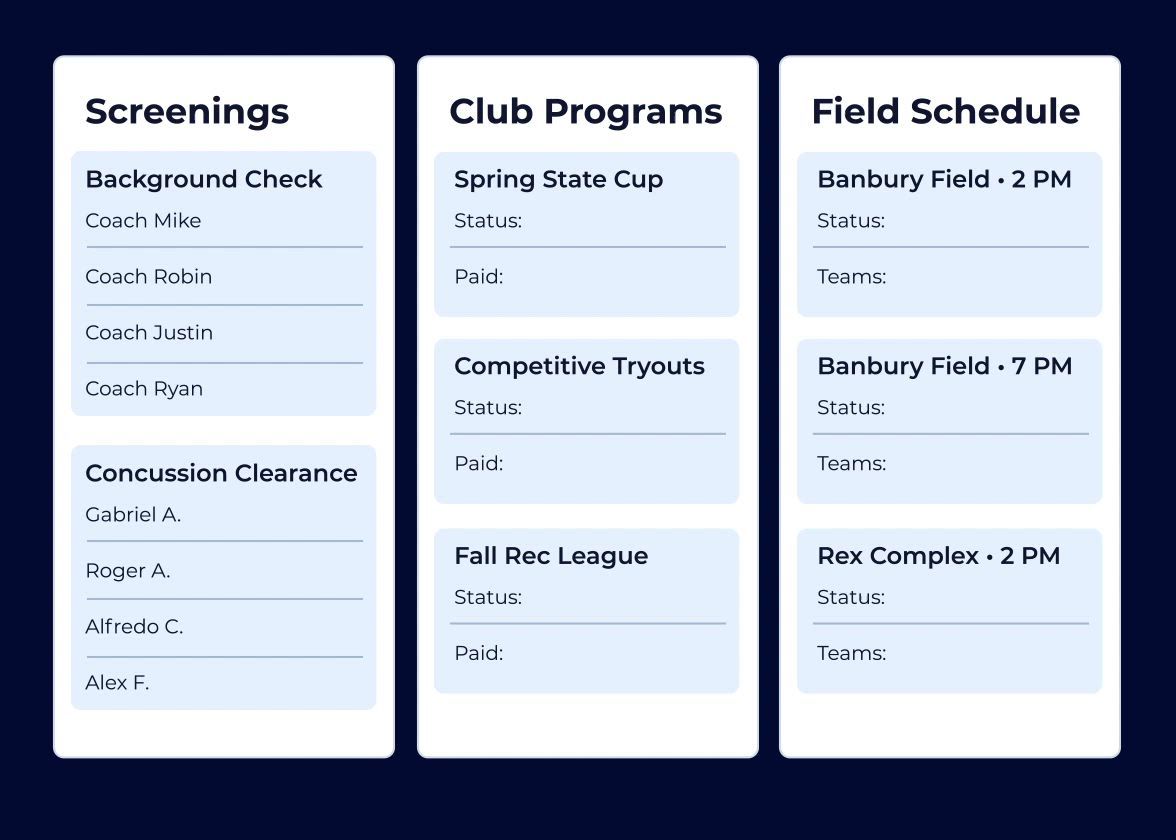
PlayMetrics' answer is four broad product areas. Programs handles the path from invitation to invoice. Play gives technical staff tools for curriculum, session plans and player evaluations. Operations covers the back-office machinery, including scheduling, facilities, rosters, screenings, files and communication. Oversight turns activity into reports for leaders and boards. A mobile app is not treated as a pocket-size brochure; staff can make changes from the field while families receive schedules, messages and account information.
“If I need to make a change to a game, I go into PlayMetrics, make the change, and hit Notify Team... Boom, done.”Drew Kepley, Triangle United and Rainbow Soccer case study
What did it cost? That is annoyingly bespoke
PlayMetrics does not publish a standard price. The company says quotes depend on the kind of organization, its size and the features it needs. Buyers who want a neat monthly number before a sales call will not get one. The more revealing calculation is the denominator: communication apps, planning software, file storage, forms, website builders, field tools and staff hours. Triangle United's director of soccer, John Cirillo, said the club added up its existing app costs and concluded that PlayMetrics would save money while putting the work in one place. The company does not disclose the club's actual bill, so the claim is directional, not a universal guarantee.
Staff-time saving reported by Legends FC after consolidating tools across 300+ teams
Approximate year-over-year improvement in fee collection reported by HTX Soccer
The customer outcomes are unusually concrete for vertical software. Legends FC said consolidation produced an 80 percent staff-time saving. HTX Soccer said it was about $250,000 ahead of the prior year's collection position and expected, for the first time in its 17-year history, to collect all season fees within the financial year. These are vendor-published case studies rather than controlled experiments. Still, they show where value can surface: fewer manual entries, faster receivables and less time spent looking for the record that is supposedly correct.
The objection was not price. It was change.
Club software is sticky for an unromantic reason: changing it threatens an entire season. Registration dates do not move because the database migration feels complicated. Coaches have habits. Volunteers rotate. Parents do not read instructions with the concentration of air-traffic controllers. Aaron Nagel of Colorado Rapids Youth Soccer wrote that he initially did not believe the PlayMetrics sales pitch and was against switching. What changed his view was the speed of development, product quality and the people behind the system.
That is also why customer support sits unusually close to the product in PlayMetrics' pitch. The company advertises one-on-one video sessions, group training, phone and email help, plus a self-service desk. In ordinary SaaS, support can look like the department that apologizes after the product fails. In youth sports, onboarding is part of the product. The platform has to survive a registrar on a laptop, a coach holding a phone in the rain and a grandparent trying to pay from an unfamiliar screen.
There is a second kind of persuasion: immediate proof. A club can debate architecture for months, but a lightning delay offers a clean demonstration. One update moves the field; the correct teams receive the alert; the administrator does not rebuild a PDF. The workflow is tiny enough to understand and common enough to matter. That is the sort of product moment another vertical SaaS founder should steal.
What another operator can copy
- Audit every tool, owner, annual cost and duplicate entry before buying anything.
- Start with one painful handoff, such as a schedule change or overdue payment, and measure the old steps.
- Choose a single system of record and retire the shadow spreadsheets after migration.
- Train by role. A finance administrator, coach and parent do not need the same tour.
- Track time saved, collection speed and support volume, not vague “engagement.”
A focused company gets much bigger
Founder and CEO Mike Doernberg arrived with a pattern. His earlier technology ventures included ReverbNation, SmartPath and The Marathon Group, each of which reached an acquisition. At PlayMetrics, the early focus on soccer broadened into volleyball, hockey, lacrosse, rugby, synchronized swimming and other sports. By the 2025 transaction, a market report said the company served more than 2,700 organizations.
Then the corporate shape changed quickly. Blue Star Innovation Partners and PSG Equity, growth investors since 2023, sold PlayMetrics into a June 2025 combination with Stack Sports. Genstar Capital became the majority owner. In May 2026, PlayMetrics acquired substantially all of SportsEngine's software and payments assets from Versant, adding products for clubs, leagues, studios, tournaments, video and volleyball competition. A month later, Pop Warner selected PlayMetrics as its official technology provider for registration, roster validation, scheduling, game-day management and communication.
The interesting move came alongside the buying: PlayMetrics sold things. It divested video-analysis tool Steva, Student Sports, Stack Athlete by CaptainU, registration and timing businesses, camps and regional road-race assets. Management described a portfolio review centered on where it could create the most customer value. Stripped of the finance language, the thesis is clear. Youth sports is a wide world, but PlayMetrics wants the daily operating layer, not every business with a ball or stopwatch.
Where the all-in-one pitch can break
Scale creates the obvious tension. PlayMetrics differentiates itself from TeamSnap, LeagueApps, GotSport, Sports Connect and the homemade stack by claiming connected depth. But buying SportsEngine and merging with Stack Sports adds overlapping products, old workflows and customers who did not volunteer for a grand unification. The company must simplify without flattening the specialist features that made each product useful. Its 2026 divestitures suggest management understands the danger; they do not make the integration easy.
Nor is the platform right under every condition. A single casual team that needs only chat and a calendar may find a lighter, cheaper app sufficient. An organization that refuses to appoint a system owner, clean its data or retire duplicate tools will merely place a new dashboard on top of old confusion. And a club with a highly specialized workflow should test that workflow, not the polished demo's happy path. “All in one” is valuable only when the important parts are good enough and people agree to use one.
For everyone else, the PlayMetrics lesson is refreshingly copyable. Find the administrative handoff where information decays. Connect the record to the action. Make the mobile version capable of doing the job at the moment it happens. Sell against the full cost of fragmentation, including human time. Then measure a result that a club director can explain without saying “digital transformation.” A parent got the field change. A payment arrived. A coach found the plan. The weekend remained boring.