At three in the morning, a restoration company does not receive a customer so much as inherit a crisis. A pipe has burst above the nursery. Smoke has settled into the curtains. The office smells wrong after a fire that the sprinklers technically stopped. Platinum Pro-Claim Restoration, better known as PPCR, enters at this ugly intersection of insurance, construction and nerves. Its crews respond around the clock across Metro Vancouver, stabilize the property, document the damage, clean the contents and rebuild what cannot be saved.
That sounds like a familiar contractor story until you notice PPCR's preferred unit of progress: the thing left intact. In March 2026, the company described drying a double-drywall, double-insulated demising wall with six compact fans, a dehumidifier, targeted vent holes, moisture probes and a borescope. The result was limited cutting and a simpler repair. It is a tiny case study with a large idea. In a trade associated with dumpsters, a better diagnosis can beat a bigger demolition.
The business behind the emergency
PPCR is a privately held full-service restoration contractor. Homeowners and businesses live with the outcome, but the commercial cast is wider: insurers, adjusters, strata councils, property managers and public agencies can all influence who gets called and what work is approved. The contractor earns revenue from emergency mitigation, environmental remediation, contents care and reconstruction. No public price list would be very useful because every loss arrives with its own water line, floor plan and insurance policy.
Its menu covers fire and smoke, water and flood, mould, asbestos and lead, plus moving and storage. The work follows a five-part loop - respond, mitigate, report, restore and guarantee. In practical terms, technicians first stop the damage from spreading, then measure it, create evidence for the claim and rebuild. The customer is buying a repair, but also coordination during a week when coordination feels impossible.

The unusual part is how many bottlenecks PPCR pulled inside. Tony Scott opened PC Flooring in 1997. The company added on-site Esporta textile cleaning and a BioSweep odour-treatment chamber after moving into a roughly 43,000-square-foot Richmond facility in 2014. PC Cabinets followed in 2015. Cabinetry is especially painful in insurance work: a water-damaged section may need to match a kitchen installed decades ago, and outsourced fabrication can stall the entire homecoming.
PPCR's cabinet shop uses FSC-certified wood, formaldehyde-free sheet goods and water-borne finishes. The company says the finishing system recaptures more than 95 percent of its water. Water-borne coatings avoid the long off-gassing period of traditional solvent finishes, allowing dry cabinets to return sooner. Here, the climate choice and the cycle-time choice are the same choice. That overlap is the company's real moat.
“The most sustainable building materials are the ones we don't remove.”Jamie Madill / Executive Director, Sustainability & Purpose
What failed first was management
Scott founded Pro-Claim in 1991 at age 26. Platinum Pacific Restoration, a strata-loss specialist started by Geoff Shand, arrived in 2007; the two businesses combined in 2013 to become PPCR. But the decisive turn in the official timeline comes earlier, in 2008, when Scott concluded that conventional management was not working. The replacement question was blunt: “What's best for the employee?”

Tony Scott built the company around a neighbour test: when someone nearby floods, do you instinctively help or quietly close the curtains?
That question became a hiring filter. Scott has said candidates are asked how they would respond if a neighbour had a flood. The desired answer is immediate help. The logic is less sentimental than it sounds. Emergency restoration requires technicians to enter strangers' homes during frightening, inconvenient hours. Empathy is part of service delivery, not a mural in reception.
The culture comes with visible perks - a dog-friendly office, an on-site CrossFit gym, volunteer days and an employee-led Green Committee. It has also won recognition, including the Richmond Chamber of Commerce's Outstanding Workplace award in 2019 and BCBusiness's Community Involvement award in 2021. Public employee reviews add an important footnote: restoration can involve overtime, physical work and long days. A pleasant office does not cancel a burst pipe's schedule.
Put the mess where you can measure it
Restoration has an awkward climate problem. Repairing a building is inherently preferable to replacing one, yet a rushed loss can send drywall, flooring, cabinets and household contents to landfill while diesel vans shuttle between scattered sites. PPCR began measuring its carbon footprint through ClimateSmart in 2016. Once the benchmark existed, mileage, electricity, landfill loads and material choices became operating variables.
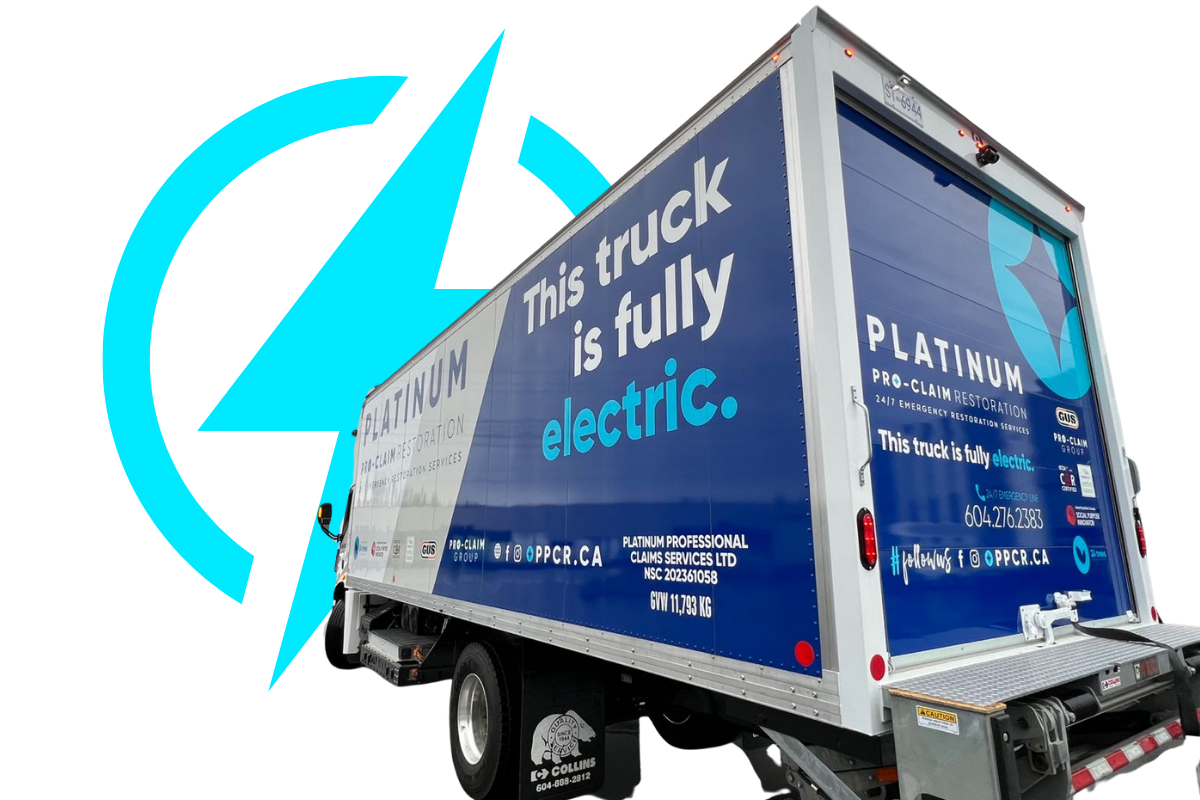
The company now sorts job-site debris across more than 20 waste streams at its Richmond facility and employs a dedicated “garbologist.” Its sustainability page reports 27 electric vehicles, representing 30 percent of the fleet, and 18 chargers free for public use. PPCR has committed to cut total emissions 44 percent by 2030 from its 2016 baseline and reach net zero by 2035 without relying on carbon credits. The Government of Canada's Net-Zero Challenge lists the company at its Diamond tier for small and medium-sized businesses.
The restoration waste hierarchy
Conceptual ranking, not PPCR performance data. The point is sequence: preserve value before managing waste.A catastrophe tested whether that machinery could travel. After British Columbia's 2021 floods, PPCR worked with Aviva Canada and MBC Group on an Eco Claims pilot. Selected claims created sorting zones, tracked material types, coached suppliers on separation and offered reusable goods to charities and animal shelters. Aviva reported that more than 22 tonnes had been diverted from landfill by March 2022. It was not a solo performance - other restoration vendors participated - which may be the more valuable result. Claims systems change only when the insurer, assessor, contractor and waste network use the same choreography.
PPCR joined the GUS restoration network in 2021, giving the wider Pro-Claim Group a coast-to-coast connection. Its local partnerships are less corporate and more muddy: recurring Richmond shoreline cleanups with 505-Junk and community partners have removed more than 20,000 pounds of dumped material, according to PPCR. The company has also funded and handled logistics for the Richmond Christmas Fund. These projects reinforce its referral economy. A contractor invited into damaged homes benefits when the city already knows its name for something other than damage.
The playbook worth copying
PPCR's lessons are not “buy 27 electric vehicles” or “build a cabinet shop.” Those are outcomes of a particular scale and geography. The portable system is smaller and more disciplined.
Measure before branding
Pick a reference year and expose the largest sources of emissions, trips and waste. A slogan cannot tell dispatch which journey to eliminate.
Dry before demolishing
Use moisture mapping, probes and targeted airflow. The cheapest skip is the one that never needs to arrive.
Give waste a person
Sorting improves when somebody owns the streams, the vendor relationships and the data - even if the title is garbologist.
Integrate selectively
Bring a trade inside only when repeated handoffs create costly delay and enough volume exists to keep the capability sharp.
The company also offers a useful answer to the “what did it cost?” question without pretending sustainability is free. Its own service language concedes that doing things responsibly sometimes costs more. The bill appears in specialized drying gear, staff training, a large sorting facility, charging infrastructure, an employee assigned to waste and capital tied up in vehicles and workshops. The return appears in materials not purchased, rooms not demolished, trips not driven and days removed from a claim. Good climate operations are often a pile of avoided invoices.
Where the model breaks
- Materials are structurally unsound or cannot be verified dry.
- Asbestos, lead, sewage or mould requires regulated disposal.
- Local recyclers do not accept separated construction streams.
- EV range, charging or payload cannot meet emergency duty.
- Claim rules reward replacement more clearly than careful repair.
- A smaller contractor lacks enough volume for in-house trades.
Those limits matter. A repair-first posture must never become a save-at-any-cost posture. Wet assemblies can hide contamination. Fire changes structural materials. Hazardous debris has rules more important than a diversion target. Vertical integration can also become expensive underused capacity. The model works when measurement is reliable, crews are trained, insurers accept the evidence and a regional reuse-and-recycling market exists.
A contractor in the climate market
PPCR competes with national networks such as BELFOR, First Onsite, On Side, DKI, WINMAR and PuroClean, as well as every capable local restoration contractor. Its differentiation is not a single machine. It is the combination of 24/7 response, environmental remediation, controlled rebuild trades, a public sustainability program and the soft skill of helping a frightened customer understand Tuesday.
The market fit is timely but not tidy. Climate-driven catastrophes can increase claims even as insurers pressure vendors to control costs and emissions. Property managers want fewer displaced residents. Homeowners want their rooms back. Recyclers need clean, separated material. PPCR sits in the middle, translating one damaged building into all those outcomes.
The company's best idea is modest enough to miss: restoration should be restorative. Not every wall belongs in a dumpster. Not every cabinet needs replacing. Not every van needs gasoline. When those choices are documented well, less demolition stops looking like restraint and starts looking like competent business.