On payday in July 2001, Jeysi Zuniga went with a friend to his workplace and found a construction office in disorder. Workers wanted their checks. She climbed onto a chair, organized a line and told people to collect their pay and go home to their families. By the time she left, the owners had offered her a job. Her first piece of construction equipment, you might say, was office furniture.
She had already been interested in the way buildings emerge from an idea. Here was a different sort of transformation: a crowded lobby becoming a process that worked. There was no elaborate career plan behind the visit. There was a problem within reach, and she reached for it.
“It was supposed to be a summer gig, and it lasted 18 years.”Jeysi Zuniga, 2021
That is her own description of the detour. In 2019, she founded Synergy Contracting, Inc. The short version fits neatly between two dates. The more interesting version concerns what an employee learns before becoming an owner, and what she chooses to carry into the company she creates.
A career measured in things that have to work
Before Synergy, Zuniga served as regional manager at Enviro Staffing Solutions Corporation. Regional management puts a person close to the machinery around construction: the workers, the assignments and the coordination that lets a project proceed. A building has visible dimensions. The business surrounding it has an equally demanding collection of moving parts.
Synergy’s services span environmental remediation, selective interior demolition, painting, final cleaning, labor support and construction work. The company also supplies materials. It operates in New England with union-trained crews. These services occupy different points in a building’s working life, from preparing an interior for changes to making a finished space ready for its occupants.
Selective demolition, for example, involves removing specified interior elements while retaining the structure around them. Final cleaning comes at the other end of the sequence. There is something pleasingly practical about a company whose work can include both taking a space apart and preparing it for someone to walk in.
For Zuniga, ownership arrived with an existing body of experience. The company’s incorporation date is September 18, 2019. Massachusetts certified Synergy as a minority- and woman-owned business effective February 13, 2020. Those dates mark formal steps in establishing the enterprise; the working knowledge behind them had accumulated over years.
The machinery comes before the money
Expansion has a vocabulary of its own: working capital, credit, equipment. These words are less photogenic than a newly finished room, but they explain how the room gets finished. A contractor needs resources at the moment the work requires them. The invoice and the payment do not necessarily arrive with such convenient timing.
In 2022, Boston Impact Initiative provided Synergy with a line of credit to help smooth its cash flow. Its 2023 impact report records support for heavy equipment connected with two multi-million-dollar projects. The project scale matters, but so does the small word “equipment.” Capacity has to become something a crew can actually use.
For a founder, that creates a particular kind of calculation. An opportunity can be commercially attractive and still require a financing plan. Labor and machinery create immediate commitments. An order book gives the business a direction; access to capital helps it move in that direction.
Zuniga’s banking relationships appear elsewhere in her account of the business. An Eastern Bank customer statement published in its annual report described a term loan for working capital and a line of credit. She connected those arrangements with the possibility of buying a property for the growing company in Lawrence.
A headquarters, then, belonged to the financial story before it became a building story. That is an instructive sequence. The place where a company works can look like a separate real-estate decision, yet the owner has to consider it alongside the same cash needs that keep ordinary projects moving. Growth arrives carrying several invoices.
Making room for the next worker
On May 31, 2023, Zuniga joined a Boston Fed panel on labor-market transitions, recruitment and retention. The discussion brought together people dealing with employment from different positions, including search, organized labor and business leadership. She came with the perspective of someone who needed workers to carry out actual jobs.
She identified an aging construction workforce as a concern. Synergy was connecting with younger workers through trade schools. She also described retaining single mothers by offering greater flexibility over time and negotiating arrangements. These are concrete employer choices, with consequences for who can take a job and remain in it.
A recruitment conversation can become abstract very quickly. Zuniga’s examples bring it back to access and scheduling. A younger person needs a route into the trade. A parent needs a working arrangement that can coexist with responsibilities outside it. An employer deciding how to recruit is also deciding which lives its schedule can accommodate.
That attention extends to the development of the workforce. Synergy’s model includes union training and apprenticeship opportunities. Education, annuity and pension funds, scholarships and legal representation appear among the provisions described in her professional biography. The employment relationship reaches beyond the immediate assignment.
Her speaker biography also describes an emphasis on sustainability and energy efficiency, a diverse workforce drawn from underserved communities, and young apprentices developing a sense of belonging in their neighborhoods. Put alongside her recruitment comments, the emphasis is consistent: the work should offer people a route forward.
Knowing the rules, then sharing the route
Zuniga’s professional background includes environmental work, real estate and biotechnology. She is also a licensed Realtor with advanced commercial and pricing-strategy credentials. Property appears in her working life from more than one angle: as something clients buy, as something contractors change, and as somewhere her own company can settle.
Her participation in Harvard’s Construction Academy carried a specific purpose. The Enterprise Center identifies her as the program’s first Latina participant and describes her aim to help develop a road map for minority- and woman-owned companies navigating Harvard’s procedures, logistics and policies.
That objective is useful precisely because it is procedural. A large institution may offer opportunities, but an owner still needs to understand how to approach them. Knowing the sequence, the requirements and the expectations can make an unfamiliar buyer less mysterious. A road map earns its name by helping someone reach a destination.
She appeared at the Enterprise Center’s Million Dollar Women Symposium in September 2023. ICIC’s 2023 reporting also lists her on the Inner City Alumni Network advisory board. These are settings where business experience can circulate beyond the boundaries of a single firm, through discussion and contact with other owners.
The CEO still has homework
Zuniga has continued to take part in business education. In a public testimonial about Patricia Bonilla’s Project Manager to CEO workshop, she described attending alongside her daughter and learning to devote attention to the business itself. Another testimonial discusses sessions on vision, mission, values and cash flow.
Those subjects sit together for a reason. A mission states what a company hopes to accomplish. Cash flow determines what it can support this month. An owner has to move between the two without allowing either to become merely ceremonial. There are few useful company values that survive being permanently postponed.
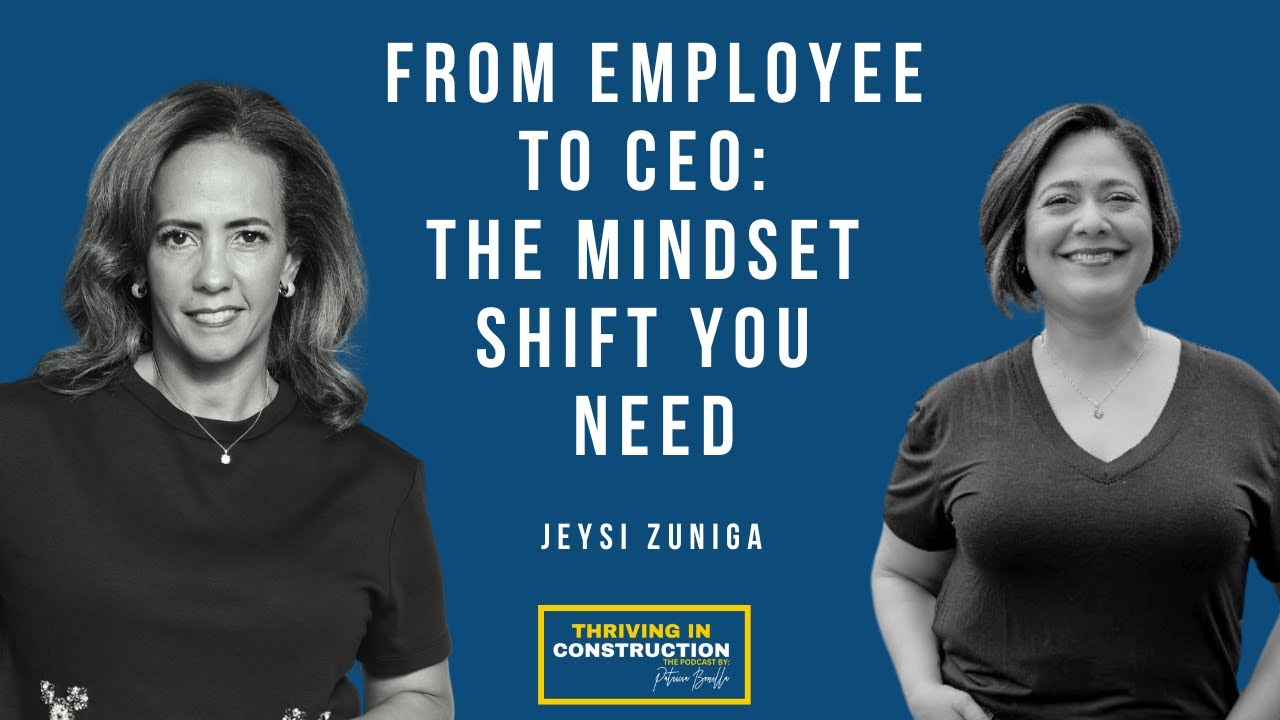
She also appeared on Bonilla’s Thriving in Construction podcast for an episode about moving from employee to CEO. Its themes include hiring, financial management, relationships and calculated risks. The transition is familiar in outline: someone who knows how to do the work becomes responsible for the organization doing it.
Her public account of ICIC learning describes being more deliberate about choosing opportunities that fit company goals and implementing systems to improve contract negotiations. It is a practical definition of education: a lesson becomes a different way of handling the next decision.
The factory with a sticky past
The Lawrence headquarters gave that next chapter a memorable setting. Synergy moved into a former glue factory. Warm weather brought glue out of the walls and ceiling; the roof also leaked. Renovation began in July 2025. Six workers spent five weeks scraping an 11,000-square-foot ceiling. The building had apparently retained a strong attachment to its former occupation.
Six workers. Five weeks. One very persistent industrial past.
The episode supplies a suitably physical ending to a story that began with organizing people in an office. Ownership brings plans into contact with actual places, materials and tasks. Sometimes the task is improving a contract negotiation. Sometimes it is finding the people and time required to clear a ceiling.
By 2026, Zuniga was announced as a featured speaker at Boston’s Hard Hats & High Heels Mixer during Women in Construction Week. Her working life now includes describing the path as well as continuing along it. The summer job became a career; the career became a company; the company keeps presenting the next thing that needs doing.