The weekend before the 2016 presidential election, a Portland man named Scott Duncombe was watching the same thing everyone else was: photographs of Americans standing in voting lines that stretched around blocks and lasted for hours. Talking with friends, he landed on a small, slightly absurd fix. If the line is the problem and nobody can shorten it fast enough, at least feed the people stuck in it. His friend Noah Manger built a website that weekend. By the morning of Election Day they had raised roughly ten thousand dollars and trained a couple dozen volunteers to take reports of long lines and phone pizzas to them.
They sent around 2,400 pizzas to more than 100 polling places across 24 states. Then, instead of switching it off, they kept going. Nearly a decade later, Pizza to the Polls is a registered 501(c)(3) nonprofit based in Portland, Oregon, that has served voters at thousands of polling sites in all 50 states, run a national fleet of food trucks, and raised its money almost entirely from donations that average under twenty dollars.
The "customer," in the loosest sense, is any voter stuck in a line long enough to think about leaving - which in practice means the neighborhoods where lines are worst, often dense urban precincts and college campuses. Nobody pays. The people who fund it are a separate crowd entirely: tens of thousands of small donors who never see the pizza they buy. That split - the person fed is not the person paying - is unusual, and it is exactly what keeps the service free at the point of the line.
The IdeaSolve the boring problem people actually complain about
Voter-turnout groups tend to fight big, abstract battles - registration drives, awareness campaigns, get-out-the-vote texts. Pizza to the Polls picked a smaller, more concrete enemy: the moment a voter, hours into a wait, decides it isn't worth it and goes home. Its entire product is aimed at that moment. Keep people fed, keep them company, keep them in line.
The mechanic is deliberately simple. Anyone who spots a crowded polling place can report it - through polls.pizza or by tweeting at the account. A small team verifies the line is real, then orders pizza from a nearby independent pizzeria and has it delivered to the people waiting. No sign-up, no ideology check, no cost to the voter.
Report
A voter flags a long line via the website or a tweet to @pizzatothepolls.
Verify
The team confirms the line is genuine before spending a dollar.
Order
Pizza is ordered from a nearby independent shop - local money, local pies.
Deliver
Hot pizza arrives at the line. Free, nonpartisan, for anyone waiting.
That last point is not a marketing footnote - it is the product. Pizza to the Polls is aggressively nonpartisan. It does not ask who you are voting for, and it makes a point of saying so. In a political culture where almost everything is coded red or blue, free pizza in a shared line is one of the few genuinely neutral goods left. That neutrality is what lets the pizza show up for everyone.

GrowthFrom a weekend project to all fifty states
The numbers tell a fairly clean growth story, cycle by cycle. What is notable is that the idea never had to change to scale. The same one-line pitch - feed people in voting lines - carried it from a few thousand pizzas to tens of thousands.
The 2020 cycle was the peak of the on-demand model: more than 70,000 pizzas sent to over 3,000 polling sites across 48 states, funded by over 30,000 donors giving small amounts. It was also the year the operation grew a second limb.
ProductsPizza on demand, trucks, and catering for everyone else
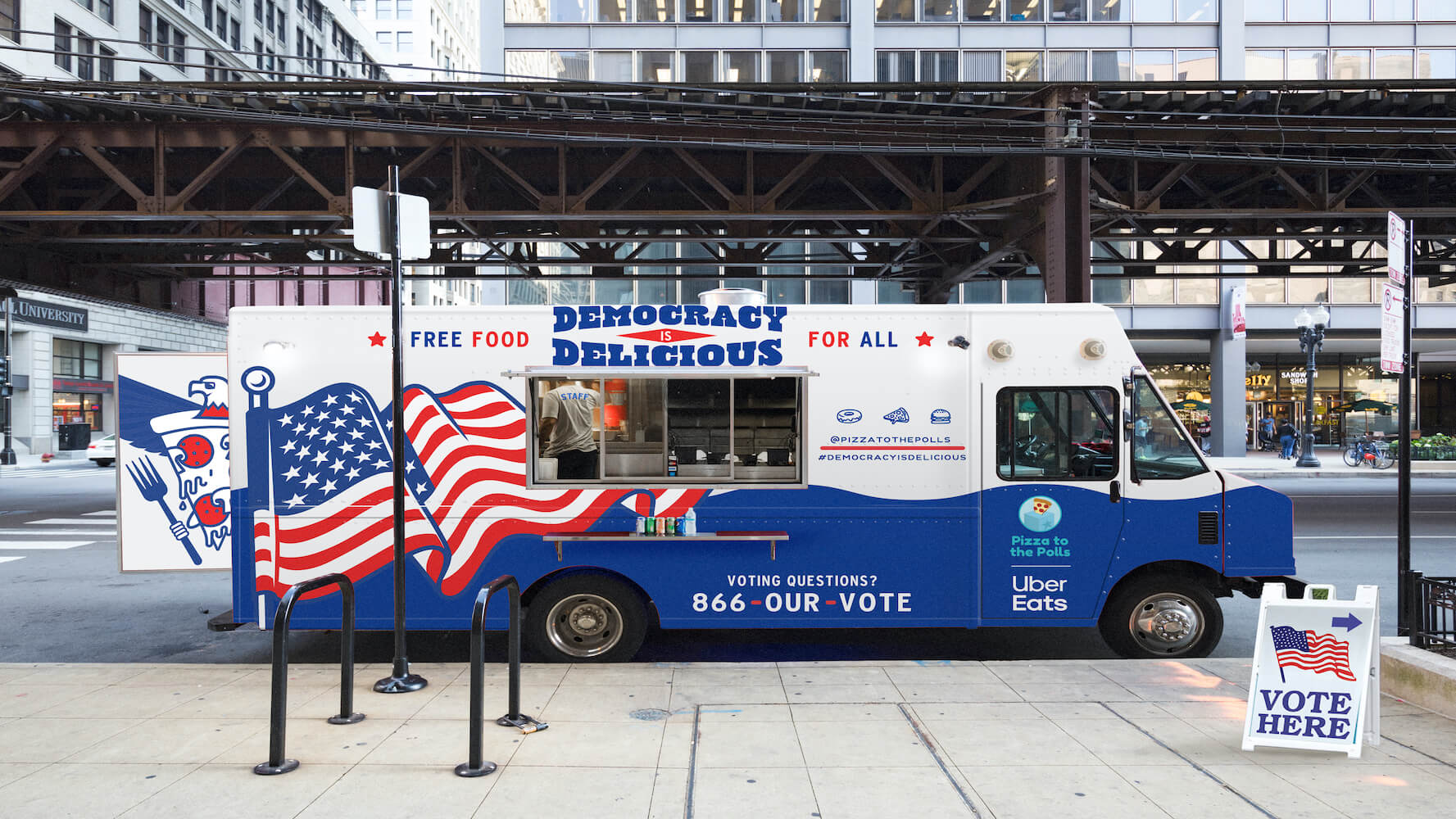
Today the nonprofit runs three programs. The On-Demand pizza service is the original and the most famous - the report-verify-deliver loop described above. The Food Truck program, built out in 2020 with the experiential-design studio Tinsel, sends mobile trucks to early-voting and Election Day sites to hand out snacks, meals, and drinks. In 2024 that program ran for 33 days across six states and gave out 429,200 snacks. And the Pre-Order program does something quieter but strategic: it caters other nonpartisan organizations' voter-registration and turnout events, with a particular focus on community-college students.
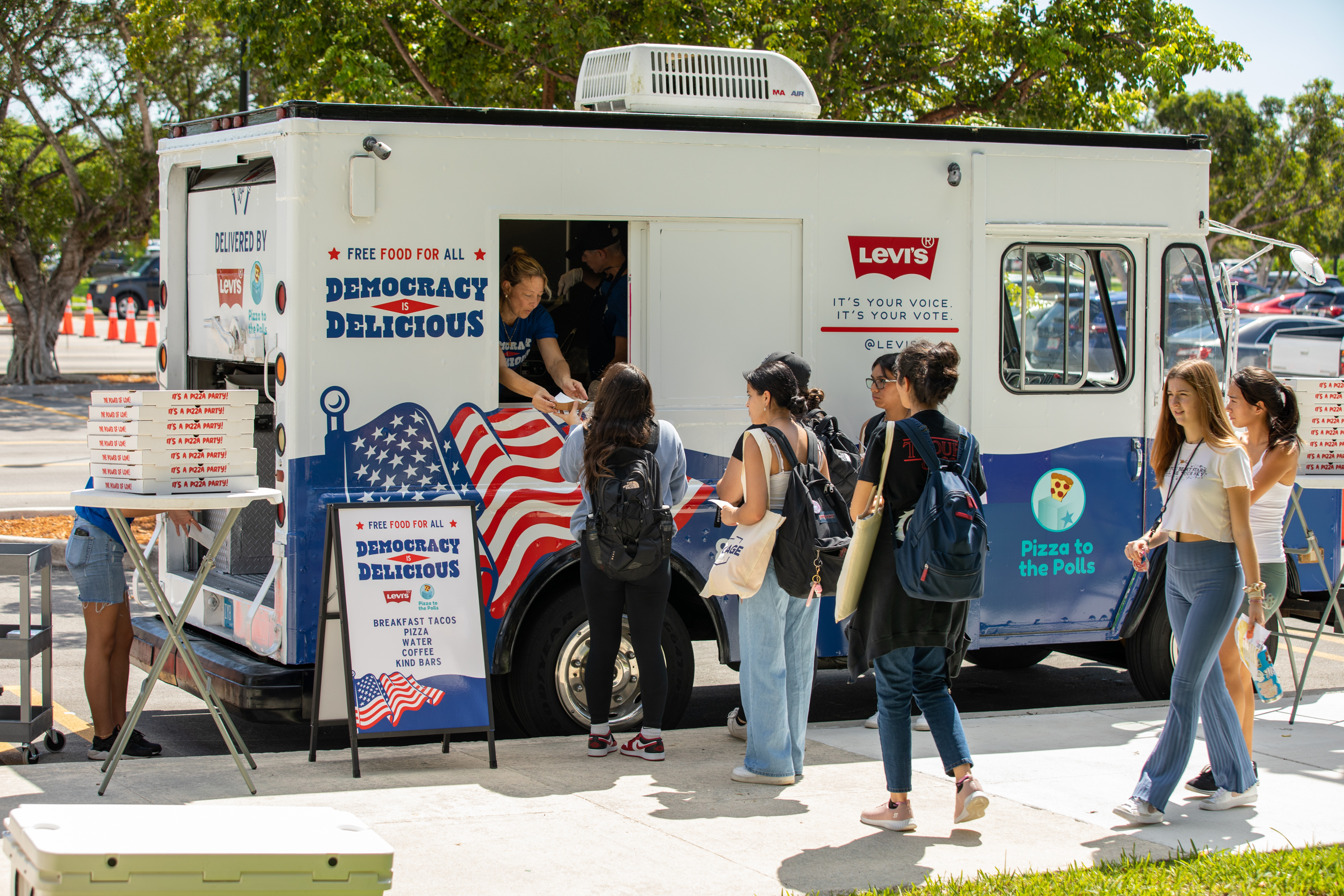
The through-line across all three is the same insight: a long wait is a shared experience, and shared experiences are contagious. A stack of free pizza boxes at a two-hour line is not just lunch - it is a small event, the kind people photograph and post. In effect, the voters became the marketing channel, which is part of how a five-person operation reached a national scale.
The MachineFive people, a lot of automation
Running national Election Day logistics with a tiny staff is only possible because most of the coordination is automated. The team has publicly described stitching together tools - Zapier for routing, Retool for internal dashboards - so that an incoming report of a long line can be verified and turned into a pizza order without a person touching every step. On a peak day, that is the difference between a few hundred deliveries and a few thousand.
The finances are unusually lean for the reach. Charity Navigator gives it a four-star rating, and the group reports a program-expense ratio of roughly 96% - meaning almost every dollar donated buys food rather than overhead. Revenue was about $1.71 million in 2024, up from $816,853 in 2022. For a nonprofit whose median gift is a person chipping in the price of a couple of slices, that is a large machine built out of small money.
There is also a deliberate rhythm to the whole thing. Activity spikes hard around elections and goes quiet in between - fundraising, delivery, and food-truck routing all compress into a few weeks every two years. That seasonality is a feature, not a flaw: the group does not try to sustain a year-round operation it would have to pay for. It scales up when there are lines to feed and scales back down when there aren't, which is part of how the overhead stays so low.
The MarketNobody else is doing quite this
There is no real head-to-head competitor. Plenty of well-funded groups work on turnout - Vote.org, When We All Vote, and the broader civic-engagement field - but they operate upstream, on registration and reminders. Pizza to the Polls works at the very last mile, at the line itself, with a tool nobody else uses: food logistics. The practical alternative to Pizza to the Polls is not another organization. It is a hungry voter deciding the wait isn't worth it.
That focus is also the honest limit of the model. It depends on lines existing - on demand it needs a crowd to feed - and on donors showing up every two years for a burst of intense activity. It works because it does one legible thing and does it well; it would not work as a year-round general charity, and it has never tried to be one.
PartnersPizzerias, pretzels, and a brand coalition
The model quietly routes money to local independent pizzerias, which is why partners in the food world lean in. A 2020 partnership with the pizza-ordering app Slice tied orders to independent shops. Snack partners like Wetzel's Pretzels, apparel brand Levi's, #iVoted Concerts, and food-truck coordinator Roaming Hunger have all plugged into the effort. Board member Liz Castelli, co-founder and CEO of Tinsel Experiential Design, helped design the 2020 mobile program that fed and entertained more than a million people waiting in line across 29 markets.
The TakeawayWhat you can steal from it
For anyone building a cause or a brand, Pizza to the Polls is a tidy case study. It took a universal frustration nobody owned, attached a cheap and joyful fix, and made the good deed inherently shareable so that its own beneficiaries spread the word. It stayed strictly neutral, which widened the audience instead of narrowing it. And it kept the operation small and automated so that nearly all the money reached the mission. The pizza gets the headlines. The discipline is what made it last.