The mannequin has done its job. The swimsuit holds its shape; the straps sit where they should. Now the mannequin, its stand and the studio behind it have to go. In a before-and-after example from Pix Clipping Path, all that equipment disappears, leaving a green patterned bikini on white. It is a small act of commercial tidying, with a very specific purpose: let the shopper look at the thing for sale.
That is the territory this photo-editing company occupies. Its work begins with an existing photograph and ends with an image prepared for a store, a catalog or another commercial use. Between those points come decisions about edges, backgrounds, shadows, color and how much imperfection to remove. The results are designed to attract attention to the product. The editor’s contribution is often easiest to notice when it goes wrong.
Pix Clipping Path calls itself “Your Virtual Photo Editing Studio.” The phrase describes a practical arrangement: retailers and photographers supply the pictures, and a remote service handles the finishing. Its menu reaches from straightforward background removal to jewelry retouching and 360-degree photo editing. The common thread is production work that a business needs repeatedly, sometimes across a large batch of images.
A bottle is easy. A bicycle has opinions.
A clipping path is a closed outline used to isolate something in a picture. Pix Clipping Path describes drawing these outlines by hand with Photoshop’s Pen Tool. A product can then be separated from the original scene and placed on a different background. The company also advertises cropping and resizing at no extra charge alongside its clipping-path service.
The revealing detail is how it classifies difficulty. Simple objects with relatively few curves occupy the easy end. More demanding pictures require more anchor points and more individual paths. A bicycle, with all those gaps, or elaborate bridal jewelry sits in the company’s super-complex category. One image is therefore a poor unit for guessing the amount of labor involved. The outline matters as much as the object.
There is an appealing honesty to that distinction. A bicycle’s price tag does not tell an editor how many awkward spaces must be preserved. Nor does a product’s physical size determine the care it needs on screen. The company’s own explanation of clipping-path complexity makes the workload visible before the customer starts comparing prices.
Smooth outline
A hand-drawn clipping path
Hair, fur, fine detail
A carefully refined mask
Separate color areas
Multiple editable paths
Hand drawing is part of the offer, but the company’s teaching material does not prescribe a path for everything. In an article credited to Rubel Babu, it distinguishes smooth, defined edges from subjects with fine strands or soft detail. Masking is the approach it recommends for the latter. A furry toy and a solid box pose different problems even when the instruction is identical: remove the background.
The article recommends examining edges at 200 percent magnification. That is a useful glimpse of the craft: look closely enough to see the mistakes that a small preview conceals. It also gives buyers a test they can copy. Inspect the difficult boundary, then look at the image at its intended display size. A clean silhouette should still belong to the photographed object.
The invisible model earns its keep
Ghost mannequin work adds another task. Removing the support is only part of the assignment; the clothing must remain convincing after it disappears. Pix Clipping Path describes reconstructing neck areas while preserving the garment’s shape, proportions and color. Its examples make the appeal plain: display the clothing with volume, without keeping the mannequin in the final picture.
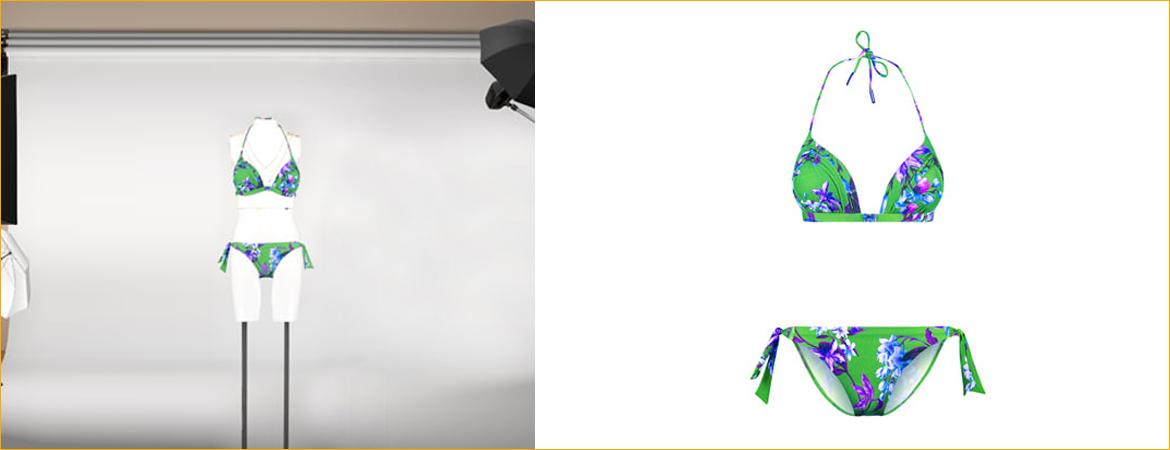
The company markets this service to clothing sellers, manufacturers, retailers and photography businesses. For those buyers, a mannequin offers a reusable way to support a garment during photography. Editing completes the presentation. The result serves a particular visual brief: a product shown on its own, with its structure still legible.
That brief matters. A shop selling the drape of a dress may want photographs of someone wearing it as well. Ghost mannequin editing answers the request for an isolated garment; it does not supply every kind of picture a fashion business might need. Deciding which view belongs in the listing remains the retailer’s job.
Take away the room. Put back the shadow.
Background removal can leave a product looking oddly suspended. Pix Clipping Path offers three shadow treatments: drop, natural and reflection. Their names describe different visual effects, from grounding an object against its new background to making it appear to sit on a reflective surface. The work can involve adding a cue that the cleanup has removed.
Its shadow service is a reminder that a convincing product image involves more than a tidy perimeter. A reflection suggests glass beneath the object. A natural-looking shadow suggests a light source and a surface. Either can alter how a shopper reads the same photograph. The desired effect belongs in the brief, rather than being left to a generic instruction to improve the image.
Jewelry presents a related challenge. The company’s retouching page discusses reflective materials and the difficulty of recording intricate designs and gemstone color. Such objects need enough light to reveal their details, yet reflections can obscure those very details. The practical aim is a legible photograph of a shiny object, with the metal and stones still looking like themselves.
There is a boundary here worth keeping in view. Cleaning a distracting mark in the photograph and changing a product’s defining features are different decisions. Buyers commissioning retouching can specify which details must survive. For a patterned garment or a piece of jewelry, the details may be the reason someone wants it.
The price of a clean edge
Pix Clipping Path’s published price list begins at $0.39 per image for clipping paths and background removal. Drop shadows start at $0.19; masking at $0.79. Ghost mannequin work and general retouching each start at $0.99, with color variants at $1.39 and jewelry retouching at $1.99. These are advertised starting rates, not a quote for an arbitrary batch.
Published price list; complexity and the agreed scope determine the project quote.
The business model is service work priced around images and assignments. Its published terms describe upfront payment for individual customers, with weekly or monthly arrangements possible by agreement. That structure suits both a one-off job and a continuing stream of production work. The useful comparison is the cost of delivering the required result across the actual batch.
Color variants illustrate a different kind of economy. The service changes selected colors in an existing photograph, allowing a seller to present several versions of a product. Pix Clipping Path uses a T-shirt as an example. Reusing the underlying composition can reduce repeated photography and editing, provided the resulting colors represent the stock being sold.
The qualification is consequential. A new color image can reuse the pose and lighting, but the retailer still needs to check the match. Giving the editor a reference for each variant turns “make it blue” into something more useful. The service can multiply pictures; accurate product information must accompany them.
A sample is more useful than a slogan
The company offers a free trial, with a form for selecting services, supplying images and describing the assignment. Rubel Babu, who identifies himself publicly as CEO and founder, describes trials involving one to three pictures. That gives a prospective customer something concrete to inspect before commissioning a larger job.
The sample has a second role. The published terms connect the standard of an approved trial image to the assessment of the finished order. They also specify a five-day window for revision and refund requests and distinguish corrections from a changed brief. Sample approval therefore deserves the same attention as the final delivery.
Send the picture with the awkward edge.
A practical takeaway from the sample-first workflow
A useful trial would include the work that is likely to cause trouble: a complicated cutout, a delicate texture or a color-sensitive item. That is an editorial recommendation, not a description of a particular customer’s order. The point is to test the service against the assignment it will receive. The easiest picture in the folder offers the least information about the hardest one.
Instructions should make the intended result visible: the background, crop, shadow treatment and details to preserve. The company’s trial form also lists alternative transfer methods, including Dropbox, Google Drive, WeTransfer and FileZilla. File delivery is part of the workflow. A clear brief attached to a usable file is where the relationship begins.
A production partner in a crowded field
Pix Clipping Path operates in a market where other editing providers also advertise hand-drawn paths and per-image pricing. PathClips and Clipping Path Source offer comparable categories of work. Manual editing alone does not establish exclusivity. For a prospective buyer, the distinguishing evidence is the provider’s execution of a relevant sample and its ability to follow the agreed instructions.
The company’s public identity combines international sales with remote production. LinkedIn lists Oakland as its headquarters and 2009 as its founding year; its own About page identifies a main office in Dinajpur, Bangladesh, and a marketing and support address in Australia. That geography fits the service it describes: handling images remotely for photography agencies and other commercial customers.
Its stated priorities are careful editing, timely delivery, responsiveness and client relationships. Those are practical promises for a business selling repeated production work. They also put the buying decision at a manageable scale. A retailer can evaluate the edges, color and consistency in the files it receives. The finished picture is the most useful sales pitch.
For a photographer, the attraction is handing off a defined part of postproduction. For a retailer, it is getting product pictures into a consistent form. For an agency, it is extra editing capacity. Each still needs someone to decide what a finished image should look like. Pix Clipping Path supplies a service for carrying out those decisions, right down to the last strap, spoke and shadow.
Look closer
Company website · Published pricing · Request a trial · Paths versus masking · Service terms · LinkedIn · X / Twitter · Facebook