Vijay Balasubramaniyan was in India, trying to buy a custom suit, when his credit card stopped cooperating. The bank saw a purchase it did not trust. He knew he was himself. The phone call between them could not reconcile those facts without a small interrogation. It was the sort of nuisance most travelers answer with a sigh. Balasubramaniyan answered it by starting a company.
Founded in Atlanta in 2011 with fellow Georgia Tech researchers Paul Judge and Mustaque Ahamad, Pindrop began with a useful inversion: do not listen only to what a caller says. Listen to the call itself. The handset, carrier path, geography, ambient noise, voice and patterns of behavior all leave traces. Pindrop called the resulting signature a phoneprint and used it to tell ordinary customers from fraudsters inside large contact centers.
That was a focused enterprise-security business. Then generative AI made a convincing copy of a voice cheap enough for almost anyone. Pindrop's old question - who is really on the other end? - escaped the call center and entered elections, hiring interviews, executive meetings and payment approvals. A company built around the metadata of a telephone call found itself staring at a wider crisis of digital identity.
The call is the credential
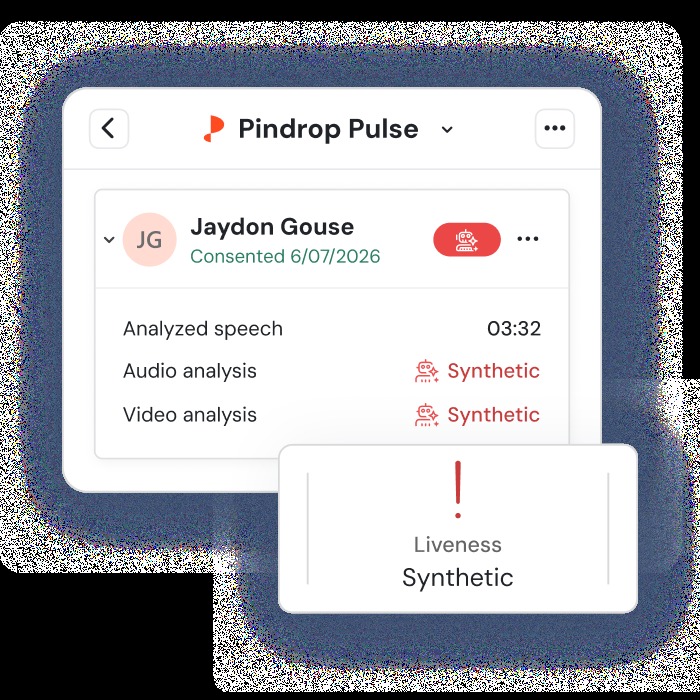
Pindrop's platform now organizes the problem into three blunt questions. Is this a real human? Is this a bad actor? Is this the right human? Pulse looks for synthetic audio and video. Protect scores fraud risk. Passport passively authenticates known customers. The products can operate together, but each addresses a different failure in the old security stack.
One interaction, many witnesses
This layered method is the important distinction. A voice match alone can be fooled by a clone, degraded by a poor connection or confused by illness and age. Device intelligence alone can punish a customer using a new phone. Pindrop's pitch is that several imperfect witnesses, evaluated together and over time, are more useful than a single stern bouncer.
The contact-center setting matters. The software sits behind the conversation, scores the caller and pushes an alert or authentication result into the systems an agent already uses. That makes it less like a consumer identity app and more like plumbing sold to banks, insurers, healthcare providers, retailers, utilities and public agencies. The buyers are enterprises with lots of calls, expensive fraud and a queue full of genuine customers who would rather not recite their first pet's name.
What failed first: the pop quiz
Before tools like Pindrop, many contact centers relied on knowledge-based authentication. The caller supplied a Social Security number, address or answer to a personal question. Data breaches weakened the premise. Criminals arrived with dossiers; genuine customers forgot the details. Pindrop's own analysis of 2,500 fraud calls across 10 financial institutions found fraudsters passed those quizzes 53 percent of the time on average.
One-time passwords added another hurdle without closing every gap. At First National Bank of Omaha, OTP checks added roughly two minutes to a call. After deploying Pindrop, the bank reported a 75 percent decrease in OTP use, a 30-second reduction in average handle time and a 47 percent decrease in average account-takeover loss. Across 17 million annual calls, half a minute becomes 8.5 million minutes. Fraud software had quietly become an operations product.
“Pindrop performed 34% better for us than what we projected in fraud loss cuts.”Steve Furlong · Director of Fraud Management, FNBO
Other published case studies repeat the pattern. A 90-year-old credit union cut authentication from 54 seconds to 18 seconds in its first months and reported fewer fraud incidents. Michigan State University Federal Credit Union reported $2.57 million less fraud exposure after a year, alongside faster authentication. HealthEquity said voice-channel fraud fell by more than 90 percent. These are company and customer-reported results, not a promise that every deployment will behave the same way. They do show what changed buyers' minds: not a perfect demo, but a return visible in both losses and labor.
The deepfake changed the budget
For years, synthetic voice was a vivid conference demo and an awkward line item. In early 2024, a fake Joe Biden robocall told New Hampshire voters to stay home. Pindrop analyzed it, compared the sound against known synthesis systems and attributed it to ElevenLabs with greater than 99 percent confidence. The incident turned an abstract model-risk discussion into something voters could hear on voicemail.
Inside enterprises, the frequency was changing too. Balasubramaniyan told Axios that Pindrop went from seeing roughly one deepfake a month across its customer base to one a day for each customer. Pulse, launched for contact centers in February 2024, signed 16 customers in about six months. He said it sold faster in that period than Pindrop's first product had during its first five years. The market did not suddenly become fascinated with audio forensics. The cost of impersonation collapsed, and the threat crossed from insurance-policy hypothetical to daily operations.
Pindrop secured a $100 million, five-year debt facility from Hercules Capital that July, earmarked for product development and hiring. The financing followed more than $200 million in disclosed venture rounds, including a $90 million Series D in 2018. Its software prices remain private and contract-based. The buying logic is public enough: customers compare the subscription and integration work with fraud losses, investigation time, call duration and the cost of making every legitimate caller prove too much.
From hold music to the boardroom
The next move was video meetings. Pulse for Meetings entered beta in April 2025 and reached general availability later that year on Zoom, Cisco Webex and Microsoft Teams. It checks audio and video for generated artifacts, passively compares a participant's voice and adds location and VPN signals. MoonPay became an early adopter. TIME included the product among its Best Inventions of 2025.
The expansion is logical, but it is not automatic. Contact-center deployments have structured calls, stable integrations and huge volumes from which to learn. Meetings are messier. People join from hotel Wi-Fi, share microphones, turn cameras off and invite outsiders who have no enrolled voiceprint. Privacy expectations also change when software continuously analyzes every participant. Pindrop lets organizations choose signals, but buyers still need clear policies, consent practices, escalation paths and human review.
A crowded market with an old head start
Pindrop sits between several established categories. Voice-biometric vendors such as Nuance, Veridas and ID R&D compete for authentication work. Contact-center platforms including NICE can supply native security features. Newer companies such as Reality Defender, GetReal Labs and Resemble AI attack the deepfake problem across different media. A buyer can also assemble a stack from one-time passwords, cloud identity services and manual fraud review. Pindrop's argument for consolidation is that a single risk layer can follow an interaction from the phone channel into the meeting room.
Its defensible asset is not merely a classifier. Years of real calls have supplied the failure cases, fraud patterns and integration knowledge that a fresh model lacks. Pindrop says its models now learn from more than 1.5 billion real-world interactions annually. Its partner network includes Zoom, Cisco, Microsoft, Five9, Verizon, NICE and AWS, giving the company routes into systems enterprises already run. The catch is classic platform risk: partners can build overlapping features, while specialized rivals may move faster on a single medium.
The smartest thing Pindrop sells is not certainty. It is useful doubt, delivered before somebody wires the money.
The copyable part
Pindrop offers a tidy playbook for enterprise founders. Start with an expensive, narrow workflow that others overlook. Collect proprietary signals while solving it. Integrate where the decision is made, not in a separate dashboard nobody opens. Then quantify two kinds of value: the disaster avoided and the ordinary minutes returned. Security fear may win a meeting; operational savings help a contract survive renewal.
Steal this, carefully
The Pindrop operating recipe
- Replace one brittle test with several independent signals.
- Run the analysis inside the customer's existing workflow.
- Measure false alarms, prevented loss and time saved together.
- Use early deployments to build a data advantage competitors cannot download.
- Follow the underlying problem into adjacent channels, not every fashionable market.
It will not work everywhere. Low-volume organizations may never recover integration costs. Weak audio, unsupported telephony, sparse history or constantly changing users reduce the available signal. Teams that cannot investigate alerts merely create a new queue. And no detector should be treated as an oracle: models face new generators, adversarial adaptation and the inevitable tradeoff between missed fraud and inconvenienced people.
That caveat is also why Pindrop's position is interesting. It does not have to prove what reality is in the abstract. It has to help a bank, nurse, hiring manager or finance team make a better decision during a live interaction. The company began by noticing that a call contained more evidence than the caller's answers. In the age of cloned voices and faces, every enterprise is being forced to notice the same thing.