A customer opens a bank account with a document and a selfie. Months later, that customer loses a phone and calls for help. The app knew who they were. The person answering the call needs convincing. Somewhere between those two encounters, a perfectly ordinary human has become a stranger.
This is the problem Daon has chosen to inhabit. Its software checks documents, compares faces, authenticates voices, and helps businesses decide when to ask for another factor. The interesting part is how those checks connect. A strong front door is useful; so is remembering who walked through it.
- The job: verify people, then authenticate them across channels.
- The buyers: banks, telecom providers, travel businesses, and public institutions.
- The bet: one identity record can connect signup, support, transactions, and recovery.
- The lesson: examine what happens when a trusted customer changes devices or channels.
The customer who became a stranger
Daon calls its approach Identity Continuity. In practical terms, it means that evidence gathered during onboarding can support later interactions. A customer’s identity has a history. The company wants a business to use that history when deciding whether an account request deserves trust.
The distinction matters because proving an identity and authenticating an account are different jobs. At signup, the question is whether a person corresponds to the identity being claimed. At login, it is whether the returning user is entitled to access the account. During recovery, the business must answer that second question after something that normally proves access has disappeared.
Daon’s ambition is to make those encounters part of a connected process. It is an enterprise software business whose work appears inside other organizations’ apps and services. Public customers include Atom bank, GCash, NatWest Group, Capitec, and Navy Federal Credit Union. Most users have better things to do than learn the name of their authentication supplier. That anonymity is rather the point.
The airport made the handoff visible
Travel offered a particularly legible version of the problem. In May 2021, American Airlines let customers on selected routes upload vaccination records through Daon’s VeriFLY app. Travelers entered their journey, supplied the required documentation, and received a pass-or-fail message. The app was free to download.
The operational idea was simple: move the document check ahead of the airport encounter. American also offered dedicated check-in lanes at several hubs for VeriFLY users. A collection of papers became a status that staff could act upon. The passenger still had requirements to meet, but the airline had a way to settle some of the uncertainty before departure.
By September 2022, Daon reported that VeriFLY had served more than 12 million travelers, including over a million Carnival cruise guests. It expanded the app’s ability to save travel and event documents to an itinerary. The travel offering now includes integration into providers’ existing apps through SDKs and APIs. Those historical health-passport deployments illustrate the work; they should not be mistaken for today’s entry rules.
travelers served - an identity workflow with a boarding queue at the other end.
A bank built around the second visit
A Daon case study describes an unnamed Southeast Asian neobank that wanted entirely digital onboarding and authentication. Buying separate systems for those jobs presented cost and implementation concerns. The bank also needed duplicate-face checks, availability, and control over fraud rules.
Daon deployed xProof, xAuth, and xFace on IdentityX. Document verification handled enrollment; device authentication and server-based facial biometrics supported later access and recovery. Flagged submissions could reach a review portal. The reported results included onboarding in under 90 seconds, 2.6 million customers onboarded since April 2021, and 38 million monthly authentication transactions.
Those are vendor-published results from one deployment. They give the design a concrete shape without promising that every bank will reproduce them. The useful detail is the connection between the first visit and the difficult later visit: a face enrolled at onboarding could support account recovery. Identity was being treated as something worth keeping.
Two platforms, one awkward question
Daon began in Ireland in 2000, founded by entrepreneur Dermot Desmond, who remains its owner and chairman. The business has spent more than two decades working on biometrics. Its public story now includes two principal platforms, and the choice starts with a decidedly unglamorous question: where should the infrastructure live?

IdentityX supports customer-controlled deployments, including on-premises infrastructure and private cloud. TrustX, launched in April 2023, is Daon-managed SaaS built to run on AWS. TrustX adds no-code workflow orchestration, allowing teams to arrange checks and adjust journeys through a visual interface.
Keep the infrastructure
For organizations that need identity systems on infrastructure they control.
Manage the journey
Daon hosts the SaaS platform; customers configure identity workflows.
The applications supply the working parts. xProof checks identity documents and biometric evidence. xAuth supplies authentication choices, including FIDO methods and passkeys. xFace supports server-based facial authentication. xVoice authenticates callers through active phrases or passive analysis of ordinary conversation. Businesses can assemble the checks around the task.
Daon sells software licenses and SaaS access to organizations, with integration and support around them. It also distributes through partners and AWS Marketplace. Joining AWS’s ISV Accelerate program in January 2025 added a co-selling route. The economic attraction is fewer disconnected integrations and, for managed SaaS, less infrastructure to operate. A buyer still needs to price the actual workflow, its transaction volume, and the work required to connect it.
In the verification market, alternatives include Entrust Identity Verification, Jumio, Veriff, and Sumsub. Daon’s positioning emphasizes verification alongside continuing authentication, recovery, and deployment choice. That is a useful procurement distinction, rather than proof that every alternative lacks similar functions. Broad access platforms can be partners too: IdentityX integrates with PingOne DaVinci.
When the familiar voice is manufactured
A voice match and a trustworthy call are not interchangeable. Daon’s xVoice asks whether speech corresponds to an enrolled person. Its xDeTECH product asks whether incoming audio is likely synthetic. The latter can provide a signal without first enrolling the caller’s voiceprint.
That distinction gives a contact center options. A suspicious call can trigger authentication through the customer’s registered app, or require a face check. Daon’s Genesys integration brings voice biometrics into contact-center workflows; its broader deepfake-defense offering combines detection with further checks. A warning needs an operational response.
Capture conditions matter too. Daon acknowledges that passive liveness can be affected by the environment in which a face or voice is recorded. An accessible workflow needs alternate paths and review, alongside protection against spoofing. A genuine customer who cannot complete a check still needs a way to get help.
The person who returns from the break
In July 2026, the British Council selected Daon for a multi-year identity-verification deployment. The announced plan includes document checks, facial comparison, liveness detection, chip reading, and manual-review fallback. Checks extend from registration to test centers and later moments, including returning from breaks and re-tests.
“Identity is the cornerstone for high-stakes exams”
Anthony Nicols, Director of Product, British Council / July 2026
An exam result is only as useful as confidence in who earned it. Checking a candidate at registration cannot, by itself, establish who returns to the desk after a break. The agreement makes Daon’s continuity argument unusually easy to understand. It describes an intended deployment, rather than completed results.
The same idea appears in its workforce fraud-prevention solution, launched in May 2026. Daon combines candidate verification, onboarding, passkey authentication, and later reverification. A hiring journey has its own handoffs: applicant, new employee, account holder, person requesting renewed access.
Its research has moved further ahead. July brought an AI-agent authorization patent announcement; August brought a five-patent Quantum Identity architecture and Frost & Sullivan innovation recognition. Daon explicitly describes the quantum work as an evolving architecture. A patent establishes protected ideas; customer outcomes require implementation and evidence.
Borrow the journey, not the slogan
The practical lesson is available to any product team. Draw the journey from signup to recovery. Follow the user across the app, browser, and phone call. Mark where identity evidence survives, where it disappears, and where a support agent must improvise. Then measure how often legitimate people abandon the process or need assistance.
Buying a platform will not settle disconnected customer records, poorly chosen rules, or an unsafe recovery policy. Daon’s documented strength is offering tools to connect those decisions. Its test is wonderfully ordinary: when the customer who passed yesterday’s checks needs help today, can the business recognize them without handing their account to an impostor?
See the checks in action
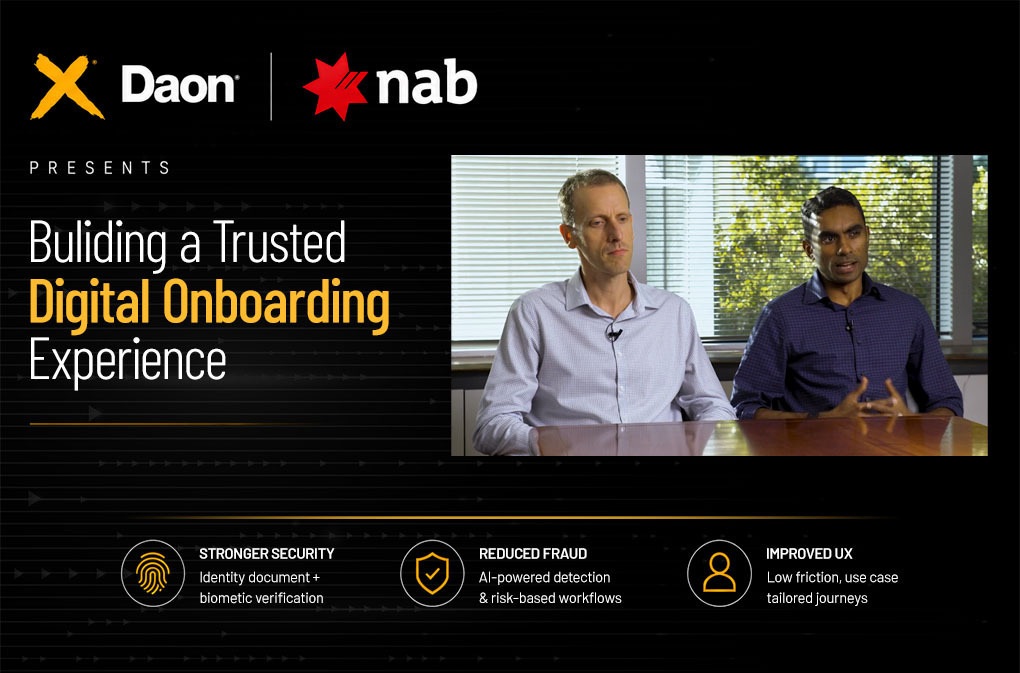
Explore Daon, TrustX, and IdentityX. Watch the TrustX product video or the National Australia Bank conversation; browse more interviews on Daon’s YouTube channel.
Follow on LinkedIn, X, or Facebook. Developers can inspect SDK samples on GitHub. More company news and commentary live in the resource center.