A song can travel farther than the paperwork that pays its composer. A photograph can acquire a second life on a website its creator has never visited. A shipment can arrive safely while some of the revenue attached to it disappears between records. Each is an ordinary commercial event. Each can also leave someone with a rather expensive question: where did the money go?
Pierre Wolf has built a business around looking for answers in places where attention runs out. He is the founder and CEO of Qi Venture Partners in New York, a firm established in 2014. Its partners include businesses working on music detection, image protection, settlement claims and logistics revenue. The subjects sound unrelated until one follows the paperwork. Then a family resemblance begins to appear.
The interesting part of this story is the distance between owning something valuable and being able to collect its value. Rights need evidence. Transactions need interpretation. Records need someone willing to compare them. A spreadsheet can be a remarkably good hiding place, particularly when there are several thousand of them. Wolf’s career offers a way to think about that gap without pretending it closes itself.
An education interrupted by arbitrage
Wolf graduated from George Washington University in 1982 with a bachelor of business administration, concentrating in finance and marketing. He briefly attended New York University’s graduate business school. After an internship at CSA researching equity-index arbitrage, he accepted a full-time position. The classroom gave way to a job in which differences between prices were the subject of the work.
His early career included developing institutional clearing services at Paine Webber. He subsequently spent three years at Lehman Brothers as a vice president in the Jonas Group, working on options strategies and institutional distribution. In 1991, he helped found the Derivative Products Group at Fimat USA, part of Société Générale. He became its executive managing director.
That sequence matters because it includes more than trading. Clearing is the machinery that lets a transaction proceed. Distribution connects a product to the people who might use it. Structuring turns a financial problem into something a customer can transact. Read together, these jobs put mathematics alongside the less glamorous business of making an arrangement function.
A market needs plumbing
In September 2006, the Philadelphia Stock Exchange announced plans for its Philadelphia Board of Trade subsidiary to list daily-expiry US-dollar LIBOR futures, subject to final regulatory approval. Wolf appeared in the announcement as a founding partner of Derivative Designs and a managing director at Fimat. The proposal joined a benchmark, an exchange, a product designer and a clearinghouse.
Its specificity is revealing. The planned contracts covered individual business-day maturities, with an initial calendar stretching eleven and a half years. The Options Clearing Corporation would clear the trades. Wolf’s comments emphasized anonymous trading, consistency with the over-the-counter market and access across the industry. Those are questions about how a market works, as much as what it prices.
A trading idea has to survive contact with infrastructure. Someone has to define the contract, establish the reference rate, arrange execution and clear the resulting obligations. There is little romance in that list. There is considerable consequence. The episode places Wolf inside a collaborative effort to make a technical proposition usable, a theme that would reappear in his subsequent ventures.
When buildings became comparable
By January 2007, Wolf was consulting to Fimat through Corridor Capital Group, another business he founded. Corridor worked on institutional relationships and new financial products. He was also a founder and director of Real Estate Analytics LLC, known as REAL. Commercial property presented a particularly interesting measurement problem: an office tower does not change hands every afternoon like a share of stock.
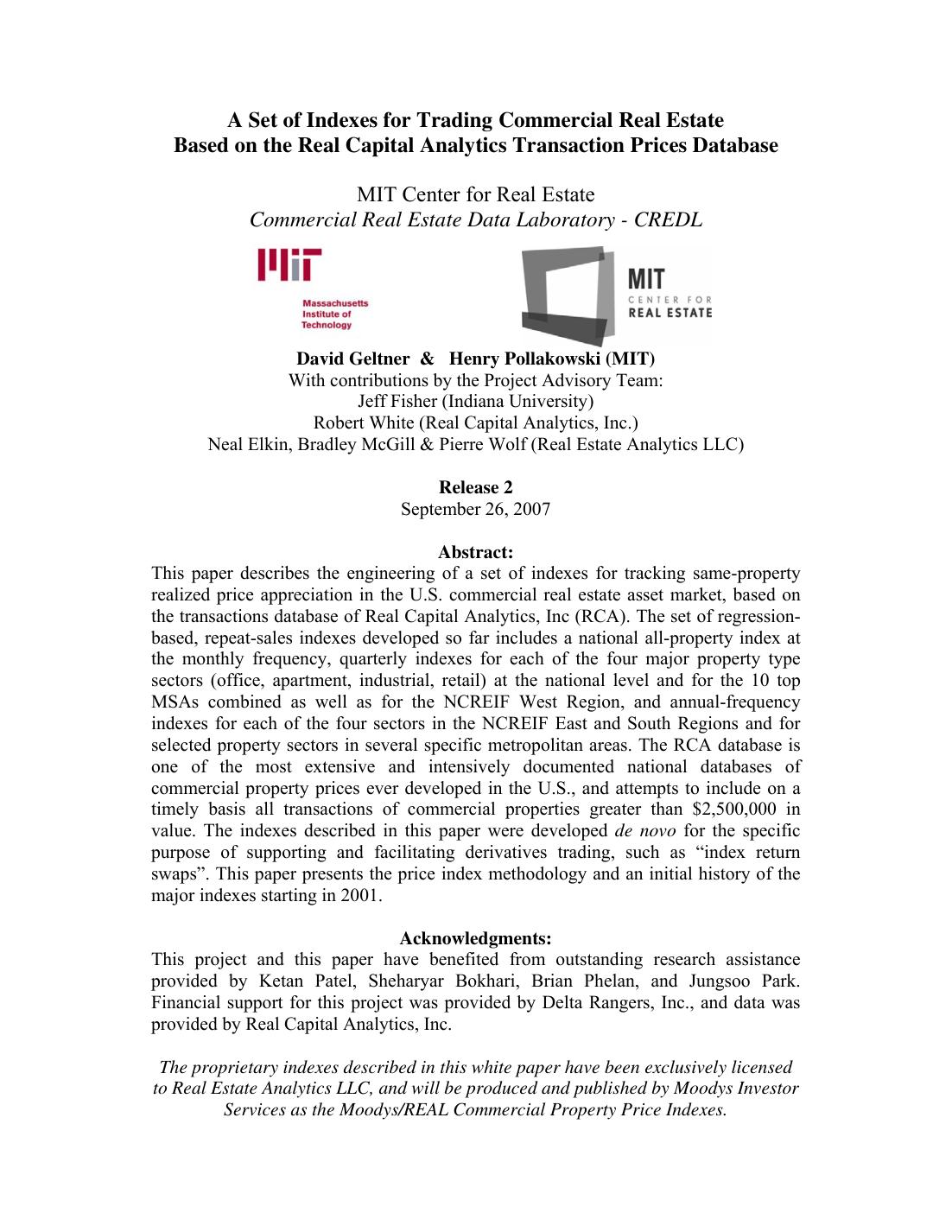
The September 2007 methodology paper for the Moody’s/REAL Commercial Property Price Indexes credits Wolf on its project advisory team, alongside Neal Elkin and Bradley McGill. MIT researchers David Geltner and Henry Pollakowski wrote the paper. Real Capital Analytics supplied transaction data. The work used repeat sales to track changes in the prices of the same properties, covering office, apartment, industrial and retail sectors.
The distinction is easy to appreciate. An average sale price can move because a different collection of buildings was sold. Comparing repeat transactions offers another way to examine price change. The paper was explicitly designed with derivatives trading in mind. A benchmark needed to describe something participants could recognize and use, rather than simply produce an impressive-looking line.
Regular publication under the Moody’s/REAL name began in October 2007, following earlier publication at MIT. In its 2008-2009 annual report, MIT’s Center for Real Estate described the indices receiving repeated attention from financial news outlets. The institution’s account places the project within its work connecting research and industry. Wolf’s contribution belongs to that shared undertaking, with academic methodology, commercial data and institutional distribution all playing separate parts.
A song leaves a trail
Qi’s portfolio makes the next chapter tangible. TuneSat monitors music on television and the internet using audio fingerprints. Its technology compares characteristics of recordings with material detected in broadcasts and online. A match can give a rights holder information about where a track has appeared, along with a recording of the detected use.
This is a useful example of why measurement and money are different stages. Finding a track does not itself settle the royalty question. A rights holder can compare detections with licenses, check reporting and pursue the appropriate collection process. The evidence helps make that work possible. Even the title of a recording is less decisive than its sound: TuneSat explains that fingerprinting follows the master recording regardless of retitling.
Pixsy applies a related sequence to photographs. It searches the public internet for image matches and gives creators tools to review their use. Copyright specialists and legal partners can handle infringement cases. Here, too, a machine’s discovery begins a process that requires human judgment. A match has to be understood before it becomes an action.
The connection to Wolf’s earlier work is an editorial reading of the pattern: make activity observable, then build a practical way to respond. Music and photography come with their own expertise and rules. The similarity lies in the organization of the problem. A creator cannot follow every copy personally; a service can turn a scattered trail into something that can be reviewed.
The claim in the filing cabinet
Class Action Capital, another Qi portfolio partner, works on settlement claims for corporations and institutions. Companies may qualify for several settlements with different deadlines and requirements. The service handles identification, filing, auditing, valuation and monetization. Eligibility can have financial significance while still demanding an administrative process before a company sees a recovery.
Quantys Group works on economic and valuation analysis of business losses across legal matters. It examines financial records, market information and other evidence to assess damages. The problem includes a fragmented litigation landscape: businesses need to understand which proceedings matter to them and how their losses might be evaluated. A number alone is insufficient; the analysis behind it has to hold together.
In logistics, ARG Global Protection looks for unbilled revenue and vendor overcharges. Its process moves from extracting records to analysis and recapture. ARG describes technology that organizes data while analysts interpret findings, validate exceptions and work with clients. The people remain part of the mechanism. Software can sort the pile; someone still has to establish what the pile means.
These examples help explain the kind of commercial territory Qi occupies. A settlement deadline, a missing charge and an image license each require different knowledge. There is no universal button marked collect. The businesses pair information with the specialist work needed to act on it. The boring-looking step is often the step on which the outcome depends.
The patience behind the numbers
Qi describes its model as venture development, working alongside operators and established companies. Its approach combines analytical work with introductions, infrastructure, capital and strategic support. Wolf’s current biography reports that portfolio companies have identified more than $2.5 billion for corporate clients. Identified value is a specific measure; it should be read as such, rather than as cash already recovered or a valuation of the firm.
The firm also describes a patient partnership approach without prescribed exit schedules. For this profile, that is a stated operating philosophy rather than a prediction of investment results. It fits the questions running through the story: how can an opportunity be demonstrated, what resources does it need, and how does the work become repeatable?
Wolf’s biography also records mentoring through Big Brother Big Sister and a summer financial fellowship for university students. His own education included an internship that led to full-time work. The two experiences make a modest but meaningful connection: an entry into the profession, followed later by opportunities for others to enter it. No elaborate origin myth is required.
“Passion in life. Passion in work. You need to have both,” is Wolf’s public formulation. It is a warmer line than the terminology of indices and financial structures might suggest. The career around it has involved teams, partners and systems, with one recurring commercial challenge: value can exist before a business has a reliable way to recognize it. Recognition is where the work starts.
“Passion in life. Passion in work. You need to have both.”Pierre Wolf