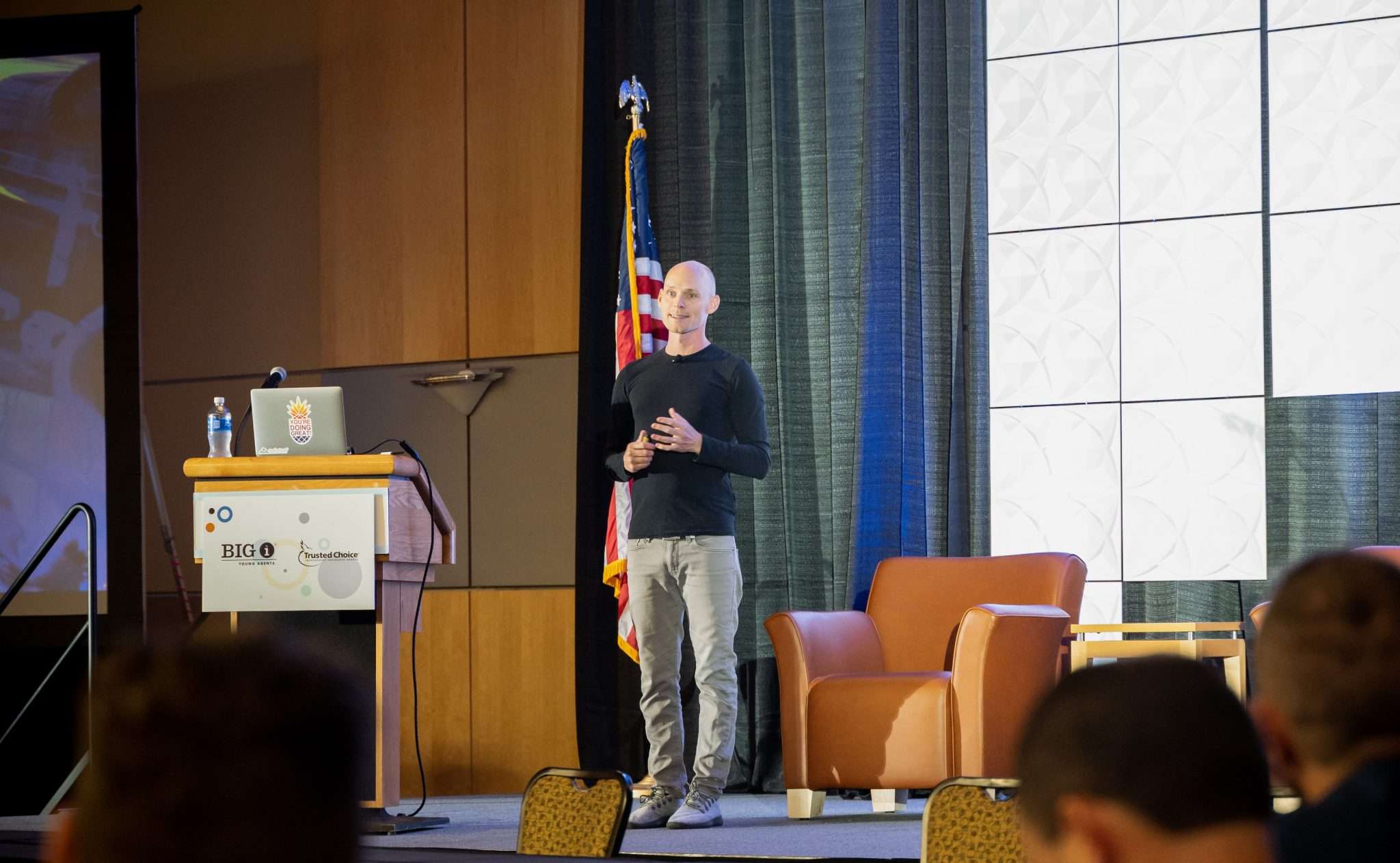
Peter MacDonald runs a company called Wunderite, a portmanteau of "wonder" and "underwrite" that he means literally. The company sits at 140 Commonwealth Avenue in Boston with a headcount of about twenty-one and one job to do, which is to make the process of moving a commercial insurance risk from an agent's desk to a carrier's underwriter feel less like passing a heavy stack of paper across a very slow river. The product is a digital forms library. It fills in ACORDs. It handles supplementals. It pulls property data. It integrates with agency management systems, with Zapier, with the small ecosystem of software that a modestly ambitious independent agency actually uses. Wunderite's promise, printed on the tin, is "insurance submissions 10x faster." This is not the sort of number a founder invents; it is the sort of number an agent, watching a producer wrestle a renewal at four p.m. on a Tuesday, arrives at by counting.
MacDonald arrived at that number the hard way. Before he ran a software company he was the producer at four p.m. on a Tuesday. He grew up around insurance - his father's agency, Murray and MacDonald Insurance Services, on Cape Cod - and joined it in 2011 after graduating cum laude in mathematics from Wheaton College in Illinois. He stayed for seven years and became a partial owner. During that stretch he acquired, in a sequence that would be exhausting to type were it not central to how he sells today, four insurance designations: CPCU, CRM, CIC, and LIA. Producers know what those mean. Non-producers can approximate their significance by imagining the CFA charter, then imagining a version of it with more sub-line-of-business trivia and less finance.
Somewhere between the credentials and the client meetings he began writing software. Not the polished kind. The internal kind, built inside the family agency, meant to solve the annoyance in front of him: filling in the same customer data across seven forms that all wanted the customer's name in a slightly different box. He was, by his own account, the kind of kid who had been intrigued by computers since he was four, who hacked the interface of AOL Instant Messenger in high school, and who had a personal web project featured in Wired before he had a driver's license. The internal tools he wrote as a working agent, he has said, racked up thirty thousand hits in a year. A tool that gets thirty thousand hits inside one insurance agency is either a very large agency or a very useful tool. His was not a very large agency.
The Founding, On Purpose, On Valentine's Day
MacDonald incorporated Wunderite on February 14, 2018. This detail is either charming or telling depending on what you already believe about founders. He had, by then, enrolled in the full-time MBA program at Boston College's Carroll School of Management, where he was a Dean's Scholar and would graduate with distinction. On day one of that program he met Joe Schnare, who had spent seven years running operations at a family wholesale distribution business and had come to Boston College to do more or less the same thing MacDonald was doing, which was to figure out what to build next. They started building together immediately. Schnare is now Wunderite's co-founder and COO. The Boston College MBA program does not generally advertise itself as a matchmaking service for insurtech founders, but in this particular case it functioned as one.
Wunderite launched its alpha in the fall of 2018. It joined Techstars Boston in 2020 - the pandemic cohort, which is worth noting only because it is the sort of biographical wrinkle that founders who lived through it never quite stop mentioning. In January 2023 the company closed a $7.2 million Series A, bringing total funding to roughly $10.25 million. Its investors include Spark Capital, Techstars, and BrokerTech Ventures, which is the kind of cap table that suggests both a generalist software thesis and a domain-specific insurance one, both of which Wunderite fits.
Why the Founder Profile Is Unusual
The reason the credentials matter is that they let MacDonald talk to insurance producers without translation. He is not an ex-consultant with a slide deck about digitizing an industry he has never worked in. He is a former partial agency owner selling software to people who used to be his peer group. Randy Schwantz, an industry consultant well-known enough that agents describe him by first name, has called him "brilliant, extremely thoughtful and very progressive." David Carothers, one of the loudest voices in commercial lines podcasting, has said MacDonald is "one of the most cerebral people I know" and "has forgotten more about commercial production than many will ever know." Those are not the sort of endorsements one buys with a demo. They are the sort of endorsements one earns by knowing what a BOR letter is without asking.
MacDonald has leveraged the credentials into a speaking circuit that functions, in effect, as demand generation. He has moderated a CEO panel at IndieTech featuring the chief executives of Vertafore, Applied, Zywave, Ivans, and PIA. He has spoken about APIs to a room of two hundred at the Agents Council for Technology. He has appeared at the IIABA's National Leadership Conference. He has done, by his own count, more than twenty podcast appearances. This is not, in the venture-backed software world, an unusual amount of talking. What is unusual is that he is doing it inside an industry where the audience actually attends the conferences and reads the association newsletters and remembers names.
The Product Argument
Ask MacDonald what the industry's core problem is and he does not say distribution or pricing or claims. He says data - specifically, the industry doesn't have enough of it, because the mechanism for collecting it is broken. Producers get renewal applications back from clients with fields skipped. Carriers ask supplemental questions that get answered on scanned PDFs. Data enters agency management systems by way of humans retyping things. Wunderite's answer is a form response engine that treats every field as structured, validated, autofilled where possible, and reusable across submissions. If the ACORD 125 wants the mailing address and the ACORD 140 wants the mailing address, Wunderite wants those to be the same object, not two boxes to be filled in twice.
This is not, on its face, an especially exciting idea. It is the kind of idea a founder with a decade of producer experience arrives at because they have watched, in person, what happens when the mailing address goes into the wrong box. It is also the kind of idea a founder with a mathematics degree writes down as a data model instead of a workflow. The Wunderite pitch works because the founder has, in the required order, been the customer, been the developer, and been the CEO.
What He Is Actually Like
MacDonald lives in Massachusetts with his wife and three children. He is described by people who work with him as cerebral, which is either a compliment or a warning depending on the meeting. He flies drones. He is an outdoor enthusiast in the way that Massachusetts founders sometimes are, which is to say enthusiastically for six weeks a year and by principle for the rest of them. He mentors entrepreneurs through the Shea Center for Entrepreneurship at Boston College, which is either a nice thing to do or an efficient recruiting pipeline, and is probably both.
His public commentary tends toward the practical. "If you're running a vanilla insurance agency, if you're good at what you're doing," he has said, "I guarantee you, your customers are going to be growing with you." This is not a prophecy. It is a producer's observation, delivered by someone who used to be at the desk when the customer's revenue doubled and the coverage limits didn't. When he talks about the future he tends to talk about connectivity - the plumbing between systems - rather than about, say, generative artificial intelligence overhauling the underwriting workflow overnight. This restraint, in insurtech, in 2026, is nearly a differentiator on its own.
The Bet
The bet MacDonald is running is that commercial insurance producers want to buy software from someone who was one of them, and that the boring work of turning PDFs into structured forms is a large-enough problem to sustain a Series A company through several more rounds. The evidence so far - a Series A closed in a hard capital market, a customer base that talks about the product on other people's podcasts, and a founder whose LinkedIn following is stubbornly, unglamorously composed of actual agents - suggests he may be right. The bet's downside is that the software category he is building in is a boring one and the incumbents, the Vertafores and Applieds whose CEOs he moderates panels with, are large and slow but not stupid. The upside is that boring categories in insurance produce durable software companies.
Whichever way it goes, the founding will remain what it is: a mathematics major with four insurance designations, an MBA from Boston College, and a childhood of hacking AIM, who incorporated a company on Valentine's Day named after the wonder in underwriting, and who has been trying, patiently and cerebrally, to make that name true.