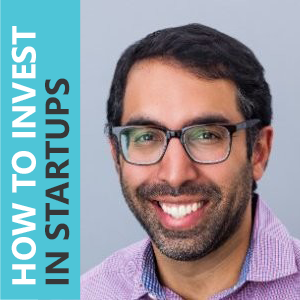
There is a rule in venture capital: if you want to seem exclusive, ignore most of what lands in your inbox. Paul Sethi ignores the rule. At 2048 Ventures, the fund he co-founded with Alex Iskold in December 2019, every pitch gets read. Every single one. In an industry where ghosting is not a flaw but a feature, that is a declaration of intent - and it has produced a Founder NPS of 100, a number so clean it looks like a typo until you realize the fund has backed more than 200 startups and earned its reputation dollar by dollar.
Sethi's path into venture runs through three distinct lives. First, he was a Wall Street analyst at a New York hedge fund, grinding small-cap tech, learning how to read companies from the outside. Then he was an operator: he took Redbooks, a sales intelligence platform spun out of LexisNexis in 2010, and ran it as CEO through a decade of scaling - product, team, technology - before selling it to a private equity firm for a return north of 10x. Between those lives, starting in 2006, he was quietly writing first checks. Before there were seed funds on every corner. Before "pre-seed" was even a category with a name.
"The best investments happen when you're willing to write the first check before there's a crowd."
- Paul SethiThe portfolio that came out of those 15+ years of angel investing reads like a greatest-hits album of the 2010s startup era: Flexport, before freight forwarding became a Silicon Valley obsession. SeatGeek, before ticketing got disrupted. Notion, before half the world's companies migrated their wikis. Eight of those angel bets reached unicorn status. Exits landed at Airbnb, Amazon, Facebook, Uber, Pinterest, Twitter, Blackstone, and Motorola. That track record did not just validate Sethi's instincts - it funded the credibility to raise $27 million for 2048's inaugural fund in 2019, then an oversubscribed $82 million for Fund III.
The name - 2048 - is not arbitrary. It nods to the puzzle game where every move doubles what you have. Sethi thinks in exponential time. The fund focuses on pre-seed and seed rounds, writing checks between $500K and $3M, with a sweet spot around $450K for personal investments. The geographic thesis bends toward New York and Boston, deeply embedded in the academic ecosystems of Harvard, MIT, Yale, NYU, and Cornell Tech - plus emerging hubs in Atlanta, Austin, Toronto, Nashville, and Pittsburgh. The sectors: vertical AI, deep tech, healthcare, biotech, enterprise SaaS, fintech, and the infrastructure companies with data moats that make competition structurally hard.
What He's Actually Looking For
Sethi does not invest in categories. He invests in founders with genuine technological differentiation - the kind where the moat is not a feature set but a dataset, a distribution edge, or a proprietary system that competitors would spend years trying to replicate. Vertical AI, as a thesis, is not trend-chasing for 2048 Ventures. It is the logical extension of a long-standing conviction: that the next generation of systems of record will be built by founders who understand a specific domain deeply and are using AI to eat it from the inside.
Vertical AI
Domain-specific intelligence layered into industry workflows - not horizontal tools, but vertical operators.
Deep Tech
Companies where the technology itself is the barrier - science-forward, defensible, and built to last decades.
Healthcare & Biotech
The largest market with the most friction. Sethi hunts founders who can navigate both the science and the system.
Enterprise SaaS
Systems of record and infrastructure with strong data moats - the unsexy infrastructure everyone needs.
FinTech
Financial services remain ripe for restructuring - from lending rails to treasury infrastructure.
Future of Work
How companies hire, train, retain, and operate as the nature of labor continues to shift.
Eight Unicorns Later
Before 2048 Ventures had a name or a fund, Sethi had already backed companies that would define entire categories. The early checks he wrote as an angel investor in Flexport - when cross-border logistics was still a fax machine problem - and in Notion - when the product was a blank canvas for people who found both Google Docs and Confluence equally frustrating - demonstrate a pattern: he arrives early, when the category does not yet exist, and he stays.
The 2048 Ventures portfolio - now exceeding 200 companies - spans companies that have been acquired by or partnered with Airbnb, Amazon, Blackstone, Facebook, Motorola, Pinterest, Twitter, and Uber. The notable current names include Delphia, Lendflow, Koffie Financial, ConverseNow, Mantl, Transfix, Customer.io, and Padlet. The consistent thread is not sector but stage: first check, when the risk is highest and the signal is thinnest. That is where Sethi has spent the better part of two decades building pattern recognition.
Side Venture
Sethi co-founded OpenFortune - an advertising platform that lives inside fortune cookies. Capital One, Coca-Cola, Disney, Grubhub, and Zelle signed on. If you think that's a gimmick, consider that it forced a brand new distribution channel into an object people have been opening since 1960.
He Built Companies Before He Backed Them
There is a specific kind of VC credibility that no amount of capital or connections can manufacture: the kind that comes from having been in the operational seat when things went sideways. Sethi has that. As CEO of Redbooks, the sales intelligence platform LexisNexis spun out in 2010, he ran the company through a full lifecycle - hiring, product development, go-to-market, and ultimately a sale to a private equity platform for a 10x+ return. That experience of scaling a business, managing a team through uncertainty, and engineering an exit at a multiple that would make most founders weep with relief shapes how he thinks about the founders he backs now.
He also co-founded Robuzz in 2014, an ML and NLP platform built for real-time alerts and structured data extraction - a bet on machine learning before it had a hype cycle. The company was exited in 2022. That timeline - start in 2014, exit in 2022 - is not a short-term trade. It is an eight-year operating commitment that overlaps with the founding of 2048 Ventures. Sethi carries multiple initiatives at once, the way founders do, not the way most investors can.
"Vertical AI isn't just a thesis - it's where the next generation of systems of record will be built."
- Paul Sethi, 2048 VenturesA Decision in 10 Business Days
Fundraising at the pre-seed stage is, for most founders, an extended exercise in managing ambiguity. Investors ghost. Timelines slip. A "we're interested" can mean anything from "we'll lead next week" to "we'll pass in six months." 2048 Ventures built something structurally different: a Pre-Seed Fast Track that commits to a decision - yes or no, with reasoning - within 10 business days for rounds between $500K and $1.5M. That is not a marketing claim. It is an operational commitment that reflects Sethi's own experience on the other side of the table, and it is one of the reasons Founder NPS sits at 100.
The firm is also embedded in the academic infrastructure of its target markets in a way that most coastal VCs aspire to but rarely achieve. Sethi serves as a Visiting Expert at the University of Pennsylvania Venture Lab, maintaining live relationships with the student and faculty entrepreneurs who come out of Penn, Wharton, and the broader Philadelphia corridor. The academic connections to Harvard, MIT, Yale, NYU, and Cornell Tech round out a sourcing engine that catches companies before they have their first term sheet, sometimes before they have their first ten customers.