Banks are very good at counting money. Comparing the precautions they take against losing it is a more awkward business. One institution describes a control one way, another uses different words, and somewhere inside the paperwork a useful comparison disappears. Paul Ford built a company around that problem. The interesting part was getting the banks to look beyond their own walls.
Acin, which Ford founded in 2018, turned descriptions of operational risks and controls into structured data that institutions could compare. By December 2022, five banks had joined its $24 million Series B: J.P. Morgan, Citi, BNP Paribas, Barclays and Lloyds Banking Group. Rivals had found something worth owning together. The subject was risk management, which rarely promises a lively evening. The arrangement was considerably more interesting than the label.
For Ford, the route there ran through the British Army, management consulting, bank operating roles and an earlier business of his own. He had spent years helping institutions function before asking whether their knowledge could be organised differently. That sequence gives his story its shape: first learn the machinery, then find the part everyone keeps rebuilding.
An officer learns the bank’s machinery
Ford began as an officer in the Royal Engineers. His next professional world was Accenture, where he worked on trading, clearing and settlement systems for capital markets. The move took him from military engineering into the detailed arrangements through which financial transactions get done. Both chapters sit well before the familiar founder photograph and the acquisition announcement.
He later held a director role at Dresdner Kleinwort Wasserstein, working on an electronic trading and post-trade processing platform. At Barclays Wealth he became chief operating officer of the ultra-high-net-worth business. At Credit Suisse he held a COO role in its Europe, Middle East and Africa division. These were jobs inside the institutions that would later become the audience for his company.
There is a particular education in being responsible for operations. The polished description of a business has to survive contact with its actual processes. Ford’s subsequent work concentrated on non-financial risk: the things that can go wrong in running an institution, and the controls intended to prevent or detect them. A bank’s accounts tell one story. Its working arrangements contain another.
In 2010, he founded Anchura Partners, an operational risk consultancy serving bank COOs. He grew that business before exiting in 2018 and founding Acin. The transition brought a different commercial question. A consultant can help one client work through a problem. A shared data platform can allow the next client to benefit from a body of knowledge already assembled.
A barcode for the things that go wrong
Ford’s explanation of Acin included an unexpectedly ordinary object: the barcode. The platform assigned Advanced Control Identification Numbers, or ACINs, to risks and controls. Identification made it possible to map descriptions, compare them and connect them with performance indicators. Before institutions could learn from one another, they needed a dependable way of recognising what they were talking about.
Think of two cupboards full of differently labelled files. Combining the cupboards merely gives you more files. A common classification lets you discover whether two documents describe the same precaution, whether something has been duplicated, or whether a safeguard is absent altogether. Acin applied that organising logic to a problem shared by financial institutions.
The comparison used anonymised peer data. A bank could examine its own inventory against the network and identify gaps or overlaps. Each additional participant could make the reference material more useful. The commercial challenge followed directly from the technical one: Ford needed institutions to see value in contributing to something beyond their own internal framework.
Different descriptions
Comparable controls
A wider view of risk
A conceptual explanation of Acin’s model, not a performance chart.
His ambition extended beyond neater inventories. He wanted a more data-led discipline and, over time, a stronger basis for decisions about the capital tied up against operational risk. That was an aim, rather than a claim that every bank’s capital requirements had already fallen. The immediate proposition was more tangible: make the existing knowledge usable and show an institution what its own view might miss.
Two years before the bigger yes
J.P. Morgan supplied a concrete test. The bank worked with Acin for two years in a subset of its trading businesses. In April 2021, it announced an expansion across Global Markets. The platform would provide benchmarking information alongside the bank’s established operational risk management practices. A narrow application had earned a wider hearing.
That timetable is useful context for Ford’s career. Selling into banking involves entering an organisation with its own systems, responsibilities and existing methods of checking work. A pilot gives the customer time to understand how an additional tool fits. The eventual announcement described another source of practical validation for J.P. Morgan’s risk framework, a measured reason to extend a relationship.
It also showed how the network proposition could develop. Wider use created more scope for comparison; a growing network could, in turn, offer a more useful reference point. Ford was building something that required both a product people could use and an agreement people would keep making. The software and the institutional relationships had to advance together.
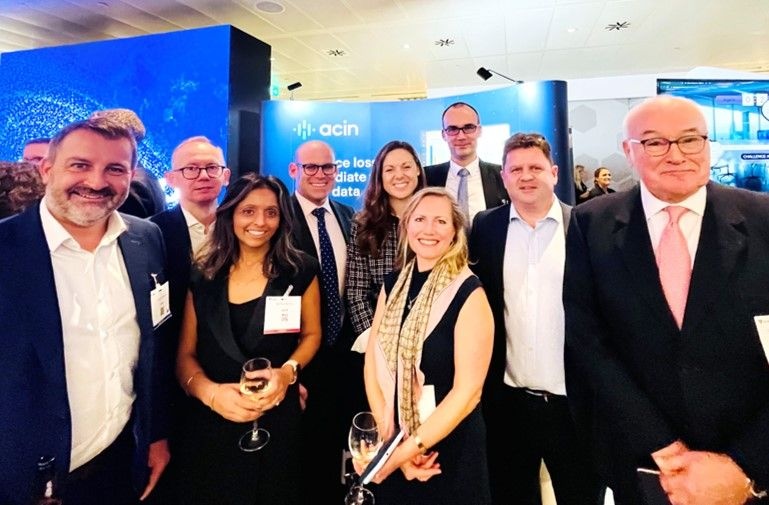
When the customers bought in
The funding story gives another view of how Ford worked. In September 2020, Notion Capital led a $12 million Series A. Ford explained that he wanted a partner with practical experience of growing a business selling software to other businesses. His company already understood its clients’ operational problems. Scaling the company required another kind of expertise.
Investor Stephen Chandler described him at the time as thoughtful and quietly spoken. The observation is a useful counterweight to the noisy conventions of founder mythology. Ford’s work involved winning confidence from people who understood the consequences of a control failure. The public account of his investor search put weight on experience, personal chemistry and help with the decisions ahead.
Then came the five-bank consortium in 2022, with existing investors also supporting the round. Those names represented more than a collection of logos for a presentation. They were institutions with direct interests in the subject Acin was addressing. Their participation connected the company’s financing with the industry it was asking to collaborate.
$24 million Series B · December 2022
The investment was intended to support product development with participating banks and existing clients, as well as expansion across financial services. In that arrangement, customers could help shape a resource they also used. Ford had assembled a business whose credibility depended partly on who was prepared to take part. Persuasion had become part of the infrastructure.
The thank-you note after the deal
CUBE announced its acquisition of Acin on June 19, 2025. The combination would connect regulatory intelligence with operational risk capabilities in its RegPlatform offering. Planned capabilities included mapping regulations to controls, tracing those connections through an institution and providing opt-in anonymised industry benchmarking. Ford’s shared reference point was entering a broader system.
His response to the announcement was revealingly social. He thanked the team, capital partners, board, advisers and others who had helped build the company. He returned to a phrase about Acin playing and winning as a team. And he joked that the journey had supplied enough stories for five seasons on Netflix. Compliance finally had a development slate.
“Acin plays and wins as a team”
Paul Ford, on the acquisition announcement
The joke gives a little texture to an otherwise formal milestone. So does the breadth of the thank-you. The public Ford is often explaining a platform, announcing a partnership or crediting colleagues. At the point when a founder might reasonably enjoy having his name in the headline, he made room for the people who had worked through the intervening years.
An exit with more work attached
There is a further clue in his participation in Collective Equity, which identifies him as a limited partner in its second fund. Ford’s public explanation of joining put value on diversification, an interest in businesses at a similar stage and contact with other entrepreneurs who had a stake in one another’s progress. The setting is different from a bank risk network, but the attraction of useful peers is familiar. Building a company can leave its founder with a very concentrated view of the world, financially and professionally. Ford had found another arrangement that made room for a broader one.
Ford’s subsequent roles kept him close to financial technology. In September 2025, Algbra announced him as an investor and strategic adviser, with a remit covering scaling strategy, risk management architecture and its technology roadmap. The company’s financial infrastructure work offered another setting for experience accumulated inside banks and while building Acin.
In May 2026, Muinmos announced that he had joined as an investor and adviser to its board. Ford pointed to its approach to data, founder Remonda Kirketerp-Møller’s leadership and the team he had met at its Denmark office. He described the work ahead in terms of execution and scaling. After the sale, the vocabulary remained practical.
Acin now lists him as founder and adviser. The operating job has changed; the accumulated experience has found other places to go. Ford’s career has moved from maintaining systems to advising institutions, from consulting to software, and from building a company to helping other founders. Along the way, a simple question kept acquiring new uses: what can you see when you stop relying entirely on your own view?