The internet has a new customer, and it is a poor guest at the party. It does not admire the layout, linger over a headline or click the advertisement beside it. It asks for a fact, takes what it needs and goes back to work. Parallel Web Systems was built for this visitor: the AI agent that needs a live answer from the web, often in the middle of another task.
That sounds like a search business, which it is. But the more interesting part is what happens after the search. A useful answer may depend on a publisher, a government record, a company website and a data provider. The agent's user may see a sentence with a citation. The sites that supplied it may never see a visit. Parallel now sells the lookup and, through a product called Index, proposes to account for the value of the material behind it.
In a minute
- Parallel provides APIs that let software search, extract, research and monitor the live web.
- Customers include agent builders in sales, legal work, real estate and enterprise software.
- Its published Search API starts at $0.001 per request for a ten-result query; deeper research costs more.
- Index gives participating content owners a way to see and be paid for contribution to agent work.
First, make the web callable
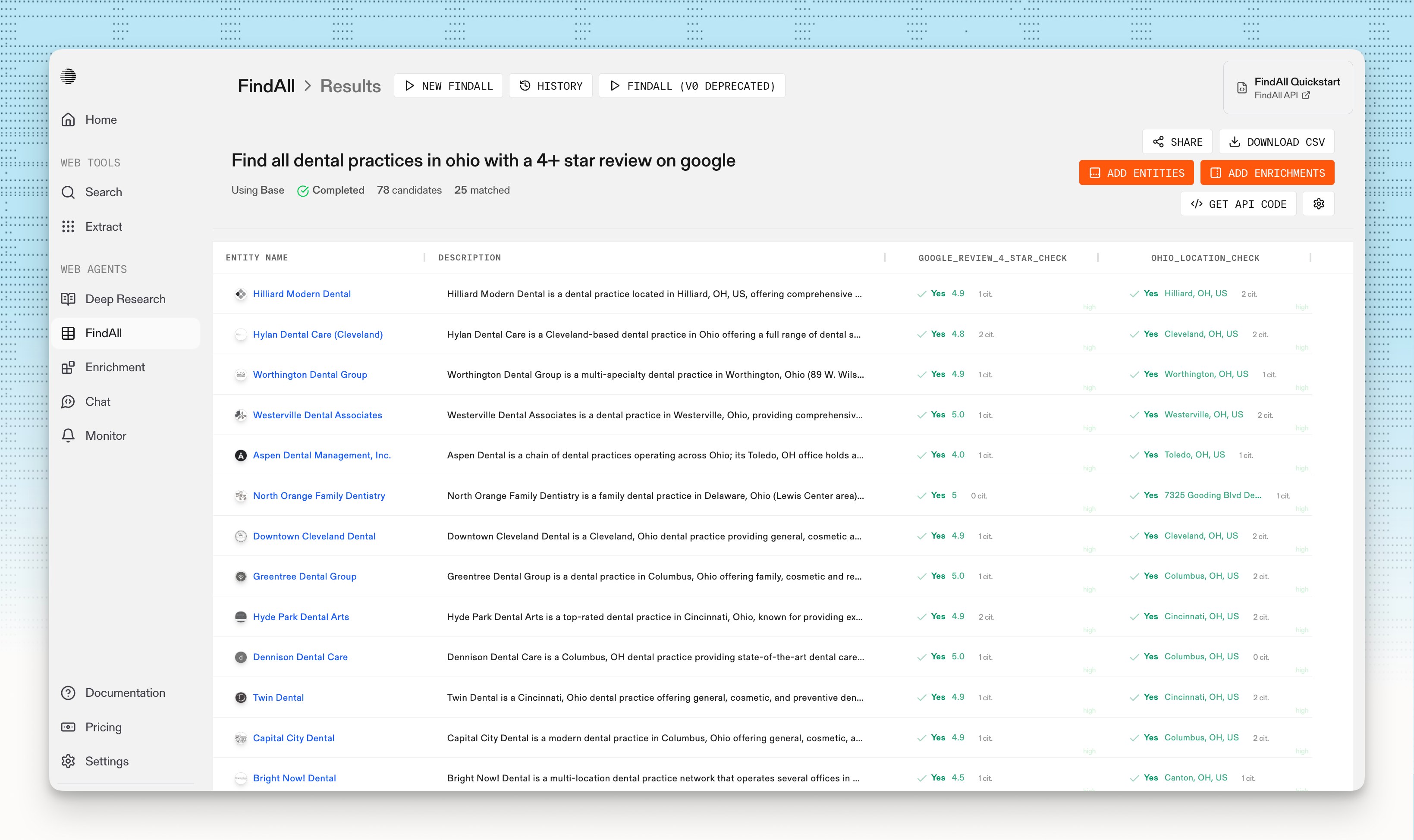
A person looking up a company's latest funding can type, scan, open five tabs and decide which source to trust. Software needs that sequence reduced to dependable steps. Parallel's Search API returns ranked URLs and compact excerpts. Extract retrieves content from pages and PDFs. Task takes an objective and can return structured, cited research. FindAll builds lists of entities matching a description. Monitor watches for new events and pushes them into a workflow.
The distinction between these products is practical. If an agent needs a current executive name, it may only need search. If it must decide whether a property has a homeowners association, identify the management company and check county records, it needs a longer investigation. If a company wants to know when a regulatory filing changes, repeated searches are clumsy; Monitor can send an event. Parallel can do these jobs because it maintains its own index of billions of pages and adds or updates millions daily, according to the company.
The workflow is illustrative. Developers can use one API or combine several, depending on the question.
The bill is part of the product
The first thing an agent company learns about web access is that a tiny cost can become a large one when software asks repeatedly. Parallel publishes request prices, with basic Search starting at a tenth of a cent per request and more demanding tools priced by tier. That makes a web lookup an explicit line item. A team can choose a quick search for a small question and reserve deeper Task runs for questions worth the wait and expense.
Nooks, which builds AI tools for sales teams, gives a useful example. Its agents need fresh details about prospects: current leadership, recent news, certifications and other facts that a static sales database may miss. Nooks says it tested providers on the questions its agents actually received, switched from built-in LLM web search to Parallel Search and cut web grounding spend by 70.5%. That is a customer-reported result, not a universal discount. The lesson is a method: measure accuracy and cost on production questions before changing the search layer.
Opendoor's use is less glamorous and more revealing. In a real estate transaction, the question of whether a home belongs to an HOA is mundane until the answer is wrong. Opendoor says Parallel's Task API changed a roughly ten-minute manual research step into about two minutes of verification. The human did not disappear; the work changed from finding the evidence to checking the result. That is the sort of bounded task in which an agent can be useful without pretending to be an oracle.
“We evaluated multiple providers on questions our agents actually get asked.”Etienne Denis, ML engineer at Nooks
The first bottleneck is often the source
Starbridge sells intelligence to companies pursuing public-sector contracts. Its raw material can live in board minutes, budgets, procurement pages and awkward government websites. In its Parallel case study, Starbridge says other providers struggled with those sites. It integrated the Task API into production within days, then built its own analytics on top. That is a sharper account of differentiation than a leaderboard: the right source may be difficult to crawl, and the customer's useful product still requires its own domain logic.
Parallel occupies a crowded layer. Developers can choose Exa, Tavily, Perplexity, a model provider's built-in web search or a home-built crawler and retrieval system. Parallel's claim is that its own index, retrieval and reasoning stack can serve both quick interactive searches and slow, more exhaustive research. Its Task output includes a “Basis” with citations, rationale and confidence information. Those features help a reviewer inspect an answer; they do not exempt anyone from checking a consequential claim.
The company was founded in 2023 by Parag Agrawal, Twitter's former CEO. He and the team frame the work as infrastructure for the web's “second user.” The founding group says it brings experience from Twitter, Google, Stripe, Airbnb, Chime, Waymo and Kitty Hawk. In April 2026, Sequoia led a $100 million Series B at a reported $2 billion valuation, bringing total funding to $230 million. Those numbers buy time to build an index and distribution; they do not by themselves prove that every search will be good.

Then comes the person who wrote the page
Search economics used to be straightforward enough for a publisher to explain over lunch: allow indexing, get a result listing, hope for a visit. Agents strain that bargain. An agent can read an article and return a useful answer while sending no reader back. Parallel's Index, launched in May 2026, lets site owners inspect how its agents use their domains and invites content partners into a compensation program. Launch partners include The Atlantic, Fortune Media, PR Newswire, PitchBook, Enigma and independent publishers.
The proposed calculation is unusual. Parallel says it estimates a source's marginal contribution to the value of an agent's task rather than paying merely for crawl access. In theory, the obscure document that settles a question ought to matter more than the fifth page repeating it. In practice, estimating that contribution is hard, and Index initially applies to agents using Parallel's own infrastructure. It is an experiment with a commercial incentive on both sides: agents need reliable material; owners need a reason to make it available.
This also explains why Parallel publishes information about its bots. ShapBot crawls for the index; Shap-User identifies user-initiated access. Site owners can use robots.txt to manage ShapBot. A named crawler, a payment program and a source-aware answer all point to the same issue: an open web cannot be treated as an invisible warehouse forever.
A method worth borrowing
A team building an agent can copy the discipline without buying Parallel. Start with one repetitive question that has an identifiable source and a human reviewer. Collect real examples, including the messy failures. Price every lookup and every deeper investigation. Compare providers on the actual questions, not a glossy benchmark. Keep citations attached to the answer, and decide in advance which claims require a person to verify them.
This approach is less attractive when the answer lives only inside private systems, when source rights are unclear, or when a wrong answer is too costly to catch later. Web search will also miss facts that are unpublished, stale or blocked. Parallel is strongest where fresh public information matters, questions repeat at scale and a product can turn cited results into a useful action. The company has made that workflow cheap enough to try. Its larger test is whether the web's first customer - the person who created the information - will find the bargain fair.