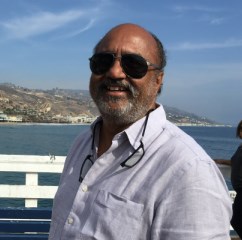
Par Chadha once bought a pair of glasses for about $40 and seemed more delighted with them than many founders sound about a financing round. They rested around his neck and joined magnetically over his nose. A small nuisance had acquired a small, working solution. For an investor whose interests range across automation and enterprise software, the enthusiasm was telling. Technology had passed the useful test: it made something easier.
Chadha is the founder, chief executive and chief investment officer of HandsOn Global Management, the family office he established in 2001. The name is an instruction. Yet his story begins before investment committees and corporate boards, with software design and a basement shared with his wife, Sharon. The distance between those settings is considerable. The question running through them is surprisingly consistent.
Before the portfolio, a basement
He trained in electrical engineering at Punjab Engineering College in India and began his working life writing computer operating systems. He has described building single-chip PCs with Sharon in their basement, then pursuing acquisitions of neglected technology operations inside larger enterprises. Voice, video and data transmission were among the opportunities that caught his attention.
This is a useful starting point for understanding the investor. He had worked on the machinery before he started buying businesses built around it. His technical interests included optical networks, communications and systems on silicon. Those are foundations on which other products depend, often without their users ever thinking about them. There is little ceremony in a connection that simply works. The ceremony tends to arrive when it fails.
By 2001, Chadha was pursuing a different consequence of cheaper, faster communication. Work could move across borders; automation might change how much of that work needed moving at all. He called the approach reverse migration. That early proposition gave his investing an operating question: how could technology change the economics of a process?
The acquisition has an afterlife
The formal milestones show a career spent inside combinations of businesses. Chadha chaired Lason from 2007 to 2011, then SourceHOV from 2011 until July 2017. He became Exela’s chairman when the business combination closed in 2017 and its executive chairman in September 2021. He also co-founded the AI automation company Rule14 in 2011.
A deal announcement can make an acquisition look like a moment. Chadha’s sequence of roles points to the years that follow: separate operations must become a functioning business, technologies must connect, and somebody must remain accountable after the signatures dry. His engineering background gives that part of the story a particular texture. Buying a system and making it behave are different stages of the same undertaking.
The current organizational map stretches further. He chairs XBP Global Holdings and HGM Limited, and his corporate biography lists the chairmanship of HGM’s regional headquarters in Saudi Arabia. HGM’s own people page describes him as managing partner for special situations. That phrase covers terrain where neat investment theories meet businesses with problems already attached.
A global business, with the complications included
In July 2025, XBP Europe completed its acquisition of Exela Technologies BPA and became XBP Global. The transaction joined operations across regions; the announcement described approximately 11,000 employees in 19 countries. The acquired business and certain affiliates emerged from Chapter 11 proceedings on July 29, the same day the acquisition closed. Bankruptcy and reorganization are part of this chapter of Chadha’s corporate career.
The subsequent results resist a tidy victory lap. For 2025, XBP Global reported $791 million in revenue, down 9.4%. Its combined pro forma revenue was $879.6 million, down 13.6%. The two figures measure different views of a business changed by an acquisition, so they should be read on their own terms. The company described its priority as stabilizing the acquired portfolio and preparing for renewed growth.
These figures give weight to the word hands-on. A chairman’s career can contain ambitious technology plans and declining revenues at the same time. Operating improvement has to show up in the business eventually. That makes the distance between a promising tool and a durable result central to this story.
The permission to disagree
Chadha’s writing about automation repeatedly returns to the employee closest to the task. In 2024, he argued that allowing staff to disagree helps expose the processes worth changing. An executive can approve a new system while knowing less about its daily irritations than the person who uses it eight hours a day.
He offered electronic signatures as a practical example: removing the print, sign and scan routine made document handling easier. The example has the modest appeal of his magnetic glasses. No fireworks are required when a recurring chore disappears. Such changes also help explain why he writes about small businesses alongside large corporate platforms. Their problems can be expensive even when their software budgets are small.
His advice allows for an awkward transition. Existing systems may need upgrades or retirement, and productivity can dip while people learn the replacement. A workforce has to come along with the change. Otherwise a technically successful installation can leave behind a room full of people inventing ways around it.
“People are the company’s soul.”
Par Chadha, on adopting automation
A boss who fills the gaps
Chadha describes his leadership in terms of service. He has said that he once associated leading with having the answers, then came to see the job as helping colleagues handle what they could not resolve themselves. In his telling, the change came from watching a team repeatedly struggle with the same problems and choosing to work alongside them.
That is his account of how he wants to lead. It places some limits on the romance of the all-knowing founder: a capable team needs space, and the executive’s presence should help it make progress. The useful test is whether assistance leaves people more able to do the next task themselves.
His writing on workplace culture adds another wrinkle. In February 2025, he questioned perks and organized fun that lack a connection to meaningful work. It is an amusing position for someone whose business concerns include engagement and productivity. A compulsory good time can become one more assignment. The office calendar already has enough of those.
The suitcase has its own operating system
The international scope has a less formal history, too. Chadha recalls taking his first flight in 1977, an international journey lasting 23 hours. By 2023, he was writing from experience traveling to more than 30 countries. One trip to Prague just before Christmas delivered him without his luggage. He bought a winter hat and made do with the rest.
Repeated lost bags eventually prompted him and Sharon to rethink their traveling wardrobe around layers and compact clothing suited to different conditions. The airport had supplied a process failure; they altered the process. It is tempting to treat that as a business metaphor, but it also sounds like two travelers who had become thoroughly tired of waiting at baggage claim.
His travel advice favors preparation, an organized carry-on and patience when communicating across languages. There is affection for gadgets here, but also a recognition that knowing the place matters. International business, in these accounts, includes the unglamorous work of getting there with something suitable to wear.
Cash gets a vote
Alongside the enthusiasm for new tools sits a decidedly conventional concern: cash. In January 2023, Chadha wrote about keeping liquid reserves, studying transactions carefully and preserving the ability to act during uncertainty. His argument joined two uses of money that are sometimes discussed separately: surviving a difficult period and being able to buy when an opportunity appears.
That concern belongs in a profile of an automation investor. Technology projects consume capital before their benefits become dependable. A business still has immediate obligations while its next system is being built. The vocabulary may be futuristic, but the bills retain their familiar habit of arriving on schedule.
His 2024 prescription for digital transformation was similarly methodical: assess the existing business, build a roadmap with measurable objectives, and keep reviewing progress. The emphasis is revealing. He wants a way to determine whether change is working, rather than treating the purchase of technology as the completion of the job.
Who owns the map?
In 2026, his attention turned to the rules around AI agents. A January essay argued that leaders must decide boundaries and stopping conditions before systems begin acting at speed. Waiting to intervene afterward may leave little room to correct the result. His position makes the design of an automated decision a management responsibility.
A May essay took up a related question: who controls the operating map of an enterprise as agents connect its applications? Chadha urged executives to understand their workflows and retain a usable view of systems, people, costs and outcomes. A vendor’s platform can be useful while creating dependencies that deserve scrutiny.
- Map the workUnderstand the process.
- Set the limitsDecide where people intervene.
- Measure the resultKeep a view of costs and outcomes.
His March discussion of cybersecurity brought human review into the picture again, this time in considering agents used for both attacks and defense. Across these essays, greater machine independence makes the placement of human judgment more consequential. The operating system now includes questions about authority.
By August 2026, Chadha was describing automation through an illustrative capacity calculation: an employee processing 100 transactions might handle 250 with better tools. He presented it as an example of how capacity can grow, rather than a measured result across his portfolio. He still wanted to know whether the investment could become a business.
The basement PCs, the combined companies and the AI essays belong to different periods. Each places him near a junction where technology must work for somebody else. There is a great deal of money and complexity around that junction now. The $40 glasses remain a rather good reminder of the original standard.