In 2007, Panchalee Thakur wrote a minister’s keynote with the right facts and the wrong voice. An industry association had asked her to draw on a report, explain the sector’s growth and sketch its prospects in India. The minister’s staff liked the substance. They had a more awkward objection: their minister would not sound like this.
Today, a speechwriter might begin with a video search. Thakur recalled finding no online videos from which to learn his delivery. Instead, she spent the next couple of days talking to his staff, adjusting the tone and style. The research had to extend beyond the report to the person who would stand at the microphone. A speech could be accurate and still fit its speaker rather badly, rather like borrowed evening clothes.
She returned to that episode in a 2019 essay about speechwriting. Its lesson has a practical intimacy: before writing for somebody, learn how they think and speak. That attention to the individual runs through her work as the founder, CEO and managing partner of Purple Iris Communications. Her business depends on helping other people put their ideas into words they can recognise.
A byline before the business
Thakur’s early newspaper work makes for an unexpectedly varied reading list. In January 2003, her Times of India byline appeared on a story about Bharatanatyam dancer Nandini Alva returning to the stage after a long absence. The subject was an artist facing a public comeback, with all the nerves and anticipation that implies. It required an ear for the person inside the announcement.
Later that year, she interviewed Karnataka’s director of census operations about new census parameters. Here the material was domestic life rendered as categories: the condition of houses, the composition of families, rooms, kitchens, gadgets and vehicles. The questions helped unpack what those measurements were intended to reveal. The distance between dance and demographic enumeration is considerable; a city reporter can cover it in a working week.
In March 2004, she reported on Bangalore’s proposed tree census. Her article set the forest department’s assessment beside the objections of a former forest official who wanted a more exhaustive count. The story had trees, satellite mapping and a disagreement over method. Even greenery, it turned out, required follow-up questions.
Those published pieces give her later career a useful context. Before writing about how organisations should communicate, she was asking people to explain what they were doing. The questions changed with the assignment. The obligation to make an unfamiliar subject understandable remained.
2003Census
2003Urban trees
2004
Three early Times of India assignments, three different ways into a city’s life.
The airport that changed the assignment
In 2009, an introduction from a former colleague brought Thakur to the Project Management Institute. His team had an assignment to manage PMI India’s website and launch a newsletter; he asked her to lead the editorial work. She later admitted that she had not heard of PMI or project management.
The first briefing made the discipline sound deceptively straightforward. Define the scope. Plan the work. Talk to the people involved. Track progress. An assignment about the newly inaugurated Bangalore International Airport soon complicated that impression. She began to understand the interplay between systems and human judgment, between a project’s documented processes and the people making it happen.
By her September 2025 account, the relationship had encompassed 89 editions, 13 national conferences and many conversations with practitioners. She joked that certification might still be some way off. The published record supplies its own markers: Manage India credited her as project editor in 2009 and 2010, again in 2019, and Manage South Asia did so in October 2023. Her curiosity had acquired a substantial back catalogue.
From her September 2025 reflection on the engagement.
When the copy desk met the click
By November 2015, Thakur was writing about another professional adjustment: the headline’s migration from newspaper layout to search results. She remembered a newsroom standard built around accuracy, the central angle and the available space. Online, a headline also had to be found, measured and marketed.
She took the new requirements seriously while retaining an editor’s suspicion of tricks. For her own essay, she considered a title about the pleasure of getting a headline right, then a familiar tips-based approach, before choosing a combination of editorial meaning and searchable language. Adaptation involved making a choice, rather than surrendering the decision to a formula.
One detail gives the essay its human sting. Whenever she considered a question headline, she remembered her former chief sub-editor treating it as an easy escape. Years later, the copy desk could still interrupt her sentence. Her discussion of headline-rating tools was equally dry: the same proposed title could do well with one and struggle with another. An editor remained necessary, if only to referee the machines.
The reader should not need a decoder
Her 2016 essay on abbreviations pursued a smaller-looking problem with larger consequences. An insider saves a few keystrokes. A reader spends time working out what they mean, perhaps hesitating to ask for fear of appearing uninformed. Efficiency has simply changed hands, and the recipient is paying.
Thakur’s prescription was plain: “Abbreviate if you must, not because you can.” She considered how a familiar set of initials could mean different things in different settings, and recommended accessible style guidance to help organisations make consistent decisions. The concern was the reader’s experience, including the small embarrassment of not understanding what everyone else seems to know.
“Abbreviate if you must, not because you can.”
Panchalee Thakur, 2016
In 2019, she applied a similar eye to capital letters. A company’s excitement about its own work, she argued, does not make arbitrary capitals useful to everybody else. Her proposed remedy again included a style guide. There is something quietly amusing about a business celebrating its importance with the shift key while an editor stands nearby, asking whether the sentence actually needs it.
Ideas have to travel properly
The same attention to the audience appears in her account of adapting a client’s global content for a regional campaign. Material could contain useful insights and still feel distant because its examples were American and its data too broad for the intended Asian readership.
Her team looked for regional challenges, local evidence and examples that would make the material matter where it was being read. She connected this to the journalistic importance of proximity. Changing the format also required editorial work: an interview’s useful insight might be buried, while a straightforward report might need further research before becoming an executive commentary. Reuse demanded thought, rather than a new heading pasted above the old paragraphs.
That is a revealing description of her craft. The facts are raw material; their arrangement depends on a particular reader, purpose and place. An idea can travel a long way, provided someone takes the trouble to help it arrive.
A company with more than one voice
Purple Iris dates its founding to 2011. Its work now covers executive thought leadership, marketing material, personal branding and employee communications. Thakur’s professional experience spans India, Singapore and the United States; she is based in Santa Clara, California, and the agency’s team works across the US and India.
The roster reflects several kinds of editorial expertise. Ishan Kaushik leads the finance practice. Anupma Mishra specialises in employee communications, Ashita Mandanna in marketing communications, and other writers focus on technology thought leadership and business writing. Thakur has built a company in which the assignment can draw on more than the founder’s own range.
For agency partners, Purple Iris describes a process that includes matching a writer to the work, calibrating voice and reviewing drafts for accuracy, substance and language. It also describes using AI for research and initial analysis, with people responsible for shaping and checking the result. The minister’s speech offers an older, rather memorable example of why those judgment calls matter.
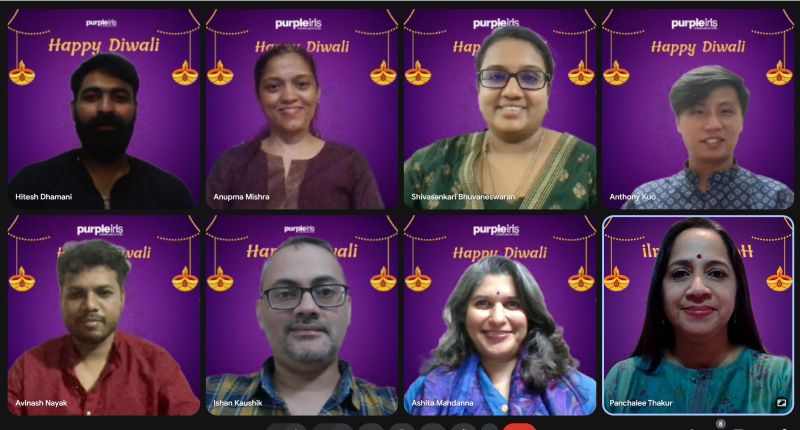
The team also makes room for conversation without a client brief. In an October 2025 Diwali post, Thakur described a virtual celebratory meal that was early morning for her. Colleagues traded festival customs, favourite desserts and film recommendations, then ventured into theories about reincarnation and the afterlife. A distributed workplace had found a fairly ambitious substitute for water-cooler chat.
Leaving room for the thinking
Running the agency creates its own competition for attention. In a December 2025 reflection, Thakur described days filled with email, copy reviews and feedback. Work moved forward, yet the ideas that needed sustained thought could struggle for space. She was experimenting with protecting afternoon time, reading and letting fragments of notes accumulate until connections appeared.
Her approach to the phone was pleasingly individual. Putting it in another room increased her urge to check it. She preferred keeping it nearby and deciding which interruptions deserved a response. The habit remained a work in progress. For someone whose work involves making other people sound assured, she was willing to describe her own method while it was still under construction.
On October 22, 2026, she published an essay about planning content before a B2B website refresh. She urged businesses to audit what had changed in their offering, audience and buying journey, then decide what to keep, rewrite, combine, create or remove. Design and content decisions should develop together.
The subject has moved a long way from a minister’s keynote. The underlying question is familiar: what does this particular speaker need to say, and how will somebody else understand it? Thakur keeps returning to the work before the polished sentence. Sometimes it takes a conversation with a minister’s staff. Sometimes it takes an afternoon with untidy notes. The finished words arrive with rather more company than they appear to have.