The most revealing thing Justin Nassiri has written about Executive Presence is also the least useful line in an ordinary sales brochure: “I run a company where discretion is the product.” This presents a small commercial puzzle. Agencies are trained to collect praise. They frame the testimonial, polish the case study, and march a happy client onto a webinar. Nassiri's best clients may never say his company's name. If an executive's post sounds ghostwritten, the ghostwriter has failed. If it works, the client receives the applause and the machinery remains backstage.
Executive Presence has made a business of that vanishing act. Founded in Denver in 2022, the company runs a fully managed LinkedIn operation for growth-stage B2B CEOs and senior leaders. It supplies strategy, interviews, writing, newsletters, comments, publishing support, and analysis. The customer is not the aspiring influencer with a ring light. It is the executive who has accumulated judgment but not a habit of broadcasting it - the software CEO in a fundraise, the search executive hunting for clients, the healthcare leader trying to recruit in a tight market.
“The best ghostwriting disappears entirely into the client's voice.”Justin M. Nassiri, founder and CEO
The monthly hour that feeds the machine
Each engagement begins with diagnosis. What does the leader believe? Which experiences earned those beliefs? What does the company need to be known for? The team sorts the answers into content pillars and revisits them roughly every 90 days. Then comes the wonderfully low-tech center of the system: a recorded interview, typically one hour each month.
The interview matters because executives are usually poor archivists of their own useful stories. The sales call that changed a product decision feels like Tuesday. The hiring mistake that cost six months feels embarrassing. A skilled interviewer hears both as evidence. Executive Presence's engagement managers are meant to “pitch and catch” with senior operators; its writers then turn the conversation into posts, newsletters, comments, and outreach messages without polishing away the odd detail that makes a voice recognizable.
This is the part another company can copy without hiring anyone. Schedule one hour. Ask about decisions, surprises, disagreements, and mistakes - not “What should we post?” Choose a few durable themes. Publish the clearest ideas. At the end of the month, compare what the executive wanted to say with what readers actually noticed. The discipline is not volume. It is creating a repeatable route from experience to evidence.
The post is a probe
A conventional ghostwriter delivers words. Executive Presence tries to deliver a feedback loop. A post about hiring may attract candidates. A contrarian view of a product category may bring a buyer into the comments. A personal account of a botched decision may travel farther than the funding announcement the CEO was eager to publish. Each response tells the company something about its market narrative.
That changes the meaning of LinkedIn analytics. Likes are visible; influence is often not. Nassiri tells the story of a prospect who read a CEO quietly for months, recommended the company to colleagues, and never clicked a reaction. The firm's answer is to combine platform numbers with questions in sales and recruiting conversations: Had you encountered our work before? Was there something that prompted the call? It is imperfect attribution, but it catches what a dashboard misses.
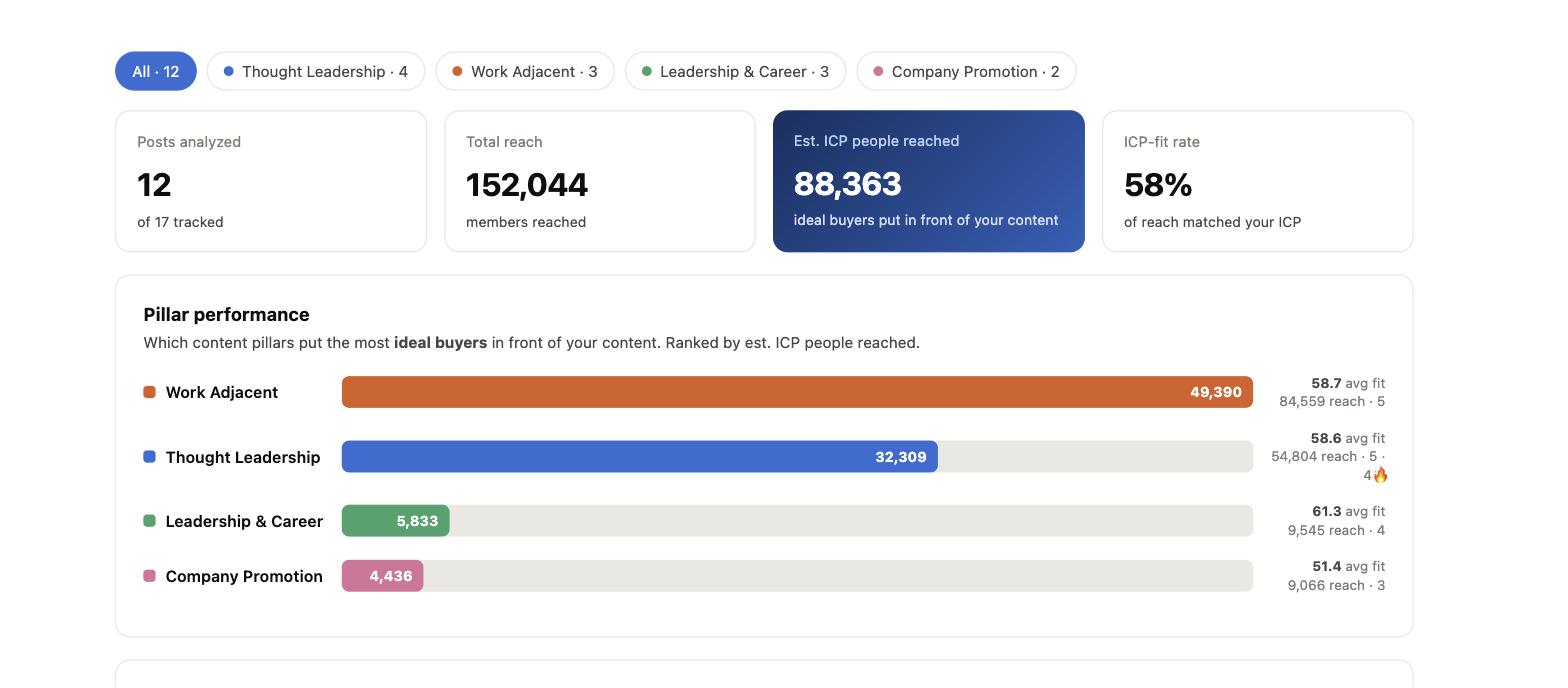
The company's published case studies report the kinds of numbers that make a marketer sit up: 15 percent of one consulting firm's revenue attributed to LinkedIn, $400,000 in new contracts for an executive-search leader, and an 811 percent rise in views for a business-consulting CEO over four months. An anonymous software CEO said a first post drew more than 500,000 views. These are selected client stories, not controlled experiments, and they should be read that way. Still, they make the firm's actual pitch plain: the point is not to become internet-famous. It is to alter who already knows you before the call begins.
The founder who dislikes the medium
Nassiri opens one podcast episode with a confession: “I hate social media.” It sounds like a joke from the owner of a LinkedIn agency, but it is closer to product research. He knows the sting of a thoughtful post landing in silence. He also knows the peculiar return: arriving at a Stanford reunion and finding that people already understand what he is building. Executive Presence is designed for leaders who share that discomfort, not for those who dream of spending the afternoon refreshing impressions.
His route to the company ran through the Naval Academy, service as a nuclear submarine officer, McKinsey, a Stanford MBA, and two earlier ventures, StoryBox and Captivate.ai. In an unusually candid interview, he described that decade as entrepreneurial failure despite raising money and selling companies. StoryBox had a contractor-heavy team. Nassiri believed interchangeable relationships would spare him from management. At Executive Presence, most of the team is full-time. He has said the later company is more direct, more externally focused, and more numerical.

The numbers have been friendly. Nassiri said the bootstrapped firm crossed $200,000 in monthly recurring revenue about two and a half years after launch. In 2025, he reported approximately $3.5 million in annual recurring revenue. In 2026, Executive Presence entered the Inc. 5000 at No. 1,451. The achievement is less mysterious when viewed as a recurring professional service: clients are not buying a single batch of copy; they are retaining a small editorial and research operation around one leader.
The company does not post package prices. The visible operational bargain is clearer: the executive supplies roughly one recorded hour each month, plus review and judgment; the agency supplies the ongoing team and system. Prospects receive pricing through a discovery call and proposal.
Where the bargain has limits
This model needs raw material. A leader with no distinct view, no willingness to discuss mistakes, or an approval process that converts every sentence into a press release will produce expensive beige. It also asks for patience. Trust compounds across repeated encounters, while a company demanding a clean last-click return from every post may quit before the quiet readers introduce themselves.
There is platform risk, too. LinkedIn controls distribution, formats, and the rules of engagement. Executive Presence has begun widening its language from posting toward discoverability - how an executive becomes visible and accurately understood by search engines and AI assistants. That move is sensible because LinkedIn is a channel, not a moat. The durable asset is the body of ideas attached to a person.
Nor will outsourced writing excuse an absent executive. The team can extract, shape, and measure judgment; it cannot manufacture the years that produced it. This is where the company's position has become more interesting in the era of fluent AI. Smooth prose is abundant. Scar tissue is not. Executive Presence is betting that the market will increasingly notice the difference.
A company built to leave no fingerprints
The obvious competitors are independent ghostwriters, PR firms, social agencies, and in-house communications teams. Executive Presence sits between them. It offers more operating structure than a lone writer, a more personal channel than corporate PR, and less demand on the CEO than an internal content habit. Its dedicated engagement managers, writers, and client-success staff turn one person's thinking into a small publishing system.
The paradox remains delicious. Executive Presence publishes case studies because it must prove that it works. Yet its premium promise is that nobody can tell it was there. The agency's own success is therefore easiest to see indirectly: in a CEO's familiar phrasing, in a candidate who arrives already persuaded, in the buyer who has been reading for eight months without leaving a single like.
A good post looks like the product. A better one behaves like a listening device. The best one does both while the people who made it quietly leave the room.