Somewhere inside a large company, an expense report is having a very good day. Its receipt looks ordinary. The merchant seems plausible. The amount sits just below a threshold that would invite a second look. In a manual audit, it may never get one. Oversight, an Atlanta software company founded in 2003, has spent more than two decades making that kind of transaction feel less lucky.
The company connects to the systems that already move corporate money - expense platforms, ERPs, card networks, purchasing programs and accounts-payable tools - then analyzes the activity for fraud, errors, duplicates, waste and policy violations. The crucial word is all. Traditional audit teams often sample because transaction volume outruns human capacity. Oversight's pitch is that software should inspect 100 percent, rank the risk and hand people a short list worth investigating.
The first thing that broke was the sample
Oversight's origin makes more sense when you remember the early 2000s corporate stack: big ERP installations, expanding card programs and an ocean of transaction records that few teams could interrogate continuously. Co-founder Patrick Taylor described the idea as continuous transaction analytics. By 2015, he was publicly calling it the “robot auditor,” a phrase that sounded theatrical then and almost conservative now.
The problem was never that companies had no controls. They had plenty: approval rules, merchant categories, thresholds, managers, quarterly reviews. What failed first was coverage. A control could stop the obvious transaction and still miss a repeated behavior spread across employees, vendors or systems. A random sample could be clean while the rest of the ledger misbehaved. In a Forrester study commissioned by Oversight, 60 percent of 207 finance and audit leaders said volume kept them from meaningfully auditing total company spend; 52 percent blamed reporting silos.
From messy spend to a decision
That sequence is Oversight's real product. The software is sold as a cloud platform with processing, intelligence and action layers. Around it sit specific applications for travel and expense, purchasing cards, procure-to-pay, vendor risk and compliance, plus professional and resolution services. It does not replace the expense system or ERP. It is the skeptical layer above them, asking why two people submitted the same receipt, why a vendor record changed before payment, or why several purchases landed just below an approval limit.
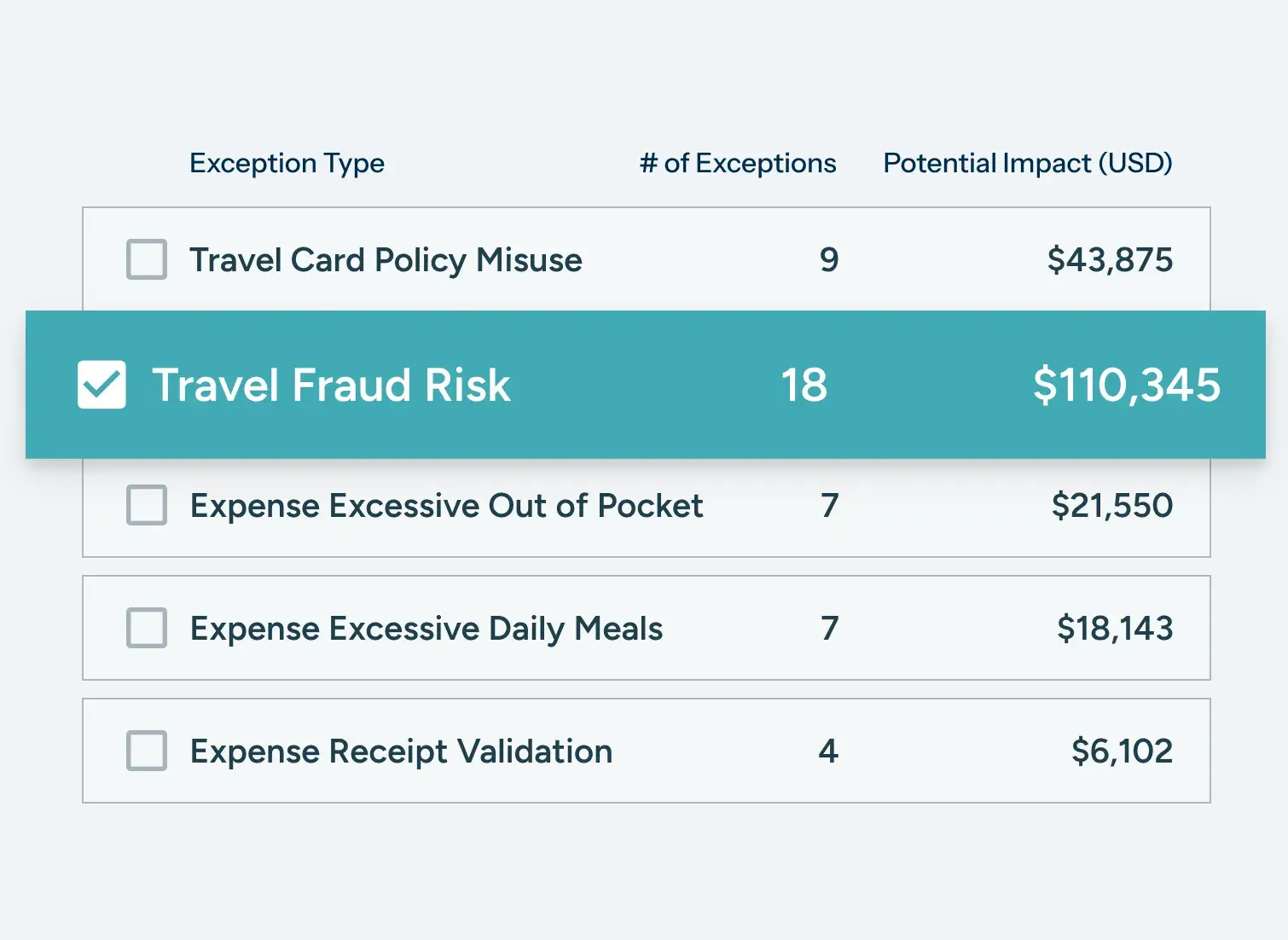
The buyer is not looking for prettier expenses
Oversight sells to finance, internal audit, accounts payable, procurement, shared-services and corporate-card leaders at large enterprises and government agencies. Named customers include Delta, Caterpillar, GE Appliances, Carrier, International Paper, Texas A&M, Autodesk and Southwest Airlines. These are organizations where a tiny error rate can still become a large dollar amount, and where evidence must survive auditors, regulators and occasionally a very unhappy CFO.
That explains the business model. This is private, custom-priced enterprise SaaS, typically reached through a demo rather than a checkout button. Integration and ongoing tuning matter because each buyer has its own policies, data quality, systems and tolerance for noise. Oversight also sells services around implementation and resolution. Its economic case is not seats occupied; it is leakage prevented or recovered, controls strengthened and reviewer hours returned.
“The ROI on this tool has been six and a half times what we paid for it.”Carolyn Hardee, Autodesk corporate card and expense management
Autodesk is a useful example because the before-and-after is legible. It used Concur across 40 countries but relied heavily on random spot checks. The card team worried about risky merchant categories and duplicate reimbursements. After adding Oversight's travel-and-expense and P-card monitoring, it was surprised by the duplicate mistakes the system found. The company did not publish the contract price, but Hardee supplied the ratio that procurement teams care about: 6.5 times the cost.
A small finding can change a big system
International Paper shows what changed a customer's mind. It began using Oversight for travel and expense in 2018. Finding duplicate submissions produced a tangible return, so the conversation moved to accounts payable. In 2020, it added payables monitoring and shifted from recovering money after errors toward preventing cash leakage. Oversight's case study reports $204,000 in T&E reimbursements saved and $62.2 million in duplicate AP payment preventions and recoveries.
Southwest Airlines offers the scale version. Oversight says it analyzed $590 million in T&E spend across 1.2 million transactions, uncovering $9.1 million in confirmed findings. The airline also used the communication workflow to engage 8,800 employees through 2022. That last number is important. A mature audit program is not simply a trap. It creates a record, asks for context and changes behavior before the next expense arrives.
These are company-published customer results, not a controlled comparison, and the bars above use separate illustrative scales. Still, they reveal the buying logic. The first win is often a duplicate or policy breach. The larger win is using the root cause to alter a workflow. One flooring company found 450 extra duplicate vendors after a recent manual cleanup and discovered split purchase orders designed to slip around ERP controls. The machine did not merely find an error; it showed where the process had learned to misbehave.
Fake receipts got AI. So did the auditors.
The newest chapter is a tidy little arms race. Generative tools can manufacture convincing receipts, while classic optical character recognition mostly reads what a document says. Oversight's Receipt Analytics looks at metadata, context, itemization, duplicates and policy. The company says the product can detect fake, altered and AI-generated receipts with more than 90 percent accuracy and reduce false positives by 80 percent compared with OCR-based approaches. It supports more than 80 languages, because expense fraud travels.
In 2026, Oversight widened the frame again. Vendor Statement Reconciliation targets the monotonous work of matching supplier records and finding missing credits or duplicate payments. A cloud architecture built on AWS and Databricks supports high-volume model training and analysis. Then Oversight Actions pushed from detection toward policy-bound resolution, with both human-assisted and autonomous workflows. The ambition is no longer just “show me the risk.” It is “help me close it, with an audit trail.”
The moat is judgment, not the word “AI”
Plenty of software can flag an amount above a limit. Oversight's differentiation claim is that two decades of actioned, labeled audit data helps its models understand behaviors and explain why a risk matters. That is more defensible than attaching a chatbot to a dashboard. Finance teams need traceability: the receipt, policy, historical pattern and resolution should line up clearly enough for a reviewer to defend the decision.
Its market position is therefore adjacent to expense-management products such as SAP Concur, Emburse, Ramp and Brex, and against manual sampling, rule-based controls and outside recovery auditors. Oversight integrates with SAP, Oracle, major card networks and issuers; it is not asking the buyer to rip them out. The wedge is the gap between systems that process money and teams that must determine whether the movement was legitimate.
Start with one expensive, measurable failure mode. Connect the complete dataset, not a curated sample. Rank by risk so reviewers are not buried. Record the investigation and outcome. Then use confirmed findings to change policies, employee coaching or upstream controls. The feedback loop is more valuable than the first alert.
When the robot auditor should stay in the box
Continuous monitoring is not automatically sensible. It works best when transaction volume is high, systems are fragmented, losses are recoverable and a team exists to act on findings. A small company with one clean ledger and a few hundred predictable payments may spend more integrating and tuning an enterprise risk layer than it could reasonably recover. Bad source data can make sophisticated models confidently annoying. Weak governance can turn a prioritized queue into another neglected inbox.
The human part remains the condition of success. Someone must decide which risks matter, resolve exceptions, protect employees from opaque accusations and feed outcomes back into the system. Oversight's recent emphasis on explainability and policy-bound action acknowledges the issue. Autonomous resolution is useful only when the boundary is explicit and the evidence is durable.
After 23 years, Oversight is still selling the same basic reversal: do not let limited human attention determine how much of the ledger gets inspected. Let software cover the field, then reserve people for judgment. The modern twist is that the strange receipt may now have been made by a machine too. Finance, meet your new office drama: robot auditor versus robot lunch.