Consider the unlucky insurance broker whose client has three quotes and a meeting in an hour. The premiums are easy to find. The interesting parts are not. One quote changes a deductible. Another quietly narrows an endorsement. The third looks cheap until the broker notices what it leaves out. Somewhere between those pages and a defensible recommendation lies a small mountain of clerical work.
Outmarket AI, founded in 2023 by Vishal Sankhla and Anshu Jain, has chosen that mountain as its address. The San Francisco company builds software for insurance agencies and brokerages that reads their documents, compares their terms, checks their work and prepares materials for clients. It is an unusually specific ambition in a crowded AI market: help the person responsible for advice get to the consequential line in the policy.
The short version
- Outmarket serves commercial, personal lines and employee benefits teams at insurance agencies.
- Its tools compare quotes and policies, find coverage gaps, review loss runs and assemble proposals.
- The company reported more than 300 agencies and 10,000 users in September 2026.
- Its latest $34.5 million financing came four months after a $17 million Series A.
The costly space between documents
The ordinary work of a brokerage is less cinematic than the sales pitch suggests. A producer may need to compare different carrier quotes, verify that the issued policy matches what was sold, read a loss run, check a lease's insurance requirements and make a proposal the client can understand. These jobs are repetitive, but a careless result can carry real financial consequences. The fact that a task is tedious does not make it safe to skip.
Outmarket's workflow catalog begins with those jobs. A user uploads documents; the software extracts and normalizes their contents, highlights differences and prepares an output. In a quote comparison, that means lining up premiums, limits, deductibles and conditions that do not line up neatly on the original pages. In policy verification, it means asking whether the bound document agrees with the quote or application. In a coverage review, it means flagging gaps that a broker can then discuss with the client.
From carrier file to client conversation
The software shortens the middle steps; the decision still belongs to the insurance professional.
That last point is central to the product. Outmarket says data points in its output are linked to source documents. A broker looking at a surprising result can go back to the precise page instead of accepting a confident sentence from a chatbot. In an industry where the wording of an exclusion can matter more than the elegance of a summary, a citation is a working tool.
A stopwatch with a caveat
On its workflow page, Outmarket uses a tidy demonstration: a quote comparison that once took two hours can take roughly two minutes with its tool. That is a company claim, not a universal stopwatch. The size and quality of the documents, the carrier format and the review a broker requires will change the result. Yet the comparison explains why the product has found an audience. If an agency makes dozens of comparisons a week, even modest savings travel a long way.
Commercial Insurance Associates offers a more detailed example. In an Outmarket-published case study, its director of carrier relations, Kevin Hawkinson, estimated that his team saved 330 hours each week across new-business benchmarks, stewardship reviews, quote reviews and policy reviews. At an assumed $50 an hour, that works out to $858,000 a year. These are the customer's estimates presented by the vendor; they are useful as a map of where time went, not as a guaranteed return for the next agency.
Agency savings: Commercial Insurance Associates estimate. Platform figures: Outmarket announcement, September 2026.
“Outmarket pays for itself. We're more agile and growing faster.”Kevin Hawkinson, Commercial Insurance Associates
The proposal is where the work becomes visible
A client does not see the afternoon spent moving facts from carrier PDFs into a presentation. The client sees the proposal. Outmarket's Proposal Builder tries to make that last mile less laborious, producing a client-ready document from the comparison work already done. The company said in September that the tool now makes thousands of proposals each month. It is a telling metric: the software is being used to produce something the customer actually receives, not merely to answer questions inside a back office.
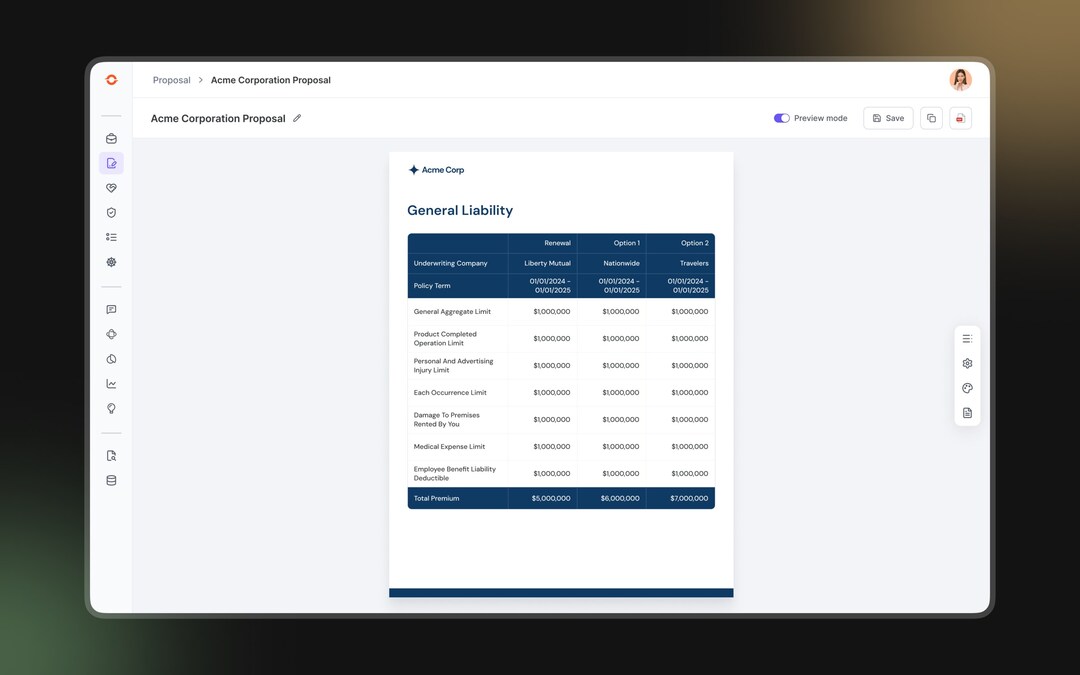
The product extends beyond commercial insurance. Personal lines tools inspect homeowners, auto, umbrella and flood policies. Benefits workflows compare health, dental, vision and other plans, model employer contributions and reconcile bills with employee census records. Loss-run analysis extracts claim details from carrier files. A newer data platform joins information inside agency management systems with information buried in documents, then offers dashboards and plain-language questions about the book of business.
There is an interesting progression here. The first sale may be a faster comparison. The larger sale is a connected set of workflows through the agency. Outmarket's custom workflow builder lets staff describe their own process in ordinary language, test it against real documents and route it through administrator review before sharing it. The agency's own rules become repeatable software. That is more durable than a clever answer to one prompt.
A company that raised twice in one season
The founders bring different parts of the wager. Outmarket describes Sankhla as a repeat founder and former head of product at Ethos, with leadership experience at Meta and Uber. Jain is its co-founder and chief technology officer. They started the company in 2023 and built from insurance document work toward a wider operating layer for agencies. Their September letter offers a plain reason for a surprisingly quick return to investors: agencies were adopting more workflows and expanding to more teams faster than the founders expected.


Outmarket announced a $17 million Series A in May 2026, led by Permanent Capital Ventures. On September 25 it announced a $34.5 million Series B, led by SignalFire, bringing disclosed funding to $56.2 million. The company reported more than 300 agencies and over 10,000 users at that point, including more than one quarter of the top 100 US brokers. Those numbers are company-reported, but they describe an unusually quick move from individual tasks to broader agency adoption.
Integration helps explain the ambition. Outmarket became a certified partner in Applied Systems' vendor program in August, connecting with Applied Epic. It also names connections to systems including AMS360, HawkSoft, ImageRight and Nexsure. The point is practical: an AI tool is more useful when it can work with the client and policy records the agency already maintains. Otherwise, a person must do the very copying the tool promised to remove.
What an agency can borrow
Outmarket sells to businesses through demonstrations; it does not publish a standard price. That makes a buyer's calculation local. Pick one high-volume workflow, count the documents and hours it consumes, and test whether the output survives a careful review by the people who carry the responsibility. The first thing likely to fail is not the flashy summary. It is an odd carrier form, a scanned endorsement or an exception that does not fit the default template. The useful question is how quickly a human can find and correct it.
The company itself appears to have learned from that friction. Its product emphasizes source-linked fields, workflows built around agency practice and connections to existing management systems. It says customer data is not used to train AI models and describes single-tenant architecture. These choices matter because brokers cannot afford a tool that is fast only when the document is easy and the agency is small.
There is no shortage of alternatives: a diligent employee with a spreadsheet, a general AI assistant, specialized document tools or features inside an agency management system. Outmarket's claim to a place among them is its range of insurance-specific tasks in one environment. The decisive test is less glamorous than a demo. Can a broker open a real renewal, spot the altered term, verify the page and explain it to the client before the meeting? For a business built around judgment, those are two minutes well spent.
Keep reading
Outmarket website · LinkedIn · Company blog · Series B announcement · Agency case study