A trucker delivers a load on Tuesday. The diesel was paid for on Monday. The driver, insurance company and repair shop do not care that the broker's invoice clock can run another 30 days. This is the awkward little canyon where Outgo built a company: between work completed and cash received.
Outgo is a Seattle financial-technology business for motor carriers, particularly owner-operators and small fleets. Its software handles broker setup, documents, invoicing, collections and accounting chores, then layers in non-recourse factoring, a bank account and a business debit card. In plain English, it behaves like an accounts-receivable department that fits in a phone - one that can also buy an invoice before the broker pays it.
The company was founded in 2021 by Marcus Womack, Mike Bohlander and Ray Fortna and launched publicly in March 2022. Womack had led products at Uber; Bohlander and Fortna had been principal engineers at freight marketplace Convoy. The trio had history. They first worked together at social-music service iLike, then co-founded the family-photo app Familiar. Outgo was less a meet-cute than a reunion tour, except the new set list featured proofs of delivery.

The trick was not factoring faster. It was factoring less.
What exactly did they do?Traditional factoring is blunt. A carrier sells an invoice to a factor, receives most or all of the money quickly, and pays a percentage fee. That can solve the timing problem, but it may finance more cash than the carrier needs. Money lands in an account, starts costing money, and waits there for the next fuel stop.
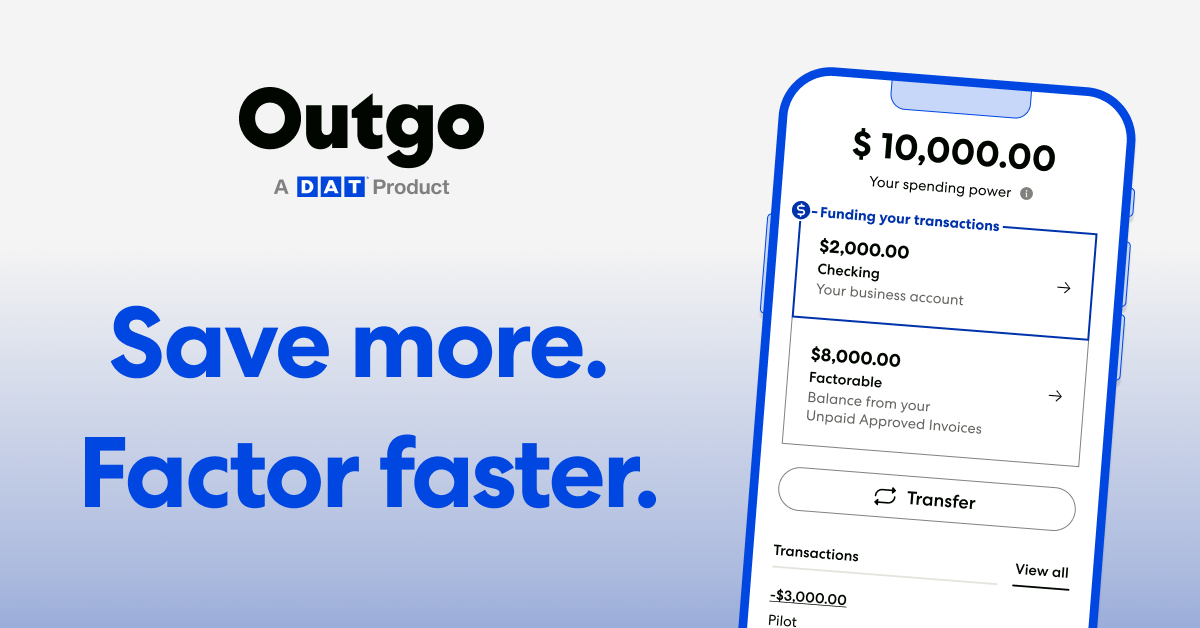
Outgo's sharper idea is “spending power.” The app combines cash already in a business account with the eligible value of approved unpaid invoices. The carrier can see the whole amount as available, but factoring happens on demand. Spend with the Outgo card or move money out, and the system selects an invoice to fund. Leave the capacity alone, and there is no reason to factor it immediately.
That changes the unit of the product. Outgo is not merely selling speed; it is selling control over when the meter starts. Card purchases can carry a 1% factoring rate. If the carrier waits until day 30, the rate can also fall to 1%. Outgo says its software chooses which invoice to factor to find savings. The delightful contradiction is that a company advertising rapid payment rewards customers who can wait.
What it costs, without the brochure fog
Outgo publishes rate tiers. Owner-operators invoicing less than $18,000 per month have a listed maximum factoring rate of 3%. Fleets between $18,000 and $80,000 are listed at 2.5%. Higher volume receives custom pricing. Qualifying Outgo card purchases and invoices held until day 30 can reach 1%. ACH transfers are free; a wire is $20; an instant transfer costs 1% with a $20 cap. An out-of-network ATM withdrawal is $2.50 and an international card transaction is 1%.
The contract design is part of the pitch: no annual commitment, no reserve, no monthly minimum and 15 days' notice to cancel. The product is non-recourse for defined broker-credit failures, so the carrier is not supposed to buy back an invoice merely because an approved broker becomes insolvent. None of that means every invoice is instantly fundable. The broker must be approved; documents need to arrive on time; a first transaction with a broker or a rate-verification check can extend funding to two business days.
What failed first: freight's financial patchwork
Before Outgo, the part that had visibly failed was not finding loads. Digital freight marketplaces had poured software into matching trucks with work. Payment remained a scavenger hunt: broker portals, emailed PDFs, separate factoring contracts, cutoff times, bank transfers and collections calls. A small fleet could look technologically modern from the windshield and still run its receivables like a doctor's office in 1997.
Outgo's founders changed the frame. The opening was not “build another bank for small business.” It was “own the financial workflow after delivery.” The company's 2022 debut described a broad vertical-banking suite. By 2024, its public story had tightened around factoring speed, flexibility and fees. That narrowing was sensible. Banking made the product useful, but factoring supplied the urgent pain and the revenue event.
The very purpose of factoring is to get carriers paid faster, but the industry has failed to innovate on speed, flexibility, and customer experience.Marcus Womack, CEO and co-founder
The customers are the people least able to float a month of operating costs: owner-operators and small-to-midsize fleets. Outgo also offers payment and document automation for brokers, but the carrier remains the protagonist. The company does not disclose customer or revenue totals. It had about 30 employees when DAT Freight & Analytics acquired it in May 2025.
One fleet's math - and the asterisk beside it
Outgo's clearest customer example is Vanguard Transportation, an 11-truck California fleet. Owner Melvin Sandoval said his former factor charged 2.25% to 2.98%, used recourse terms and required early paperwork for same-day funding. Outgo bought out the contract, set a 1.5% base rate, and Sandoval used the debit card enough to report a 1.05% average rate.
The Vanguard switch, as reported by Outgo
This is a company-produced case study, not an audited industry sample. Outgo calculated the base-rate savings against the customer's former 2.25% rate and added Smart Factoring savings over roughly a year and a half. Still, the mechanism is legible: lower the contracted rate, avoid factoring unused cash, and move routine purchases to the card.
This is where Outgo differs from established factors such as Triumph, TAFS, TBS, OTR Solutions, RTS Financial and eCapital. Its argument is not that receivables finance is new. It is that the carrier should get public pricing, a modern interface, fewer lock-ins, quicker eligibility decisions and payment tools in the same account. Its other competition is doing nothing: waiting for standard broker pay or accepting a broker's own QuickPay fee.
Why DAT bought the shortcut
DAT operates North America's large truckload marketplace. It already sat at the moment a carrier chose work; Outgo sat at the moment that work became cash. The acquisition joins those two decisions. A blue checkmark in DAT One can now identify a load eligible for Outgo factoring. The marketplace gets a trust signal and a payment rail. The factor gets distribution at the exact moment its customer selects a receivable.
Terms were not disclosed. Before the sale, Outgo had announced $3.4 million in seed funding and $15 million in additional venture investment from firms including Gradient Ventures, Construct Capital, Neo, PSL Ventures and Bezos Expeditions. Upper90 also supplied a $50 million credit facility to purchase receivables. That facility matters: factoring software still needs a balance sheet behind the button.
DAT kept Outgo operating from Seattle as a distinct service, and Womack joined its executive team. The distribution effect was immediate. On a Freight 360 podcast, a DAT executive said Outgo broke its one-day application record 30 minutes after the acquisition announcement, then broke its monthly application record before that day ended. It is a tidy demonstration of what a niche product can do when placed inside a much larger workflow.
The part worth stealing
Outgo's five-line playbook
- Find a delay that forces customers to finance their own work.
- Bundle the documents, decision and money movement around it.
- Make price visible enough that customers can do the math.
- Charge when value is consumed, not merely when capacity appears.
- Plug into the marketplace where the underlying job begins.
A founder can copy the logic without touching trucking. Look for a vertical where small businesses complete a job, wait to collect and juggle software that never sees the whole transaction. The winning product may not be another dashboard. It may be a workflow that turns a verified claim into controlled liquidity.
Where it would not work
This model needs predictable invoices, creditworthy counterparties and enough data to underwrite both. It is a poor fit when work is disputed, documents are weak, brokers cannot be approved or margins cannot absorb even a 1% fee. A carrier with ample cash, cheap bank credit and an efficient back office may be better off waiting for free standard payment. A company that wants equipment loans or a merchant cash advance needs a different product.
The broader lesson has a condition too. Embedded finance looks elegant only when the software owns a real workflow and understands its risks. Otherwise it is borrowed money wearing a nice interface. Outgo had the freight documents, broker relationships, payment behavior and product context. DAT added the load marketplace. Together, they can connect finding work with getting paid. The value is not that the money moves faster in a demo. It is that a small carrier can choose when speed is worth buying.