There is a peculiar kind of weather in Albany. A clause arrives in a bill on Tuesday, a budget table shifts on Wednesday, and by Friday an organization that thought it was watching education policy discovers it also has a procurement problem. The forecast is rarely printed in one place. It lives in committee agendas, agency guidance, conversations, amendments and the practiced sense that one small change is about to matter.
Ostroff Associates sells a way to read that weather. Founded by Rick Ostroff in 1995, the firm sits at 150 State Street, a short walk from the Capitol, and works for a clientele broad enough to resemble an accidental census of New York. Its published roster has included Aetna, Airbnb, Binghamton University, BP America, KPMG, Regeneron, Siemens, disability-service organizations, agricultural groups, sports franchises and construction firms. In a 2019 interview, Diana Ostroff supplied the perfect detail: the firm represented both large corporate names and the state association for monument builders. “Everyone is represented in Albany by somebody,” she said.
The product is a moment of clarity
Calling the business “lobbying” is accurate in the way that calling a restaurant “cooking” is accurate. It names the visible act but misses the preparation. Ostroff works on legislation and regulation, but also on state and federal budgets, tax policy, public procurement, compliance, communications and the daily monitoring that tells a client whether anything changed overnight. Its staff builds legislative trackers, watches media coverage, summarizes hearings and prepares issue briefs. The meeting with a decision-maker is one frame in a much longer film.
This solves a simple problem with expensive consequences: public institutions speak in processes, while clients think in outcomes. A healthcare provider wants a workable reimbursement rule. A technology vendor wants to compete for a state contract. A nonprofit wants its program funded. An employer wants to know what a proposed mandate will cost. The firm's job is to translate each desired outcome into the procedural language of government - and then translate government back into a decision the client can make.
The first thing to fail in this kind of work is often not persuasion. It is timing. A team discovers a provision after the window for comment, notices an appropriation after the coalition has formed, or starts reading a request for proposals when the strongest bidders have already prepared. Ostroff's monitoring and alerts are not decorative extras. They are the early-warning system around the advice.
“Everyone is represented in Albany by somebody.”Diana Ostroff, 2019
The operating choiceOne client, several pairs of eyes
The firm repeatedly describes its approach as team-based. That phrase can dissolve into brochure language, but here it points to a practical design. A procurement lawyer can see a compliance snag that a legislative specialist might miss. A budget expert recognizes that the decisive language is not in the policy bill at all. A communications adviser knows when the argument needs an audience beyond the committee room. The account is not simply passed to the person with the relationship; it is worked from several angles.
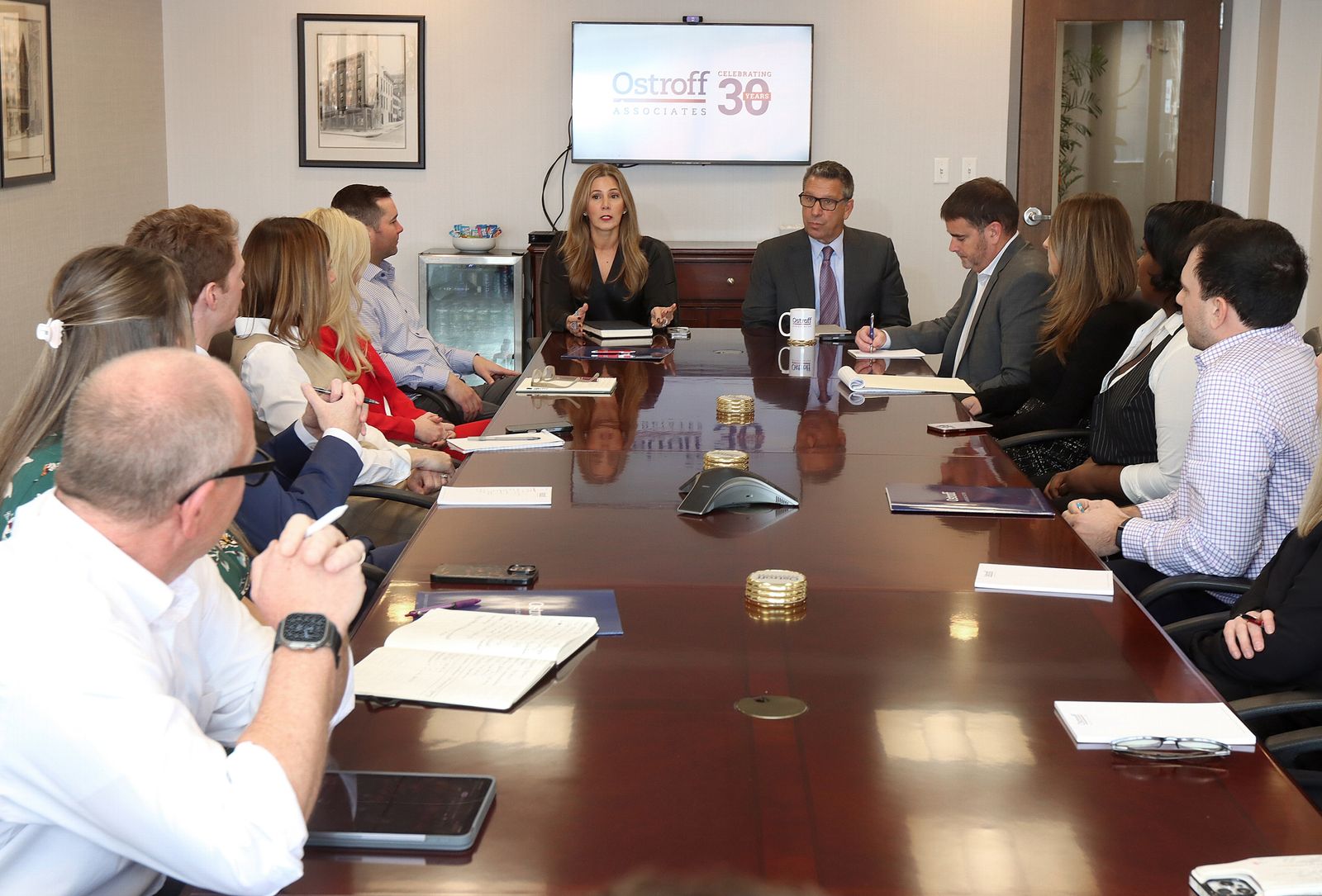
That became more important as the client mix changed. When Diana Ostroff joined in 2011, she later recalled, she began bringing in more corporate work; FedEx was the first client she brought in, followed by Walmart. Large companies look for evidence that a firm can handle the complexity of other large companies. The reference list becomes a growth engine. By 2018, the firm had 20 employees and reported $6.38 million in lobbying compensation. City & State's 2025 ranking, based on 2024 filings, put it fifth statewide at $9.19 million.
The figure needs a label. It is lobbying compensation reported to regulators, not a disclosed valuation and not necessarily the firm's complete revenue. The business is private and self-owned. Public filings do, however, reveal the shape of the model: clients retain the firm for ongoing representation. One 2025-2026 registration lists a $5,000 monthly engagement. That is one contract, not a menu price, but it makes the abstraction tangible. Clients pay for continuity - for someone to keep watching when nothing dramatic appears to be happening.
The win was a new route into accounting
In 2026, public profiles credited Ostroff with helping pass a New York law allowing CPA candidates to pair four years of education with two years of work experience before licensure. It is a useful specimen of the firm's work: a technical workforce rule, committee relationships, professional interests and a legislative finish line.
The useful lesson is not “know everyone”
Relationships matter in government relations; pretending otherwise would be coy. Rick Ostroff worked in Governor Mario Cuomo's administration before founding the firm, and the team includes people who have served inside state government. But “know the right people” is not a copyable strategy. The transferable idea is the system surrounding those relationships.
First, monitor before you advocate. Build a narrow watchlist of bills, rules, appropriations and agency actions tied to a real operating decision. Second, write the one-page translation: what changed, who decides next, what it costs, and when the window closes. Third, put different expertise on the same problem early. Procurement, finance, policy and communications are frequently one problem wearing four outfits. Finally, keep the client close enough to supply facts. The advocate may understand the process, but the client understands the consequences.
- Customers
- Corporations, institutions, associations and nonprofits exposed to government decisions.
- Core services
- Lobbying, budget advocacy, procurement, tax policy, compliance, monitoring and communications.
- Difference
- A cross-functional team and unusually broad sector coverage centered on New York.
- Alternative
- An in-house government affairs team, a trade association, a law firm or another Albany lobbying shop.
- Best fit
- Organizations with recurring, high-stakes New York policy or procurement exposure.
There are limits. A company seeking only a one-time federal filing, a campaign in several countries or a self-serve software dashboard is shopping for a different product. Ostroff's advantage depends on sustained attention, human judgment and knowledge of New York's machinery. That makes it valuable when the cost of missing a turn is high. It makes less sense when the issue is generic, low stakes or far from the terrain the team knows.
Beyond the client listA local footprint with statewide reach
The firm's market is statewide, but its identity is stubbornly Albany. It says it donates more than $250,000 each year to New York nonprofits, and team members volunteer, serve on boards and support organizations including the South End Children's Cafe. City & State named the company a 2026 Top Workplace, describing a 30-person organization with flexible scheduling, fully employer-paid health coverage and an insistence that a child's game or recital is a legitimate claim on an employee's time.
There is a pleasing symmetry here. Ostroff makes a living by explaining large systems to organizations that can feel small inside them. At home, it behaves like a small organization that knows it is part of a larger system. Neither posture is revolutionary. Both require the same habit: pay attention to the people affected by the decision.
Albany's weather will keep changing. Budgets arrive late, rules acquire footnotes, and yesterday's settled issue develops a new constituency. Ostroff Associates has built its place in the market by making that instability legible. The clever bit is not predicting every storm. It is keeping enough specialists at the table that someone notices the pressure dropping.