The awkward thing about selling faster internet is that customers can leave faster, too. Optimum has spent years upgrading the network behind its familiar cable brand. Fiber customers are rising. Mobile lines are rising. Yet the total broadband customer count keeps falling. Inside that contradiction sits a useful portrait of American telecommunications: impressive engineering, impatient households and a bill that has to make sense every month.
By June 2026, Optimum served about four million broadband subscribers. Its fiber network reached roughly 3.16 million homes and businesses, with about 749,000 fiber customer relationships. Those are substantial numbers. They also describe different things. A cable passing a building is an opportunity; a household paying for service is a business. Optimum’s task is to turn more of the first into the second.
That makes this a company worth understanding beyond the introductory offer. Optimum sells home internet, mobile, television and voice services, alongside business connectivity, advertising and local news. Its future depends on making that collection useful enough to keep, while managing the financial obligations inherited from its acquisition-built past.
A cable empire gets one name
Optimum’s corporate family tree requires more attention than its advertising. The present holding company was incorporated in 2015 as the business that became Altice USA. Patrick Drahi’s Altice assembled its American operation through Suddenlink and Cablevision. Cablevision, which already used the Optimum brand, joined the group in June 2016 in a transaction with a $17.7 billion enterprise value, including debt.
This explains the unusual geography: a strong New York metropolitan presence alongside markets across the south-central United States and elsewhere. The company operates across 21 states, but that does not mean every address in those states can order its service. Telecommunications maps have holes, edges and occasionally very frustrating differences between neighboring streets.
In August 2022, Suddenlink became Optimum. The change extended to stores, vehicles, uniforms and websites. Customers also received something more tangible than new lettering: the removal of data caps from Suddenlink internet plans. The accompanying brand promise was “Get Closer, Go Farther.”
The corporate name finally caught up in November 2025, when Altice USA became Optimum Communications. Its stock began trading as OPTU later that month. The sequence matters: first combine the businesses, then unify the consumer identity, then put the same name on the company. None of those steps automatically makes an installation appointment arrive on time.
The upload is the interesting part
Optimum runs both a hybrid fiber-coaxial network and fiber directly to homes. The distinction can disappear in broad descriptions such as “fiber-powered.” A buyer should bring it back into focus. Fiber somewhere in a network and fiber reaching the premises do not describe the same connection.
Its fiber service offers symmetrical speeds up to 8 gigabits per second in eligible areas, a tier introduced in 2023. Symmetrical means that uploading can match downloading. That is useful for sending large video projects, backing up files or supporting several demanding users at once. The less glamorous upward arrow on a speed test can matter more than another enormous download number.
There are conditions. Optimum advertises maximum speeds for wired connections; Wi-Fi performance varies. An 8 Gig plan does not give every phone an 8 Gig connection. The router, device, wiring and destination all affect what a user actually experiences. For many households, matching the service to ordinary usage is a better purchase than collecting the largest number on the menu.
Same brand. Different final connection. Check the address before comparing the speed.
The competitive set changes with that address. Verizon Fios and AT&T Fiber are alternatives where their networks overlap; fixed wireless products from T-Mobile and Verizon offer another way into the home. Optimum’s pitch combines its own fixed network with mobile and television. The relevant contest is the local one: available technology, recurring price, upload performance and service experience.
The new bundle fits in your pocket
For decades, cable bundles revolved around television. Optimum is putting more weight on the relationship between home broadband and the phone. The business logic is straightforward: selling another service to an existing household may make that relationship more valuable and give the household another reason to stay.
Optimum Mobile uses T-Mobile’s network under a mobile virtual network operator arrangement. Optimum does not need to construct a nationwide radio network to sell nationwide wireless service. Its infrastructure-based agreement also gives it control over its own mobile core and SIMs, with the ability to move traffic onto Wi-Fi.
On August 31, 2026, it announced an expanded multiyear T-Mobile agreement covering access to 5G Standalone capabilities and support for a broader range of devices, including wearables and tablets. Enhanced roaming and additional connectivity features form part of that roadmap. Those are announced capabilities and intentions, rather than proof that every customer already receives every feature.
The commercial opportunity is visible in the adoption figures. Only 8.9% of the broadband base also subscribed to mobile at the end of June 2026. That leaves room to sell bundles. It also means most broadband customers had yet to take that offer. An available cross-sell is not a completed sale.
Net changes. Fiber includes migrations from existing customers; these categories overlap and should not be added together.
Television remains part of the package. Optimum offers Entertainment TV, Extra TV and Everything TV, while Optimum Stream brings television and streaming applications onto a device with an on-screen interface. The practical benefit is fewer places to navigate. Whether it saves money depends on the channels and subscriptions a household actually wants.
The bill has a second chapter
Optimum makes most of its money through recurring service charges. Speed tiers, television packages, mobile lines and add-ons change the monthly total. Promotions help acquire customers; keeping them after the attractive opening price is the harder commercial assignment.
Its internet page, checked in September 2026, advertised a 1 Gig offer at $25 a month with a three-year price lock. Eligibility included a $10 discount for qualifying automatic payments and paperless billing, with taxes and fees additional. Availability varied by area. That is an offer to investigate at a specific address, not a universal price for every customer.
The useful buying habit is to read the second chapter of the bill before ordering the first. Check when the promotion ends, which payment method earns the discount, what equipment costs and how cancellation works. Compare upload speeds as well as downloads. A package can be competitively priced and still be the wrong fit for a particular household.
Business customers have a different shopping list. Optimum Business markets secure internet, phone and mobile services, with additional technology offerings for larger organizations. Its advertised 500 Mbps Secure Internet offer was $65 a month for 24 months, subject to payment requirements, taxes, equipment and installation charges. For a shop dependent on connected systems, continuity and support deserve as much attention as headline bandwidth.
The company behind the truck
There is more here than a residential internet brand. Lightpath serves enterprise and hyperscale connectivity needs; Optimum holds a 50.01% stake. Optimum Media sells advertising across screens. News 12 supplies local journalism. The same corporate group therefore participates in carrying information, producing it and selling access to audiences.
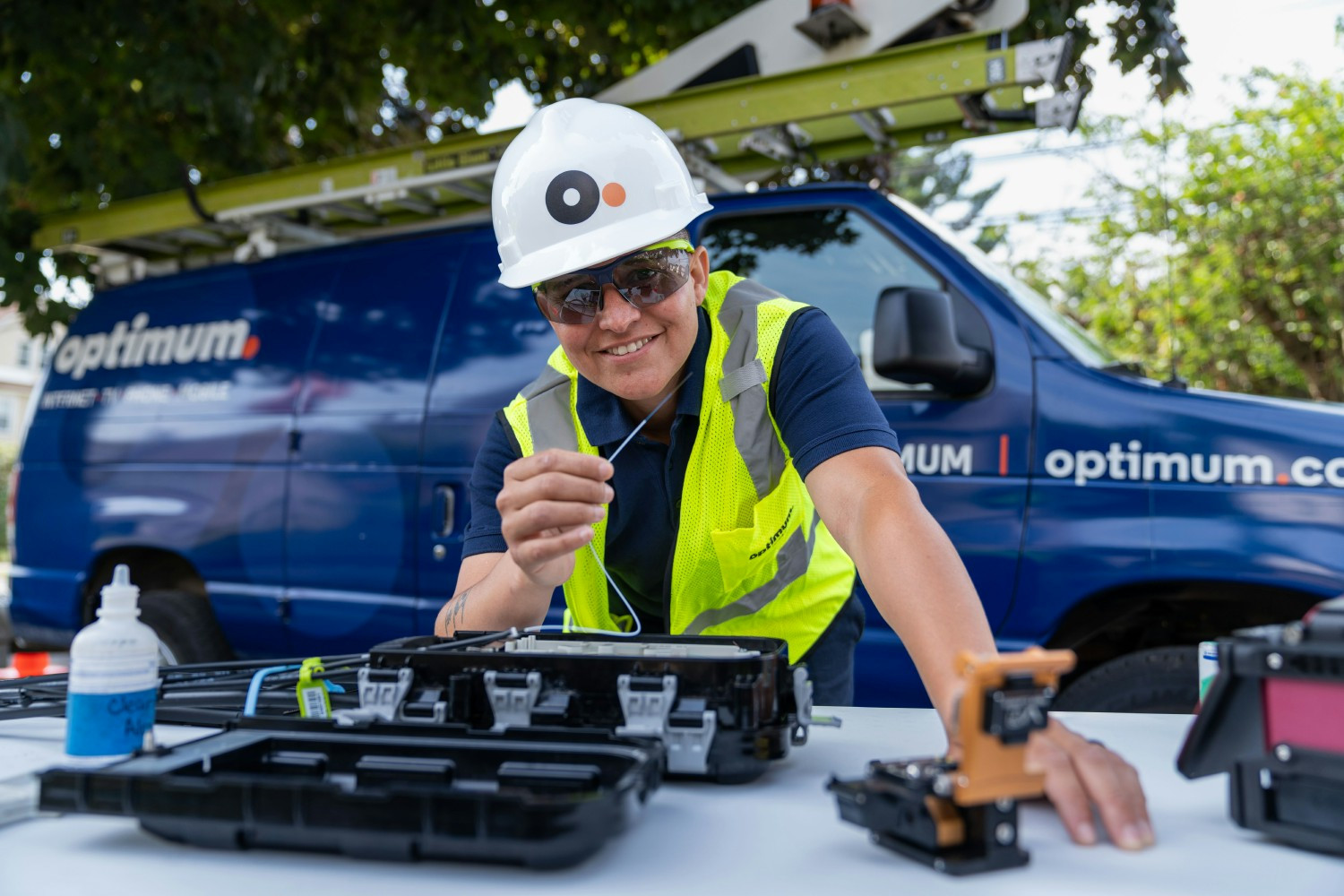
The operational expertise is physical as well as digital: network construction, field installation, maintenance, customer support and service packaging. A fiber upgrade has to survive the journey from a capital budget to a working connection inside someone’s building. That is where the technician, the appointment system and the customer-service agent become part of the product.
Under chairman and CEO Dennis Mathew, the company has described leadership development, employee feedback and a “First Time Right” service initiative. Its stated ambition is “to become the connectivity provider of choice in every community we serve.” The practical interpretation is appealingly ordinary: solve the problem without making the customer start again.
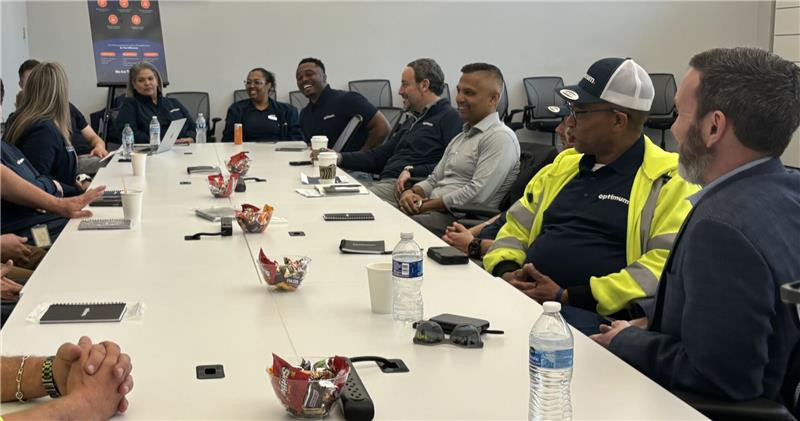
There is some independent evidence on workplace sentiment. Optimum’s Great Place To Work profile, updated in April 2025, reported that 71% of employees called it a great workplace. That is an employee survey result, not a customer-satisfaction score. It offers one useful view of the organization without settling the question of what happens when a subscriber needs help.
Better fiber meets an older debt bill
The financial pressure is substantial. Annual revenue fell from approximately $8.95 billion in 2024 to $8.59 billion in 2025. In the second quarter of 2026, cash capital expenditure was $320 million, while the company reported a $91.9 million free cash flow deficit. That spending figure covers capital investment across the business; it is not a standalone price tag for the fiber rollout.
In June 2026, Optimum announced an effort to negotiate a comprehensive restructuring of debt at CSC Holdings. That subsidiary had $21.8 billion in funded debt at March 31, including about $6.2 billion due in 2027. The company reorganized assets, including its eastern cable business and Lightpath stake, under an unrestricted holding structure. It said ordinary operations continued without interruption.
Then came an August NYSE notice concerning the stock’s average closing price falling below $1 over 30 trading days. The notice did not immediately remove the shares from the exchange or alter business operations. It did add another public measure of pressure to a company already attempting a difficult financial repair.
A faster network can improve the product. Keeping the customer requires the whole service to work.THE BUSINESS TEST
The observable weakness has been customer retention and revenue, even as parts of the network improved. Management’s later emphasis on simpler pricing, mobile bundles and proactive customer engagement shows how the response has broadened.
Other subscription businesses can copy the discipline: distinguish upgrades to existing customers from genuinely new demand, remove avoidable service friction and make the full price intelligible. The approach depends on competitive local service, useful bundles and enough money to maintain the network. Optimum’s next convincing achievement would be pleasantly unglamorous: more households deciding that this month’s bill is worth paying again.