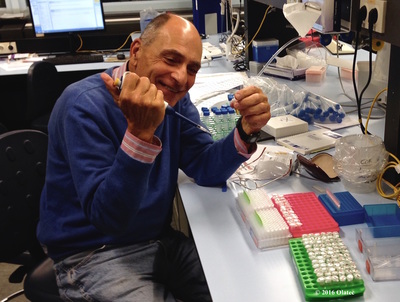
A lab bench in New York where one stubborn protein - NLRP3 - gets talked out of sounding the alarm.
A 14-person clinical-stage biotech that wants to do something biology has resisted for decades: switch off inflammation with a pill you can swallow.
Who they are now
Walk into Olatec and you will not find a campus. You will find a small office in Manhattan, a website built on Weebly, and a pipeline of roughly 40 drug candidates pointed at a single protein.
That protein is NLRP3, an inflammasome that behaves like the immune system's smoke alarm. When it senses trouble, it floods the body with the cytokines IL-1 beta and IL-18 - the molecular sirens behind gout flares, failing hearts, and inflamed brains. Useful in a fire. Less useful when the alarm will not stop ringing.
Olatec's whole reason for existing is that ringing alarm. The company is clinical-stage, which is biotech for "we have a drug in humans and have not yet been told whether it works at scale." Its lead compound, dapansutrile, is in Phase 2/3 trials across indications as unrelated as gout, type-2 diabetes, melanoma, and Parkinson's. For a team you could fit around two dinner tables, the ambition is almost rude.
The problem they saw
The drugs that quiet IL-1 work. They also tend to come in a syringe.
For years, the most effective way to blunt this inflammatory pathway has been injectable biologics - antibodies and protein traps like canakinumab and anakinra. They are powerful. They are also expensive to manufacture, awkward to take, and reserved largely for patients sick enough to justify the trouble.
So a gap sat in plain sight. Inflammation is everywhere - in arthritic joints, in heart attacks, in the slow burn of neurodegeneration - and yet the best tools for it were locked behind a needle and a price tag. The question Olatec kept circling was almost childishly simple: what if you could do this by mouth?
The founders' bet
Olatec was founded in 2003 by Damaris B. Skouras, who remains Chairman and CEO. The science, though, leans on a name that immunologists tend to say with reverence. Charles A. Dinarello - co-Chief Scientific Officer and chairman of the company's Scientific Advisory Board - is widely described as one of the founding fathers of cytokine biology, the man who helped define how IL-1 and IL-18 drive inflammation in the first place.
That pairing is the bet. Skouras built a company structured to develop a platform, not a single drug. Dinarello brought the deep cytokine science that lets a 14-person team credibly chase NLRP3 across twenty-odd diseases. The drug development team has worked together for over a decade - an unusually long runway for a company this size.
The wager they made: that one well-aimed oral molecule, protected by a thick wall of patents, could be turned and re-turned at indication after indication. Risky? Of course. Most biotechs that bet everything on one mechanism find out the hard way that biology does not read the pitch deck.
Founder, Chairman & CEO. Built Olatec as a platform company rather than a one-drug shop.
Co-Chief Scientific Officer. A foundational figure in cytokine biology and IL-1 / IL-18 research.
The product
Dapansutrile is a small molecule with a memorable lab code - OLT1177, a quiet nod to the company's own name. It is selective, which in inflammasome circles is the whole game: instead of broadly suppressing the immune system, it targets NLRP3 specifically and prevents the inflammasome from assembling. No assembly, fewer IL-1 beta and IL-18 sirens, less inflammation.
It is taken orally. That single fact is the difference between a hospital infusion and a tablet on a kitchen counter, and it is the reason the company exists.
Behind dapansutrile sits a platform: roughly 40 candidates and a portfolio of more than 180 patents and patent applications. The strategy is breadth - one validated mechanism, many doors.
Targets NLRP3 specifically rather than blanket-suppressing immunity.
A swallowed tablet, not an injection - the practical heart of the pitch.
Active across 20+ preclinical models, from arthritis to Alzheimer's.
Milestones
Damaris Skouras starts the company in New York with a focus on inflammation.
Cytokine pioneer Charles Dinarello joins the drug development team and Scientific Advisory Board.
Phase 2a dapansutrile gout-flare data appears in The Lancet Rheumatology - no serious adverse events.
A Series A round pushes total funding past $102M, backed by Advection Growth Capital and others.
First patient dosed in a Phase 2 diabetes study; a Phase 2 early-Parkinson's trial is announced.
Olatec presents preclinical evidence of disease-modifying activity for dapansutrile in Parkinson's.
A two-decade slow burn, then a five-year sprint. Biotech timelines age like fine cheese - mostly by sitting still.
The proof
Skeptical readers deserve figures. Here is the case Olatec is building, by the digits it has put on the record.
Bars scaled within each metric for readability, not against one another. Figures from public company and investor sources.
The clinical headline so far is gout. In an open-label Phase 2a trial published in The Lancet Rheumatology, dapansutrile was given to 34 patients with acute gout flares. No serious adverse events. The most common complaint was diarrhea - the sort of footnote that, in drug safety, counts as good news.
The validation is not only internal. The Michael J. Fox Foundation awarded Olatec a research grant - alongside the Medical University of Innsbruck - to test dapansutrile in animal models of Parkinson's disease progression. When a foundation that rigorous writes a check, it is buying a hypothesis worth running down.
34 patients, zero serious adverse events in the Phase 2a gout study.
IL-1 beta & IL-18 - the two cytokines dapansutrile is designed to quiet.
The Netherlands & New York - Olatec has run operations on both sides of the Atlantic.
The mission
Strip away the cytokine names and the trial phases, and Olatec's mission is plain: give patients a way to turn down chronic inflammation without a needle, a hospital visit, or a biologic's price tag. The company frames it as improving health and well-being for patients around the world. The mechanism frames it more bluntly - make the body's inflammatory alarm something you can switch off on your own terms.
There is a cost-of-goods argument folded into the idealism. Oral small molecules are cheaper to manufacture than injectable biologics, which means a working dapansutrile would not just be more convenient - it could be reachable for people that today's IL-1 drugs price out. Convenience is nice. Access is the point.
Why it matters tomorrow
Gout proved the molecule is safe. Parkinson's will decide whether it matters.
NLRP3-driven neuroinflammation is implicated in some of the diseases medicine least knows how to slow. If dapansutrile - dosed orally for twelve months - can blunt that inflammation in early Parkinson's patients, Olatec would have something rare: a potential first oral disease-modifying approach to a NLRP3-driven neurodegenerative disease. That is a very large "if," and the company is honest that it is still unproven in people at scale.
Now go back to that small Manhattan office. The Weebly website, the 14 names, the one stubborn protein. What looked modest is, on closer inspection, a concentrated bet: that the smoke alarm wired into human inflammation can be reasoned with, by mouth, across disease after disease. The lab bench in the photo has not changed. What happens at it - if the trials read out the way Olatec hopes - might change a good deal more.
Go deeper