Odiong Akpan began taking photographs of university campuses he encountered on his travels. Some visits were planned; others happened because he was nearby. Then the collection acquired an ambition. He announced that he intended to visit at least 100 universities around the world within 24 months. The camera had apparently joined the business-development department.
He called it a “plaything-turned mission”. His interest was the relationship between universities, industry and government, and how those institutions might work together on practical problems. The pictures were a way into a conversation about collaboration. A campus could be a pleasant stop on an itinerary and an invitation to ask why knowledge sometimes travels so slowly beyond the gates.
That small episode offers a useful introduction to the founder and CEO of Ubulu Africa, also described as its managing partner. His working life crosses engineering, business advisory, research and support for entrepreneurs. Across those activities, a recurring concern emerges: the connections that allow individual effort to become collective capability.
The university plan was an aspiration, announced publicly in 2022. Its appeal lies in the choice of destination. Someone interested in innovation might collect startup conferences, investor dinners or photographs beside famous founders. Akpan was also looking at the places where learning happens, wondering how their work could reach the people building businesses outside.
24 months.
One proposed itinerary.
Akpan’s stated goal for connecting his campus visits with advocacy for university-industry collaboration.
02Before the startup stage, the transmission network
In June 2005, Akpan joined Vmobile Nigeria as a transmission engineer. His job involved planning, implementing and operating the networks carrying mobile communications. In his later account, he remembers concentrating on the engineering immediately in front of him. The wider continental implications had yet to become his principal concern.
That changed through the experience of Celtel One Network. When Nigeria joined the expanding cross-border initiative in 2007, his team was asked to align its operations with it. Akpan recalls coordination between transmission, switching and billing systems, alongside experimentation with internet-based calling technologies. A customer’s apparently simple experience depended on several groups solving different problems together.
He returned to that experience in March 2026, using it to examine Africa’s approach to artificial intelligence. His argument favours shared infrastructure, compatible standards and governance that can work across countries. He worries about separate initiatives repeating each other’s work. The engineer’s old assignment has become a reference point for his thinking about institutions.
There is a practical appeal to this way of looking at things. Connectivity is tested when the call goes through. Collaboration deserves an equally demanding test: can people actually use what the partnership makes possible? A memorandum, like a beautifully labelled cable, still needs somewhere useful to lead.
03The doctorate had its own staircase
His education took him from a bachelor’s degree in electronic engineering at the University of Nigeria, Nsukka, to a master’s in engineering business management at Warwick and a doctorate in business administration at Bradford. His doctoral work examined digital competencies, culture and workforce transformation. The subjects connect technical change with the people expected to carry it out.
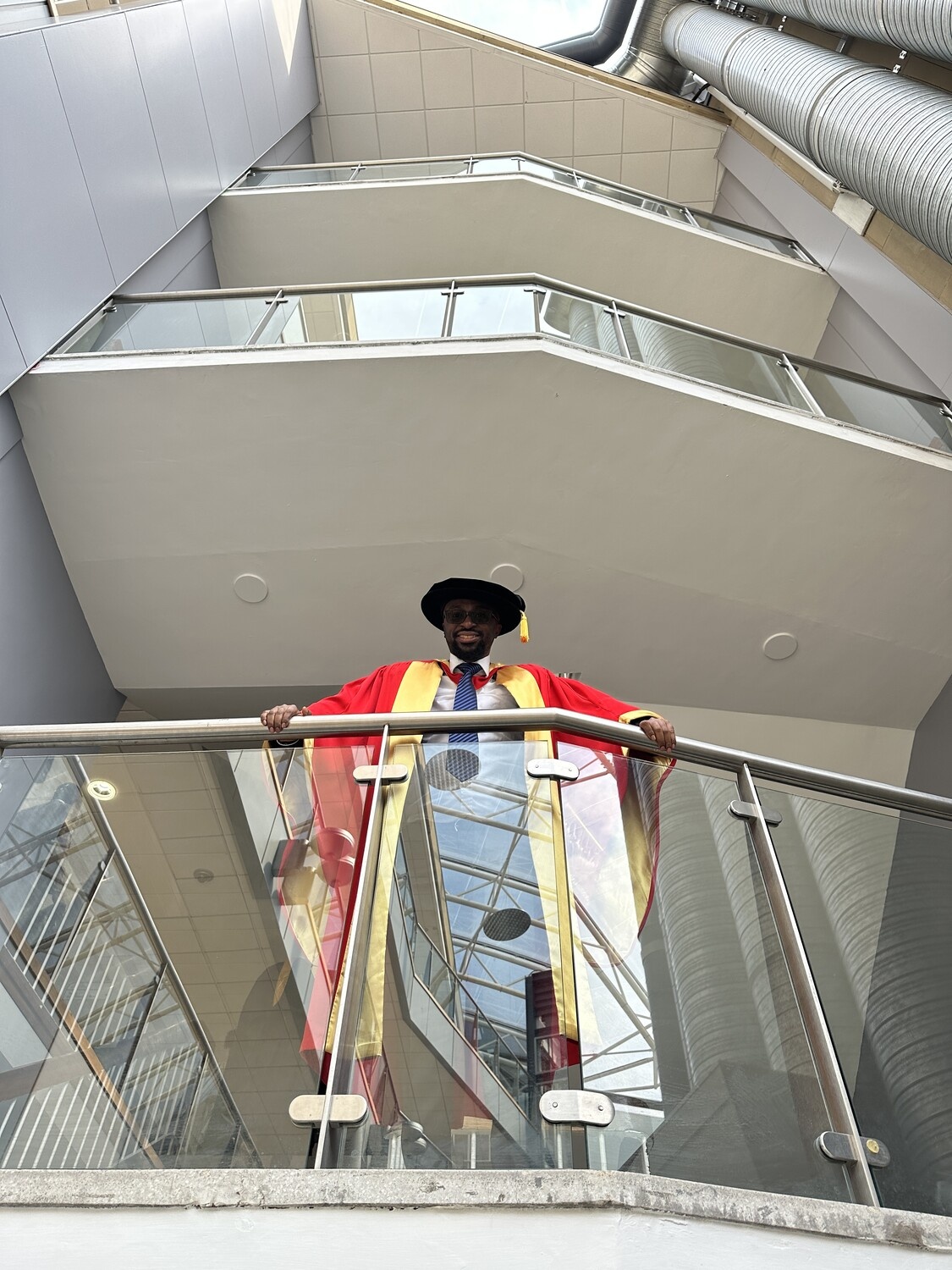
The doctorate also produced a photograph with an unusually helpful setting. On the day of his July 2023 conferral, Akpan stood on an elevated floor, in academic robes, with more floors above him. A month later, he used the image to reflect on achievement and further learning.
His description of the doctoral journey made room for both pride and exasperation, including the parenthetical “who send me abi?”. The little joke gives the graduation scene some air. A degree can be a serious accomplishment without requiring its recipient to pretend that every hour of acquiring it was delightful.
He wrote about learning to celebrate accomplishments while continuing to look upward. It is a revealing choice of metaphor for someone whose professional vocabulary often concerns systems. Here, the system is a staircase. There is a place to stand, a chance to take stock, and another floor waiting above.
04Fifteen finalists, a thousand beginnings
By July 2023, Akpan was moderating an investor panel at the third Pitch2Win in Lagos. The programme placed him with Olumide Soyombo, Oyin Solebo, Maya Famodu and Ola Brown for a discussion about what followed a changed funding environment. The moderator’s task sits comfortably with his broader interests: bring people with different experience into the same conversation, then make the exchange useful.
For the fourth edition in 2024, he was identified as programme director. More than 1,000 applications became 15 finalists. Those numbers describe a selection problem before they describe a stage show. Somebody has to read, compare, decide and communicate, while founders wait to learn whether their particular attempt at the future will get a hearing.
Ubulu Africa subsequently reported that InnoX supported the narrowing of more than 1,300 applications to 12 finalists for Pitch2Win 5. The arithmetic belongs to the programme, rather than to Akpan’s personal trophy cabinet. It gives a sense of the administrative scale of the work around him.
A shortlist cannot tell us which company will endure. It can show the responsibility attached to deciding who receives attention now. For a founder, visibility may mean the next conversation, and the next conversation may be the first one with someone who understands the business. Selection is consequential even when the prize has already found its winner.
His scheduled July 2025 Founders Series session in Uyo addressed the other side of that process: preparing a pitch, responding to investor objections and negotiating terms. These are teachable activities, even if the outcome remains uncertain. An entrepreneur has to make a business intelligible to someone who did not spend the previous year thinking about it.
05Who gets the introduction?
Akpan’s work also reaches the organisations that support entrepreneurs. Ubulu Africa described contributing to a capacity-building bootcamp for 30 participants from 10 innovation support organisations across five Nigerian states and territories. The focus was helping those organisations serve non-tech small businesses. Here, the immediate audience consists of the people who will go on to help someone else.
At the December 2025 reception for the Business Growth Initiative for Startups, he spoke as chief executive of Ubulu Development Foundation. The programme, implemented with Spurt!, had worked with 14 women-led ventures over five months. He drew attention to the uneven representation of women-led businesses and urged others to adopt comparable support approaches.
Those activities give the word ecosystem a more specific meaning. It includes who receives advice, which intermediaries are equipped to offer it, and whether a founder can reach a useful network. A programme’s invitation list is part of its design. So is the decision to keep working with people after the formal programme ends.
His institutional connections extend to board membership at TechQuest STEM Academy, a directorship at Ibom Innovation Network and an advisory role at FutureMap Foundation. NIGCOMSAT has also recognised him as a mentor and facilitator for its accelerator. Together, these roles place him among educators, public institutions and entrepreneurs, with different responsibilities in each setting.
06A Yorkshire village enters the argument
Akpan has visited Saltaire twice. In February 2026, he turned those visits into an argument about African innovation hubs. The Yorkshire village interested him because of the relationships between its working life, buildings and community. His concern was what keeps a place functioning after the excitement of construction has passed.
He organised his thinking around four elements: place, people, programmes and partnerships. His questions are operational. Who runs the place? What happens there regularly? Which institutions are connected to it? How is it paid for when an initial funder moves on? These questions make an innovation district sound rather more demanding than a property launch, which is precisely his point.
This essay is also a reminder of his range of reference. A former mobile-network engineer finds a useful comparison in an industrial village; a venture builder carries an interest in universities into his travels. His enjoyment of chess and landscape photography adds two more activities to the picture, without needing to turn either hobby into a management doctrine.
The value of the Saltaire comparison is its timescale. A launch photograph captures a fraction of a second. The operating arrangements have to survive ordinary Tuesdays, staffing changes and the arrival of the next bill. Akpan’s attention keeps moving towards that longer, less photogenic stretch of institutional life.
“Longevity is design meeting governance over time.”
Odiong Akpan / February 2026
Four elements in Akpan’s Saltaire essay. Labels below each are editorial shorthand.
07The next connection is in Akwa Ibom
In October 2026, Akpan was speaking as programme director for the forthcoming Akwa Ibom Tech Week, scheduled for November 2 to 7 across Uyo and Ikot Ekpene. The plans included a startup competition, a career fair and workshops for public-sector workers. His explanation connected opportunities for entrepreneurs with the state’s appeal to investment, tourism and cultural exchange.
He also stressed the importance of government policy and the willingness to implement it. Private initiative, in his account, has limits when the surrounding conditions fail to support it. That observation belongs beside the university photographs and the telecoms memories: each concerns the arrangements between institutions, and the work required to make those arrangements useful.
The career fair provides a particularly clear example. Employers want skilled people. Skilled people want work. Their needs can coexist without a productive meeting ever occurring. Akpan described the fair as a way to bring them into direct contact. The intervention sounds straightforward because its purpose is straightforward. Organising it is the work.
Return to those campus pictures and the pattern comes into focus. Akpan sees a place, then starts asking who could be connected through it. A university, a mobile network, a founder programme, a regional gathering: each offers a different setting for the question. The next photograph may be easy. What happens between the people in it takes rather more attention.