A 404 page is an odd place to look for a company’s personality. Something has gone wrong: a link points nowhere, a visitor has taken a wrong turn. NinjaSites let its users design that little dead end with text, pictures, and navigation buttons. Even failure could have a template. It illustrated a larger proposition: running a business online should require fewer specialists, fewer separate purchases, and considerably less fuss.
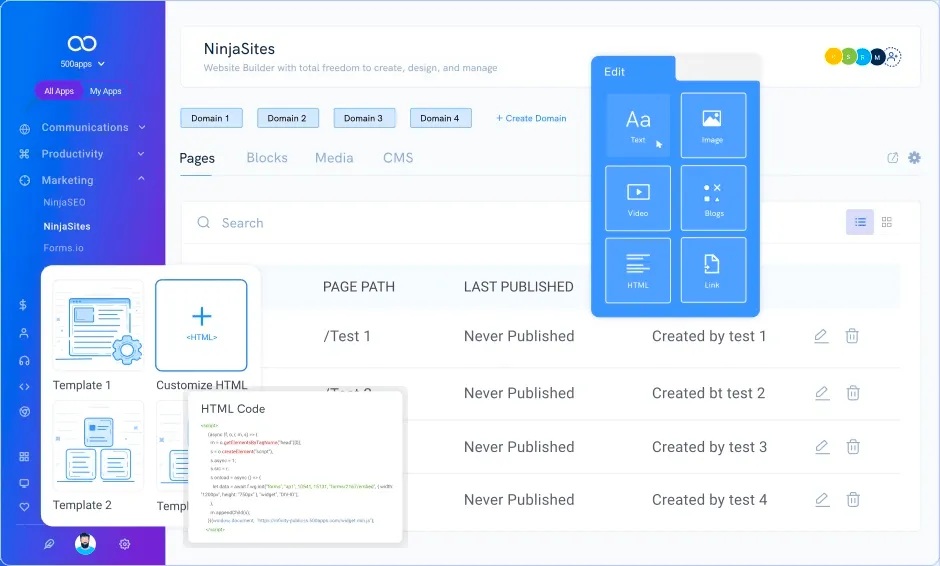
NinjaSites by 500apps was a browser-based website builder for people who wanted a working site without writing code. The attraction extended beyond the editor. Its subscription belonged to a portfolio of business software. A website sat beside tools for marketing, sales, support, and operations. For a small business looking at a growing pile of subscriptions, that arrangement had an obvious appeal.
- A visual builder for websites, blogs, and landing pages.
- Historically bundled with 50 apps at $14.99 per user per month.
- Its parent now announces a wind-down and a move to 500agents.
The website was only part of the purchase
On September 9, 2021, 500apps publicly launched its Infinity suite. The following day’s announcement named more than 30 applications, including NinjaSites, and advertised a price of $14.99 per user per month. The catalog ranged from electronic signatures to recruiting, time tracking, and customer support. Buying software was being packaged rather like buying a toolbox: take the box, then reach for the instrument you need.
The number of applications grew. A provider-supplied G2 pricing entry, last updated in October 2024, offered 50 apps at the same $14.99 per-user monthly headline price. It also listed multiple workspaces, no feature caps, and a free trial. That was the historical offer, rather than a current checkout quote. Its unit matters: the charge followed users. Ten paid users at that listed rate would mean $149.90 each month, before any other charges.
The distinction is useful when comparing website builders. A buyer thinking about one website might value a polished template above everything else. A buyer juggling several business tasks might value the bundle. NinjaSites’ competitive argument lived in that second calculation. The website editor was doing two jobs: building pages and making the wider subscription easier to justify.
A small publishing desk in a browser
The product’s work was concrete. Start with a template, move blocks around, add images, and preview a landing page. A content management system handled pages and blog material. An image library kept visual assets available for reuse. Forms gave visitors a way to leave information. These were familiar publishing chores arranged for someone whose main occupation might be running a business rather than maintaining its website.
Its search controls included image alt text, page titles, and descriptions. Those are useful editorial handles: explain a picture, name a page accurately, and describe what a visitor will find. A built-in SEO grader gave the process a checklist. Such controls help a publisher prepare a page; they do not buy a place at the top of a search result. The difference matters whenever a software feature starts sounding like a promised outcome.
Free SSL certificates and centralized domain management addressed two more chores. NinjaSites advertised unlimited domains, with several sites managed from one dashboard. For an operator with separate businesses or campaign destinations, the organizing unit could become the portfolio rather than a single homepage. Its expertise lay in assembling these routine tasks into a visual workflow. The customization of a 404 page fits neatly here: housekeeping deserved an editor too.
The customer who already knew WordPress
A September 2022 G2 review supplies a telling complication. Sugiya O., identified as a small-business writer, liked the lightweight builder and its ability to manage websites and domains together. Yet familiarity pulled in another direction: the reviewer was accustomed to WordPress. A favorable impression had run into an established habit. That is a formidable competitor, even when the alternative arrives with a generous bundle.
A different account, published by Software Advice in June 2023, described creating landing pages for multiple businesses. The reviewer identified cost and usability as reasons for switching. Software Advice disclosed that the vendor had invited the review and offered a nominal incentive. Read at that scale, the account illustrates a plausible use case: an operator who needs several straightforward destinations and wants to maintain them without commissioning each one.
These accounts help locate NinjaSites in the market. Its natural audience included small businesses, independent operators, and teams making campaign pages. WordPress supplied the familiar alternative; Wix and Squarespace occupied the broader visual website-building category. The relevant comparison was the work each customer needed to finish. A large catalog would carry less weight for someone who needed only one carefully specified publishing system.
“I’m still used to creating a website using WordPress.”
Sugiya O. · G2 review · September 2022
Fifty tools meet one hard decision
Visit NinjaSites’ domain now and the story takes a turn. As checked on October 23, 2026, it redirects to a 500apps customer notice announcing that the suite is winding down. The message is signed by Manohar and the team. Manohar Chapalamadugu is identified publicly as 500apps’ founder and CEO. The stated destination is 500agents, a conversational AI platform.
The notice describes maintaining 50 products as stretching the team too thin and says customer experience helped shape the new direction. It sets out a relative 90-day sunset plan, offers help exporting data, and describes continued support during the transition. That is the company’s explanation of its decision. It also changes how a prospective user should read the older product listings: their feature descriptions record the previous offer.
There is a lesson here for anyone assembling a software bundle. Count the work behind every included application: an editor to maintain, users to support, features to improve. The parent’s announcement makes that tension visible. Breadth had helped sell the proposition; maintaining breadth had become a problem the team chose to address.
Copy the workflow. Count the upkeep.
The useful idea to borrow is specific. Put related publishing chores close together. Give the person creating a page access to its search description, images, forms, and domains. Start with a reusable structure, then make the necessary edits. That approach can reduce the handoffs surrounding a modest website. It works best when the available editor matches the actual job.
The bargain becomes less convincing when a project requires capabilities outside that workflow, or when a customer cannot tolerate a provider’s change of direction. Existing users now have a more immediate job: follow the transition notice and arrange their exports. NinjaSites’ custom 404 page offered a graceful way out of a broken link. A software relationship needs an equally usable exit.
Follow the next chapter
Read the transition notice or watch the historical demo.