The meeting ends, and everyone has agreed. This is the dangerous part. Agreement feels remarkably like accomplishment, particularly when the coffee is good. A week later, the number nobody liked is still red, the person who promised to investigate has been busy, and the quarterly plan has acquired the dignified silence of a document nobody opens.
Ninety occupies that interval. It is cloud software for running a company, particularly one using the Entrepreneurial Operating System, or EOS. Its proposition is plain: put the plan, the people, the performance numbers, and the unfinished business somewhere they can keep encountering one another.
- One workspace connects quarterly priorities, weekly meetings, scorecards, and accountability.
- Its customers are chiefly small and midsize organizations and the coaches advising them.
- Nearly 19,000 companies use it, according to an August 2026 company announcement.
- The useful habit is following through. Software gives that habit a place to live.
A spreadsheet had a very good head start
Mark Abbott came to the problem as a business coach. His clients already had a way of thinking about management. They wanted an easier way to share it. Ninety’s opportunity was unusually specific: translate an existing discipline into connected software, then reach customers through people they already trusted.
In a 2026 retrospective, Abbott and first full-time employee Christine Watts recall spending roughly $500 a month on Facebook in the early years. Coaches supplied introductions; customer feedback supplied direction. There was also resistance to technology in EOS sessions. Even a scorecard notes field required a debate, Watts recalled. The constraint was permission to change the routine.
Remote work altered that calculation. When colleagues could no longer gather around the same whiteboard, a shared digital record became practical infrastructure. The lesson for other founders is appealingly unglamorous: start where people already practice a useful habit, and remove the friction they can describe.

The quarter meets the week
EOS is a management methodology created by Gino Wickman. Ninety is an officially licensed software provider, giving its vocabulary a working home. A “Rock” is a quarterly priority. A Scorecard tracks recurring measures. The Accountability Chart describes responsibilities. A Level 10 Meeting supplies a regular agenda for reviewing progress and addressing issues.
The distinction is the connection. A weak number can become an Issue for discussion. Discussion can produce a To-Do with an owner. A quarterly priority can be reviewed alongside its milestones. The system preserves the relationship between what a company says matters and what someone must do next. A task list alone leaves much of that relationship to memory.
Illustrative workflow, not a required sequence.
Consider FIT Technologies, an IT services business. In Ninety’s published case study, FIT describes creating client teams where people can see agendas and add Issues and To-Dos. Its chief strategy officer, Fred Franks, argues that the value should extend into departments. An executive team with excellent visibility can still preside over an organization whose other teams are guessing.
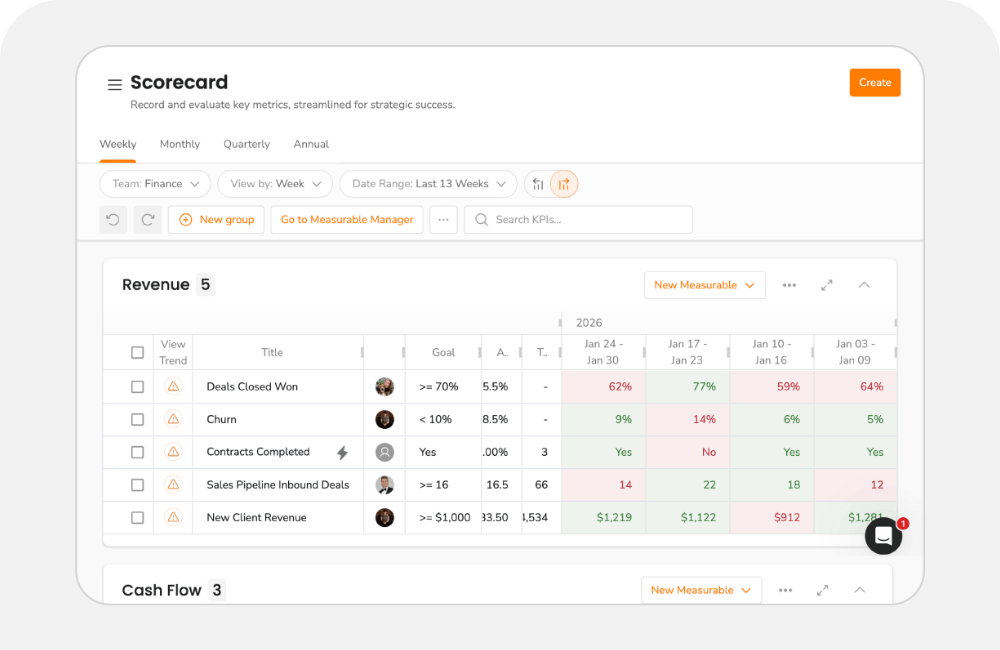
At UK construction recruiter Thorn Baker, the previous arrangement involved paper and spreadsheets. Group director Rob Ford described the change succinctly: “Our old way of working was all over the place.” These are vendor-published customer accounts, but the problem they describe is recognizable: information exists, yet nobody has a dependable view of the whole.
The subscription is the easy expense
Ninety sells subscriptions per paid user. Its published standard monthly rates are $12 for Essentials, $14 for Accelerate, and $16 for Thrive. The pricing page also displays lower prices; buyers should check which discount applies. At list rates, ten Essentials users cost $120 monthly before tax. Ten Thrive users cost $160.
Essentials covers weekly execution. Accelerate adds planning and people tools. Thrive adds knowledge creation and process documentation. The Free plan helps document vision and structure but excludes Meetings, Rocks, To-Dos, and Scorecards. A 30-day trial lets a team try the fuller system. The product can begin cheaply; organizational adoption still demands attention.
There is capital behind the routine. Insight Partners led a Series A announced in 2021. A $35 million Series B followed in November 2023, led by Blue Cloud Ventures with Catalyst Investors and Insight participating. That round valued Ninety above $200 million and was intended to fund development, research, and hiring.
By August 2026, Ninety reported serving more than 80 countries and having supported 6.6 million meetings. Those are company-reported totals, rather than proof that each meeting improved. They do establish the scale of the behavior being digitized. Professional services and coaching partnerships address the less photogenic work: helping teams actually use it.
An assistant with access to the promises
Maz, Ninety’s AI companion, brings another interface to the same record. Ask Maz can answer questions about live company data and create or edit operational items. Its documentation says access follows the user’s permissions and is available on paid plans. The attraction is contextual: ask about priorities and numbers that already belong to your organization.
September 2026 release notes add an MCP connector for working with Ninety data through supported AI platforms, plus an EOS Pure setting to disable optional features. The direction is revealing. Some teams want more automation; others want stricter adherence to the method. Ninety is trying to accommodate both.
It has company. EOS One comes from EOS Worldwide itself. Strety combines EOS tools with projects, performance features, and integrations. Ninety’s position rests on connected workflows, its coaching network, implementation support, and Maz. Prospective customers should compare how each handles their actual meeting and follow-up work.
A long feature list is a poor substitute for rehearsing your actual meeting.
The buying test
Copy the connection, then buy the tool
A reader can borrow the underlying discipline immediately: give each priority an owner, identify a measure, review it regularly, and turn obstacles into assigned actions. Keep the decisions where the next meeting can find them. That is an editorial prescription drawn from the workflow, not a guarantee of growth.
It depends on people updating the record and admitting when work is off track. If the numbers are stale, responsibilities evasive, or department teams excluded, a polished dashboard will faithfully organize the omissions. Ninety makes follow-through easier to inspect. Someone still has to follow through.
Take a look inside
Explore the tools, watch them work, or hear the early team tell the story.