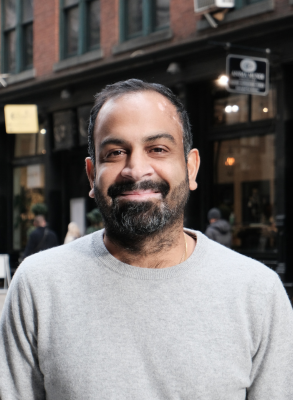
There is a certain type of venture capitalist who shows up with a term sheet and disappears. Nihal Mehta is the other kind. As Co-Founder and General Partner of ENIAC Ventures - one of New York City's most respected seed funds - Mehta has spent fifteen years building a reputation as the investor who actually calls back, who makes introductions without tracking favors, and who sat across the table from founders pitching Uber and Airbnb before the rest of the world could spell "sharing economy."
His philosophy is unfashionable in its simplicity: be a good human. That is it. No framework with Greek letters. No proprietary thesis about the convergence of distributed ledger technology and synthetic biology. Just a relentlessly warm approach to connecting people - which is why the industry long ago dubbed him the Human Rolodex, a nickname that gets more ironic each year as everyone else's Rolodex migrates to a CRM and Mehta's stays in his head.
ENIAC Ventures was not born from a Stanford GSB thesis. It started in 2009 as a nights-and-weekends side project - a $1.6 million fund with a few dozen LPs - while Mehta and his co-founders were still running their own companies. The name is a direct wink at their shared alma mater: ENIAC, the world's first general-purpose digital computer, was built at the University of Pennsylvania's School of Engineering, where Mehta and his partners met in 1996. It is the kind of origin story that sounds invented but isn't. By Fund VI, ENIAC had grown to $160 million and a track record that includes early bets on Uber, Airbnb, AdMob (acquired by Google), SwiftKey (acquired by Microsoft), Attentive, and Tala.
Mehta's investing style is pre-Series A, often pre-traction, almost always pre-obvious. ENIAC writes checks between $500K and $5M and averages $2M per deal. The pitch Mehta actually cares about is not the deck - it is the founder. A decade of running companies before running a fund gave him a sensitivity to founders that most investors cannot manufacture. He knows what it feels like to wake up at 3 a.m. convinced the company is dying. He has lived that particular insomnia.
That insomnia was sharpest in his early 20s, when his first startup - philly2nite.com, built out of his senior-year house at UPenn in 1999 - did not survive the dotcom implosion. He filed for Chapter 7 bankruptcy. When asked why he did not quit entirely, his answer was characteristically unromantic: "I definitely thought about it a lot. I was probably just being stubborn." That stubbornness became his most transferable skill. He went on to found ipsh!, one of the first full-service mobile marketing agencies, and sold it to Omnicom in 2005 - years before "mobile marketing" was a budget line at most Fortune 500 companies. Then came buzzd, a real-time city guide, which he grew into LocalResponse and expanded to Inc. 5000 territory: 2,153% revenue growth over three years.
By 2009, when the iPhone was two years old and the App Store was barely twelve months old, Mehta was already preaching mobile-first gospel to anyone who would listen. "Uber would never exist without mobile," he has said - a statement that, in retrospect, sounds obvious and, at the time, sounded like a fringe belief. He backed his conviction with checks. The result is a portfolio that reads like a museum exhibit of "things people thought were too risky."
Then there is Pitch and Run NYC. In 2019, Mehta had a genuinely strange idea: what if founders pitched investors while running? He started the club with three people at Chelsea Piers on a Monday morning. It has since grown to hundreds of members, expanded to Denver, Los Angeles, and Austin, and become the kind of thing the Financial Times writes features about. Multiple companies in the group chat have gone on to raise Seed and Series A rounds. The joke tells itself: the fastest way to a term sheet might literally be the fastest you run.
Away from the fund and the run club, Mehta is a co-founder of Project Ahimsa, a nonprofit providing scholarships to disadvantaged youth in India - a cause rooted in the fact that his parents immigrated from India in the early 1970s. He also hosts the Human Unicorn Podcast, where he interviews the founders building the next wave of transformative companies. His Instagram bio says he is "a dad, husband, son, citizen, world traveler, and really amateur chef." His Facebook handle is @djnihal, which raises more questions than it answers.
What separates Mehta from the crowd of seed investors is not his portfolio - though the portfolio is excellent. It is the consistency of posture. He has never had a period where he became "too big" to respond to a cold email or too successful to make a warm introduction that benefits him not at all. In a business that celebrates contrarianism on deal selection and tolerates ghosting as a professional norm, Mehta's contrarianism runs deeper: he simply refuses to be transactional. The industry has a word for that. They call it the Human Rolodex. He calls it being a good human. Both descriptions are accurate.