The machine is impressive. It has swallowed a warehouse of data, answered the executive’s question in seconds and produced a dashboard so handsome it could acquire a small following of its own. Then the demonstration ends. The operators return to their desks, their old spreadsheets and the peculiar little workarounds that have kept the institution alive for years. The future, having performed beautifully, is quietly ignored.
Nicole Sanders has built a company in the distance between the applause and the workaround. As co-founder and co-CEO of Foxtrot Services, she leads a Washington, D.C.-headquartered team that implements Palantir Foundry and AIP in enterprises and government organizations. Its job is not merely to make artificial intelligence function. It is to make the system credible enough, governed enough and useful enough that somebody with a real responsibility will choose it on an ordinary Tuesday.
This is less cinematic than teaching a machine to reason. It may be more consequential. Enterprise software is full of clever objects that became expensive furniture. Sanders’s thesis is that adoption cannot be saved for the final slide. It belongs in the architecture from the beginning.
A career in consequential machinery
The idea has roots in Sanders’s earlier work. In January 2020, Lockheed Martin identified her as senior manager for strategic programs in a feature on the U.S. Navy’s Littoral Combat Ship. She described the vessel’s mix of modularity, open architecture and common systems as a recipe for moving capability quickly. The ship was designed so that substantial parts could be reconfigured as missions changed. It was, in the article’s analogy, less a desktop computer than a smartphone.
There is a straight line from that language to the problems Sanders now chooses, although the objects have changed. A Navy ship and an enterprise data platform both have to accept new capabilities without becoming a new machine each time. Both operate amid permissions, dependencies and inherited systems. Both must make sense to people who cannot respond to a failure by refreshing the browser and hoping for the best.
Sanders later served as a director of business development at Palantir Technologies. There she encountered Foundry from the platform side: a system for connecting data, decisions and operations across organizations whose information rarely arrives tidy, labeled or eager to cooperate. She and Christine Williams, also a Palantir veteran, eventually founded Foxtrot in 2023. They chose an unusual arrangement for a young firm. Both would be chief executive.
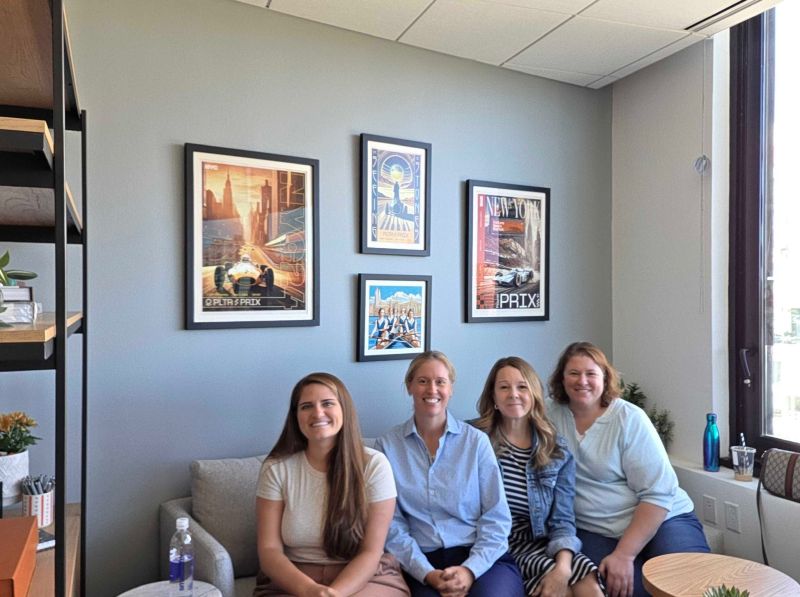
The arrangement fits the argument. Foxtrot speaks publicly about respect, listening and collaborative decisions beginning with its co-CEOs. Sanders has written about the value of “shared power,” a phrase that can terrify an org chart but often improves the room. She also credits female leaders and engineers who made her feel that she belonged even when women were a minority. Looking at Foxtrot’s growth, she wrote that the idea of providing that feeling for others gave her chills.
“Clients bring Foxtrot into work that really matters, and that trust means a lot to me.”Nicole Sanders
The four people every AI project needs
Sanders gave the clearest version of Foxtrot’s operating model while announcing her first podcast appearance in 2025. The company, she wrote, was built around four groups: platform experts who know the technology; subject-matter experts who know the domain; experienced leaders who can locate the valuable problems; and user-builders who have already endured “the bumpy road of adoption at enterprise scale.”
+ governed data
+ user-builders
+ durable adoption
The list is revealing for what it refuses to separate. Technical fluency is necessary, but it does not get to declare victory over the heads of users. Domain knowledge matters, but it is not permitted to remain a collection of complaints about IT. Leadership must identify value, while builders translate it into a system that can survive the local weather of a real organization.
On CodeStrap’s Code and Connor, Sanders appeared beside Williams and Foxtrot CTO Martin Seebach. The advertised topics were sober and specific: governance, security and observability around AI; ontology as a product; the tension between IT and forward-deployed engineering; and trust as the condition for adoption. The conversation treated AI less like a magic ingredient than a forcing function. Before an organization can ask intelligent questions, it may finally have to get its data in order.
An ontology, in this world, is the shared model that tells a system what the institution’s objects and relationships mean: a customer, an order, a part, a risk, a decision. Treating it as a product gives it ownership and a future. Treating it as invisible plumbing invites sprawl. The distinction sounds technical until two departments discover they have built incompatible definitions of reality.
At Lockheed Martin, Sanders explains how modularity and open architecture can move capability faster.
Business-development leadership provides a view of complex data platforms from inside the ecosystem.
Sanders and Christine Williams found Foxtrot Services and share the chief executive role.
Foxtrot’s leaders take the trust-and-adoption thesis to a public podcast conversation.
A Series A backs expansion across commercial and federal delivery.
Culture as a production system
Foxtrot’s preferred description is “a people-first business in a technology-first world.” It is a neat sentence. The difficult part is preserving it while headcount stops fitting around a table. In a 2026 company post, Foxtrot said it had moved from two founders to 63 team members in two years. Its website later reported more than 85 employees around the world. The site also identifies the business as a certified women-owned company and presents a leadership bench across AI, delivery, federal work, finance and operations.
Growth tests every tender noun in a founder’s vocabulary. Care becomes a policy. Ownership becomes an escalation path. Listening becomes a calendar problem. A two-person intuition must become a system legible to dozens of colleagues and clients. The irony is pleasing: Sanders’s company now faces internally the same adoption problem it solves for customers. Can an idea become a dependable operating habit?
Her public comments suggest she understands the risk. When Sanders met Megan Jaffer and Cadie Hopkins of Iron Butterfly Media to discuss stories of women in leadership and shared power, she ended with an observation that could serve as a founder’s compass: “The things that scare you the most are right where you want to be.” It is not recklessness. It is a preference for work substantial enough to produce nerves.
The buyer of AI may be the business. The final judge is the operator who must trust the answer when nobody is giving a demonstration.
After the pilot
In February 2026, Foxtrot announced a Series A led by Spicewood Ventures with participation from Scare the Bear Capital. The amount was not disclosed. The company said the capital would expand delivery capacity across commercial and federal work after a period in which it had remained bootstrapped and profitable. Funding is useful, but it also increases the difficulty level. Delivery businesses scale by multiplying judgment, and judgment is annoyingly resistant to mass production.
Sanders’s answer appears to be an organization assembled from people who have already lived inside the systems they now deliver. Foxtrot describes its leadership as built “inside the systems,” and its hiring language asks for engineers who can translate technical knowledge into outcomes. This is the forward-deployed temperament: close enough to the operator to hear what the workflow is actually doing, technical enough to change it and humble enough to revise the first idea.
The aspiration is larger than installing one platform. Sanders wants organizations to move through complexity with confidence. That phrase appears in her own description of the work, after a list of conditions familiar to any institution: complicated, important and hard to untangle. Confidence here does not mean swagger. It means that the data can be traced, the model can be governed, the tool matches the work and a human being understands why the answer deserves attention.
That view also clarifies why Foxtrot works across manufacturing, logistics, financial services and government rather than presenting AI as a single trick repeated in different costumes. The data changes. The consequences change. The person who needs the answer changes. What remains is the choreography: connect fragmented information, model the real relationships, build an application around a decision and stay close long enough to learn where the design was wrong. A consultant can leave behind a recommendation. A delivery partner has to leave behind a capability. Sanders’s language consistently favors the latter, with the client moving forward rather than merely admiring what arrived.
There will always be another glossy demonstration. The supply is excellent. The scarcer thing is a system that earns a place in the morning routine and remains there when conditions get ugly. Sanders has chosen the less theatrical side of the market, where software must encounter memory, incentives, permissions and doubt. It is where artificial intelligence becomes institutional behavior, or becomes another abandoned tab.
The old spreadsheet is patient. It knows everyone’s name. To replace it, the future will have to be more than brilliant. It will have to be trusted.