In 2022, Bonnier News tried to hand part of its newspaper production to a machine. The machine could make pages. The trouble was getting pages the publisher could reliably print. Some needed substantial repair. For a business that must deliver again tomorrow, an occasional beautiful result is a fairly useless kind of beauty.
- Naviga connects content production, advertising and reader revenue.
- Its print automation works alongside experienced editorial staff.
- Bonnier’s lesson: redesign the workflow before expecting the software to carry it.
First, the pages went wrong
Bonnier paused. It redesigned newspaper templates to suit automation and tested an improved version of Naviga’s technology. The change in approach matters. A newspaper layout contains a remarkable number of small judgments: which image deserves space, which headline fits, where one story should stop. Asking software to reproduce every inherited convention gives it a very complicated assignment.
In INMA’s account, the retry worked because the publisher changed both its tools and its organization. Journalists concentrated on digital articles. Print specialists prepared the material for the paper. That separation let the newsroom publish without constantly measuring its work against tomorrow’s columns.
“But it’s not that easy. You still need to have a lot of professionals to control automation.”
Benjamin Peetre · Bonnier News Local · June 2025
The resulting process is wonderfully specific. Planners select stories, check the material and send it to the layout system. Pages can then be adjusted in Adobe InDesign. In the Bonnier deployment, the robot arranges material without rewriting the journalism. The distinction is reassuringly practical: deciding where a sentence goes is a different responsibility from deciding what it says.
One newsroom. Two publishing rhythms.
A company assembled around the deadline
Naviga’s history explains why it is comfortable in this unglamorous territory. The business began in 2013 as Newscycle, formed through Vista Equity Partners-backed acquisitions of DTI and Saxotech. Atex AdBase and MediaSpan expanded the collection. In 2019, Newscycle became Naviga. Miles 33 and Abacus later joined the portfolio.
This was a company assembled from publishing specialists, with expertise in the places a generic website builder rarely visits: circulation, print production, advertising orders and subscriber accounts. Its natural customers include newspaper groups, magazine publishers and specialist business media. They need to make content, deliver it and collect money, often across several titles.
The breadth has a price in complexity. An external Google News Initiative CMS assessment described a portfolio whose separate components could require substantial integration. That assessment concerns the wider product collection; it should prompt buyers to examine their proposed configuration. A familiar vendor name across the stack does not settle how the parts will work together.
Follow the money past the publish button
Consider the advertising side. A publisher sells a campaign, reserves space, collects creative, delivers the advertisements and sends an invoice. Each handoff offers an opportunity for somebody to copy the wrong thing into the wrong system. Naviga Ad connects this chain, from customer management and proposals through production, billing and collections.
Farm Journal’s problem was exactly this kind of fragmentation. It wanted to stop manually tracking information across isolated systems and add an integrated sales funnel. After implementing Naviga Ad, it had support for cross-platform inventory, pipeline development and Google Ad Manager integration. The useful improvement was a more organized commercial operation.
Audience software tackles another chain: attract a reader, offer a subscription, take payment and persuade that person to stay. Naviga’s tools include account management, segmentation, billing and retention analysis. Abacus adds customer-data and digital-experience capabilities; ZINIO supplies digital magazine technology and distribution. The portfolio reaches beyond the moment someone clicks “publish.”
The bill includes changing the work
Naviga sells business software and services through a sales-led process. Hosting, configuration, migration and support belong in the buying conversation. A publisher evaluating it should price the implementation around its actual titles, data and integrations, then account for the people who will train colleagues and handle exceptions.
The organizational cost is visible in Bonnier’s experience: redesigned templates, a pause, testing and a different division of labor. These consume time before they release it. The practical return depends on whether enough repetitive production work can move through the new process without being sent back for repair.
A useful evaluation would follow one real article, one advertising campaign and one subscriber through the proposed system. Ask who corrects a failed handoff, which data moves automatically and how the team recovers near deadline. Publishers protecting unusual layouts or maintaining many bespoke integrations should test those cases early. A polished demonstration of the easiest page proves very little.
Tomorrow still needs an editor
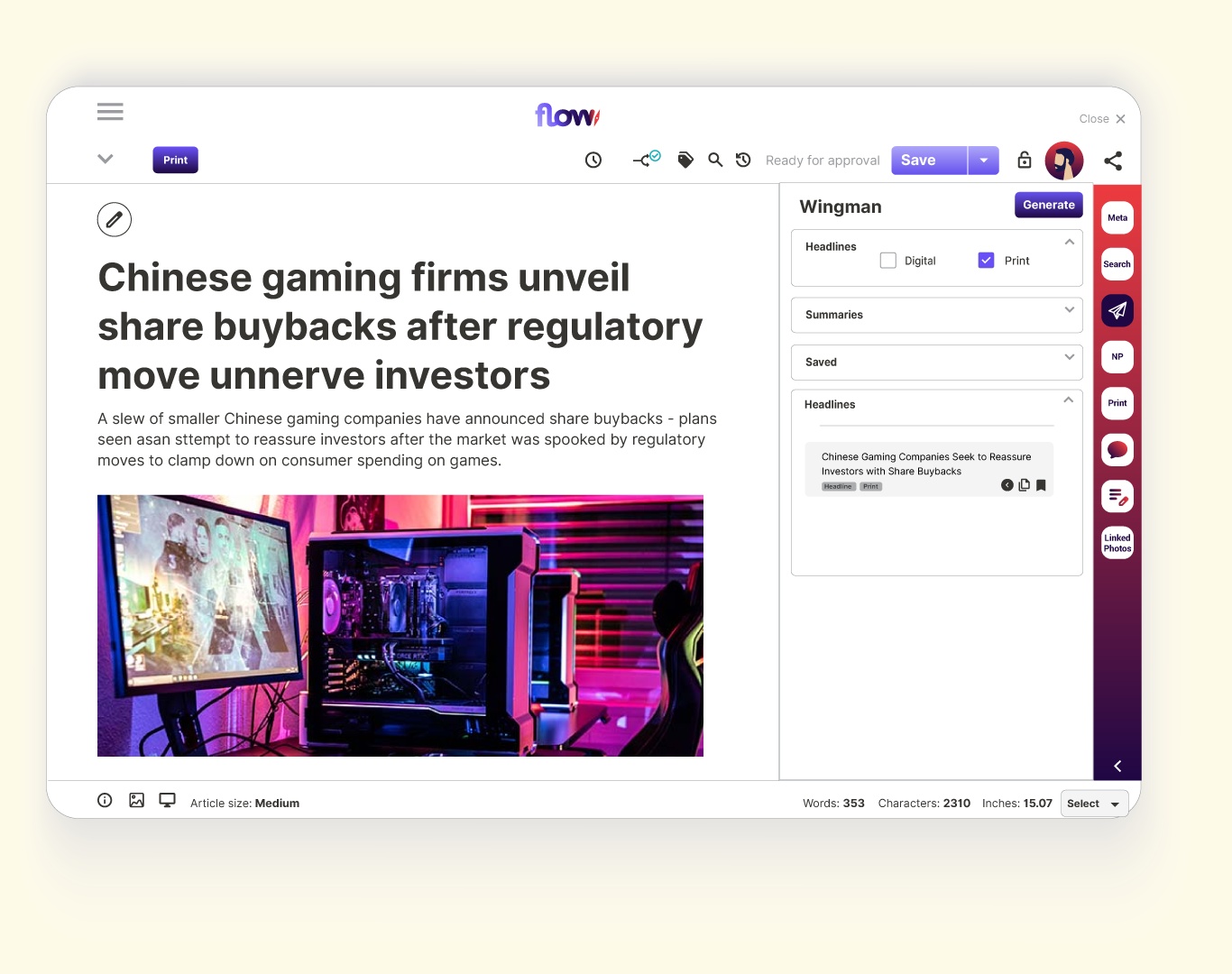
Flow now advertises AI-assisted headlines, summaries, social posts and image tagging, with configurable prompts and model choices. These are advertised capabilities, rather than a promise that every newsroom will save the same amount of time. The attractive proposition is giving editors help inside the tools where they already work.
Commercial modernization continues too. In June 2026, Naviga announced that Guernsey Press had selected its advertising platform to replace Knowledge Prospect. The proposed system connects customer and campaign management with production, billing and reporting. Another publisher, another set of handoffs to tidy up.
Bonnier offers the more memorable test. According to its account, readers did not notice the switch to automated layouts. For production software, that is an oddly satisfying ambition. The newspaper arrives, looks like itself and leaves its people with a more manageable way to make the next one.