BREAKING   Cambridge Terahertz closes $12M seed - Amazon & Felicis back the round SCALE   ~10,000 antennas on a single chip SHRINK   Fridge-sized scanner physics now smaller than a toaster MISSION   "Even one death from a concealed weapon is too many" CRED   FCC THz license + 5 active US Gov / DoD contracts BREAKING   Cambridge Terahertz closes $12M seed - Amazon & Felicis back the round SCALE   ~10,000 antennas on a single chip SHRINK   Fridge-sized scanner physics now smaller than a toaster MISSION   "Even one death from a concealed weapon is too many" CRED   FCC THz license + 5 active US Gov / DoD contracts
Founder · Engineer · Cambridge Terahertz

Nathan Monroe

He taught radio waves to see through clothing, then built a company so the rest of us could look.
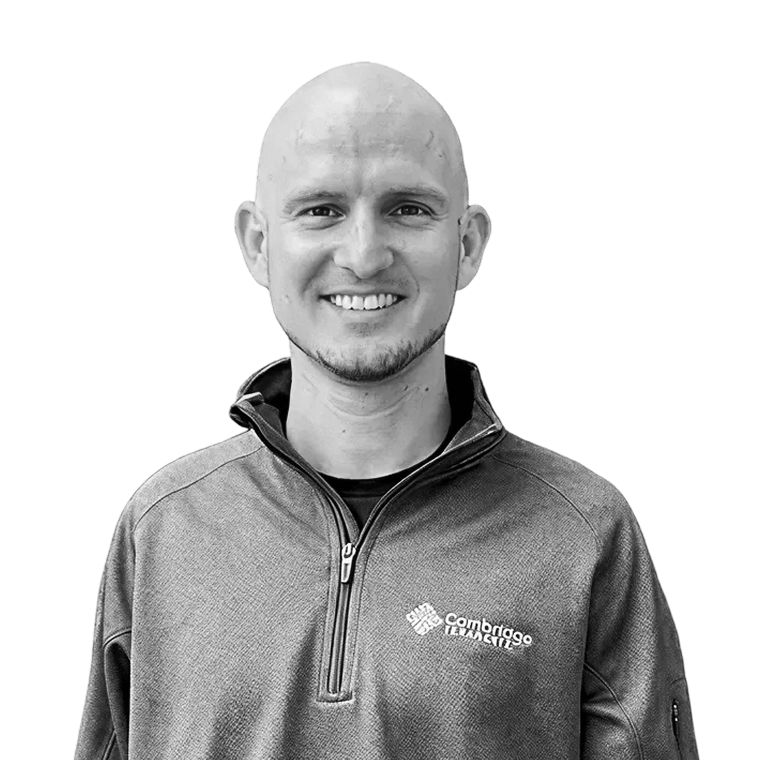
PhD, MIT CEO & Co-Founder Terahertz Imaging Sunnyvale, CA
Nathan Monroe, co-founder and CEO of Cambridge Terahertz
EXHIBIT A. The hardware guy his investors call the best they know. He'd rather show you the chip.
The Dispatch

A camera for the things cameras can't see

Point a surveillance camera at a crowd and it sees coats, bags, and the weather. Point Nathan Monroe's sensor at the same crowd and it sees the outline of a pistol under a jacket, the shape of a blade in a backpack, the contraband tucked inside a sealed box. Same physics that runs an airport scanner. None of the airport.

Monroe is the co-founder and CEO of Cambridge Terahertz, an MIT spinout that turns a sliver of the radio spectrum into 3D vision. The pitch is almost rude in its simplicity: take the room-sized machine you shuffle through at the gate, compress it onto a chip, and let it sit quietly on a wall like any other camera. Then let an AI - and only the AI - look at the picture.

The technology is exotic. The reason he built it is not. Monroe grew up in Florida, and his high school lived through a shooting in which the principal was killed. That fact is the load-bearing wall under everything he has built since. He spent more than a decade at MIT making the physics work, and now he spends his days arguing that detecting a concealed weapon should be as ordinary, and as invisible, as a security camera.

We believe even one death from a concealed weapon is too many. Cambridge Terahertz, founding principle
~10k
Antennas on chip
$12M
Seed raised
6
Patents filed
300+
Fortune 500 demos
See the invisible. Detect weapons. Save lives.
The Physics, Plainly

Refrigerator in, toaster out

Terahertz waves sit in the awkward, useful gap between microwaves and infrared light. They pass through fabric, paper, plastic, and ceramic, and they bounce off metal and skin. For decades the equipment to harness them was the size of a refrigerator and priced like one too. That is the wall Monroe spent his PhD knocking down.

As a researcher in MIT's Terahertz Integrated Electronics group, he demonstrated one of the highest-performance terahertz phased antenna arrays on record - on the order of 10,000 antennas - and built the first THz circuits in Intel's 22nm FinFET process. The trick was using ordinary, scalable CMOS, the same manufacturing that makes everyday chips cheap. The result: airport-scanner capability in a package smaller than a toaster.

FIG. 1 - Terahertz: long enough to pass through cloth, short enough to draw a shape.

How the sensor sees

1

Emit. Safe, non-ionizing radio waves - not X-rays - sweep across a person or package.

2

Read. The waves pass through clothing and materials and reflect off metal, plastics, and skin, returning a detailed 3D signal.

3

Interpret. AI reads the raw image in real time and flags the shape of a weapon - a guard never sees the body underneath.

4

Deploy. The whole thing mounts discreetly, like a camera, so screening is invisible instead of a checkpoint.

Just like you deploy surveillance cameras to see what is visible, you can now deploy our terahertz sensor system to see the invisible.
The Long Road

From a garage near MIT to a government contract

PRE-2015
At Microsoft, helps bring new sensor technology to market inside the Xbox Kinect. A first lesson in making strange sensors ordinary.
2015 - 2022
PhD researcher in MIT's Terahertz Integrated Electronics group. Builds record-setting phased arrays and the first THz circuits in Intel's 22nm process.
2021
Cambridge Terahertz spins out of MIT to commercialize the research.
2022
Completes his PhD, focused on Terahertz Integrated Electronics.
2023
Takes the helm as CEO with co-founder Anand Dixit (PhD, Stanford). Prototypes give way to DoD and NSF contracts.
2025
Closes a $12M seed round backed by Amazon, Felicis and Tishman Speyer. Speaks at the Global Security Exchange.
The Detail That Proves It

He didn't start in a lab. He started in a garage.

The founding mythology of Cambridge Terahertz is unfashionably literal: a prototype, a workbench, and a garage near MIT. From there the team grew into one stitched together from Microsoft, Amazon, Analog Devices, Bell Labs, Boston Consulting Group, and the U.S. Army.

The mission has two origin points, both public, both heavy: a school shooting and the Boston Marathon bombing. Monroe doesn't dress them up. They are why a man who could have stayed in academia chasing record-breaking arrays decided instead to ship a product.

Nathan is the best hardware person I know. A portfolio-company CTO, via Felicis
The Bench

A founder is only as good as who he convinced to follow

Nathan Monroe
CO-FOUNDER & CEO · PhD, MIT

The terahertz and chip mind. Ex-Microsoft Kinect. Six patents and a record-setting array to his name.

Anand Dixit
CO-FOUNDER & CTO · PhD, STANFORD

20+ years in the chip industry, 10 patents. Pairs Stanford silicon depth with Monroe's MIT terahertz.

Kittur Nagesh
CHIEF PRODUCT OFFICER

25+ years in product, former CEO and director roles around Cisco and Juniper, 17 patents.

Privacy is non-negotiable. Only the AI sees the raw image. Cambridge Terahertz, on how the system is designed
Marginalia

Five things worth filing away

PEDIGREE

Before weapons detection, he helped ship sensor tech inside the Xbox Kinect. He has a habit of making weird sensors feel normal.

SCALE

The core technology compresses equipment once the size of a refrigerator into a device smaller than a toaster.

SAFETY

It uses safe, non-ionizing radio waves - not X-rays - to see through clothing, paper, plastic and ceramics.

PRIVACY

By design, no human guard sees the raw scan. Only the AI interprets the body underneath.

PAIRING

His co-founder holds a Stanford PhD - an MIT-plus-Stanford terahertz brain trust in one company.

RANGE

The same sensor that finds weapons can spot return fraud by seeing inside an unopened package - which is what caught Amazon's eye.

The Bet

If he's right, the scanner disappears

Monroe's wager is that weapons screening becomes ubiquitous by becoming invisible. No checkpoints, no lines, no taking off your shoes. A sensor on a wall in a school, a venue, a transit station, doing the work quietly and handing only the answer - not the image - to the people who need it. The funding, the FCC license, the five government contracts, the 300-plus demos: all of it is in service of one stubborn idea about what public safety should feel like, which is to say, like nothing at all.

Pass it on

The Sources

Read further