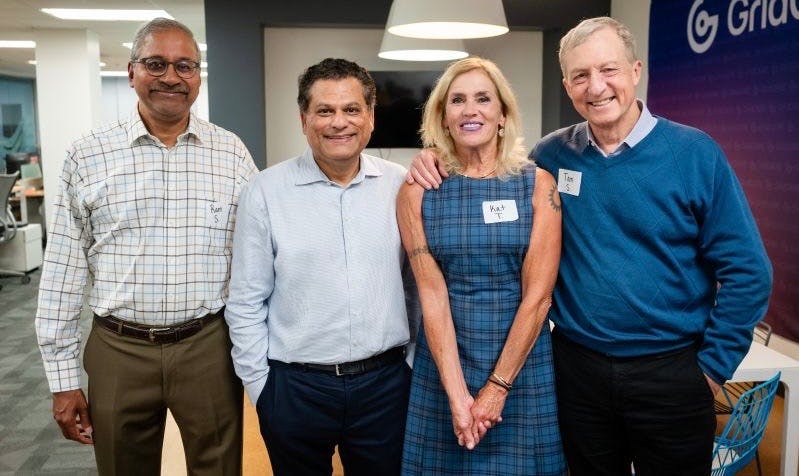
There are roughly 8,000 megawatts of electricity being managed by Virtual Power Plants that Amit Narayan's previous company, AutoGrid, built across 15 countries before Schneider Electric bought it. Most people who know that fact think it's the impressive part. Narayan would tell you the impressive part was finding the 8,000 megawatts in the first place - demand hiding inside thermostats and water heaters and industrial motors, waiting to be orchestrated. He ran that company for a decade. Then he looked at the U.S. power grid and found something larger.
GridCARE, the company Narayan co-founded in June 2024 and launched publicly in May 2025, is built around a single, disorienting claim: more than 100 gigawatts of data center capacity already exists inside America's power grid. It has not been discovered yet. AI data centers are waiting 5 to 7 years to connect to the grid not because the capacity isn't there, but because the methods used to find it haven't changed. GridCARE's DeFlex platform changes the methods. It analyzes billions of data points - grid physics, hourly demand modeling, flexibility parameters across hundreds of variables - using generative AI techniques comparable to those used in protein folding. The grid has structure. DeFlex reads it.
The first proof came in Oregon. Portland General Electric partnered with GridCARE for a project in Hillsboro. The result: 80-plus megawatts energized by 2026, 400-plus megawatts by 2029, years ahead of what traditional grid interconnection queues would allow. National Grid followed with a New York collaboration in March 2026, targeting large-load customers facing the same bottleneck. PG&E is working with GridCARE too. So, according to Narayan, are nearly all the major hyperscalers. GridCARE's 27-person team sits at the intersection of every data center deal in the country that is stuck waiting for power.
The company's revenue model is surgically designed around proof: GridCARE earns when developers and utilities actually sign contracts based on megawatts unlocked. No contracts, no revenue. That is not an accident. It is the kind of constraint you design in when you are confident enough in the product to bet the business model on verified outcomes.
"We use AI to deploy AI faster by turning hidden grid capacity into a fast lane, compressing years into months, and solving the defining constraint on AI - power - to enable an era of abundance."
- Amit Narayan, CEO, GridCARE
Before GridCARE, before AutoGrid, Narayan built semiconductor design software at Magma Design Automation - software that ended up being used to design more than one-third of all advanced chips ever made. That company sold to Synopsys for $523 million in 2012. He also founded Berkeley Design Automation in 2003, an analog and mixed-signal circuit verification startup that Mentor Graphics acquired in 2014. Three companies. Three acquisitions. Each one rooted in the same skill: finding latent capacity inside systems that specialists call too complex to optimize.
His academic arc traces the same pattern. B.Tech at IIT Kanpur. Ph.D. at UC Berkeley. Director of Smart Grid Research at Stanford. Twenty-five published research papers. Seven patents. He is not a founder who borrowed credibility from a prestigious degree - he is a researcher who built companies because the research led somewhere buildable.
GridCARE's co-founders complete the picture: Ram Rajagopal (Stanford professor, AI for power systems), Liang Min (Executive Director, Stanford's Bits & Watts initiative), and Arun Majumdar (inaugural Dean of Stanford Doerr School of Sustainability, former VP of Energy at Google). The founding team is not assembled from central casting. It is assembled from the actual intersection of energy physics, AI research, and policy. The company was incubated quietly through the Stanford Sustainability Accelerator before Narayan brought it public.
Narayan also runs Aina Climate AI Ventures, a company creation studio and fund dedicated to catalyzing climate solutions using generative AI - which itself co-invested in GridCARE. Between AutoGrid's sale and GridCARE's launch, he did not go to the beach. He built the institutional infrastructure to keep funding the next thing. National Grid Partners invested in Aina at the 2025 NextGrid Alliance Summit.
Fast Company named GridCARE to its World's Most Innovative Companies list for 2026 in three categories: Applied AI, Energy, and Small and Mighty. The World Economic Forum cited GridCARE's Oregon project in its Innovation Playbook for Future Power Systems. Ram Shriram - founding board member of Google - joined GridCARE's board in January 2026. These are not validation from the sidelines. They are what happens when a 27-person company cracks a problem that trillion-dollar infrastructure spending cannot route around.