One student is a rather severe review of a business plan. When Natacha Beim Boserup finally opened her first school, delays had scattered the families who had expressed interest. She had a curriculum, a conviction and a very short attendance register. Her next task was to call parents who had toured the premises and invite them to try the school for free.
She had already applied for 25 bank loans, found someone to co-sign financing and weathered construction trouble. A classroom full of children was the point of the exercise. Getting the adults through the door turned out to require an education of its own.
The school was CEFA, short for Core Education and Fine Arts. It opened in West Vancouver in June 1998. Today, the organization reports more than 50 schools across Canada. Between those two facts lies a teacher’s sustained attempt to change what adults expect of young children, and what a school should offer them before formal kindergarten begins.
A poet’s idea of a timetable
Beim’s own education had never fitted comfortably into a single subject heading. Born in Uruguay and raised in Montreal, she published poetry at sixteen. Ballet, theatre, painting, journalism and running also appear in her public biography. She speaks English, French and Spanish. The list has the pleasantly crowded quality of a school noticeboard.
Those interests help make sense of the institution she eventually built. An adult who has found room for both teaching and performance might reasonably want a child’s day to accommodate both numbers and drama. CEFA’s name puts the proposition in plain sight: core education and fine arts share the billing. Neither has to wait politely outside while the other finishes.
Her early ambition was teaching. Work in elementary education led to a specialization in junior kindergarten in Europe. Teaching in the French system gave her experience of an academically structured approach to the early years. It also gave her something to argue with. She wanted the possibilities of academic learning, with more room for fascination, artistic expression and the child’s own urge to investigate.
There is a personal consistency here. Her career began with an appetite for several kinds of learning; her school made space for several kinds of ability. A painting, a question and a mathematical idea could all count as serious work. Seriousness, in this setting, did not require everyone to sit solemnly.
“They’re trained to question ‘what and why’ they teach their students.”
Natacha Beim, on CEFA teachers
The adults needed a demonstration
Opening a school gave Beim the freedom to assemble the day she wanted. It also made her responsible for convincing families that this unfamiliar arrangement deserved their trust. In her account of starting CEFA, she recalled parents questioning the length of its program when other schools offered only a couple of hours. An educational argument had become a decision about where somebody’s child would spend the day.
That is a demanding audience, for sensible reasons. Parents can admire an idea and still hesitate at the door. A founder’s enthusiasm cannot take the place of seeing a teacher engage a child. Free trials gave families the opportunity to judge the experience for themselves.
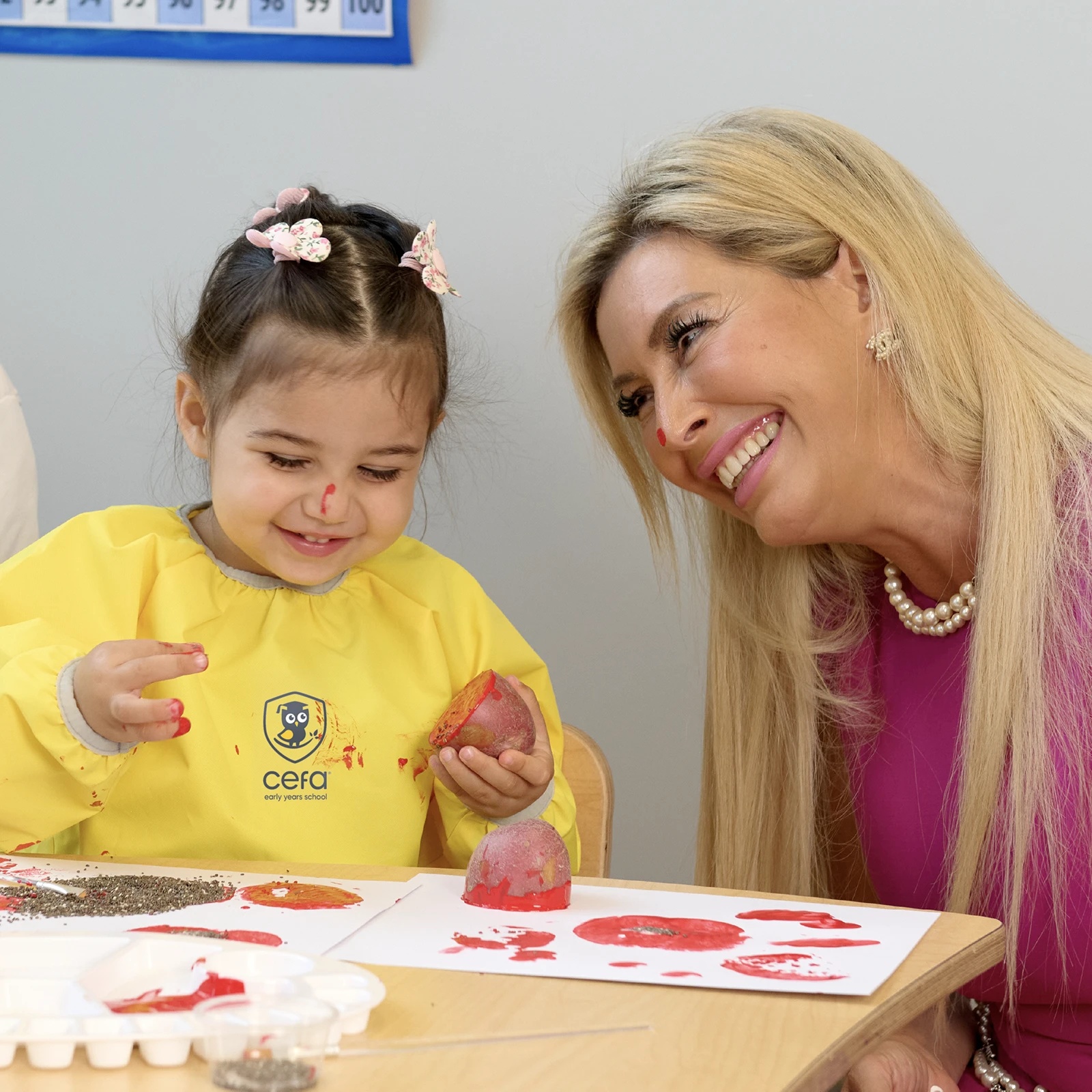
The program brought reading, writing, mathematics and science alongside music, visual art, dramatic art and movement. Community contribution and empathy belonged in the mix too. The ambition extended beyond preparing children for their next classroom. Beim wanted them to discover interests and abilities they could eventually bring to other people.
Her description of the curriculum emphasizes exploration. Children should be able to experiment with their surroundings and retain their desire to play. For the educator, that requires preparation: an activity needs enough intention to introduce something useful and enough flexibility to follow a child’s curiosity. The timetable may look orderly. The learning inside it can still involve surprises.
One classroom becomes somebody else’s classroom
A second school opened in Burnaby in 2003, the year CEFA began franchising. That expansion introduced a different challenge. Beim could personally train the teachers at the first school. A growing network required ways for other educators and owners to understand the approach, use it and improve it without depending on her presence.
Her conception of the curriculum left room for teachers to contribute. Educators could develop ideas and adapt learning to individual students. Calling teachers thinkers carried an obligation: they needed permission to exercise judgment. A child who becomes absorbed in a question rarely checks whether the question is conveniently placed on the schedule.
CEFA’s teacher training, developed by Beim, covers its methodology, curriculum and materials. It also addresses communication with families, classroom leadership and planning. Those details matter because a school’s character is expressed in ordinary exchanges. Parents hear it in a conversation at pickup. Children experience it in the way an adult responds when an activity becomes difficult or unexpectedly interesting.
West Vancouver
Burnaby
reported by CEFA today
Franchising also made choosing collaborators part of the educational work. In an early interview, Beim singled out careful franchisee selection as a major lesson. She wanted owners who would contribute ideas and understand the philosophy. Buying into a school required a willingness to take responsibility for what happened there.
By 2018, franchise partner Rosy Jain described a relationship in which she could discuss ideas openly with Beim and help shape curriculum and operations. Jain had first encountered the program through her son and niece. The route from parent to owner is revealing: familiarity with the classroom could become a reason to take on the business.
A founder learns in public
Alongside building CEFA, Beim became involved in networks beyond her schools. She mentored through the Forum for Women Entrepreneurs and served as president of Entrepreneurs’ Organization in 2015–2016. Her work placed her among other business owners facing their own questions about growth, people and responsibility.
In February 2014, she joined British Columbia’s Provincial Child Care Council. The appointment brought an education entrepreneur into a wider advisory setting. The provincial government’s biography documented her master’s degree in education from Uruguay’s Universidad de la República, along with entrepreneurship and educator awards.
That same year, EY named her a Pacific Entrepreneur Of The Year finalist in its business-to-consumer category. It was recognition of the business she had built around her educational ideas. A school founder has to inhabit both worlds: the argument for what children should experience, and the organizational work that makes an experience possible.
Beim has described herself as an avid learner. In a 2015 interview, she said she read at least three books a week and set aside two hours daily for research. Those were her reported habits at the time, and they suggest a founder who treated learning as work with a place in the diary. Curiosity benefited from an appointment.
The former student at the dinner table
One of CEFA’s early students had an unusually close view of its founder. Julian Beim, her son, grew up hearing about the schools around the dinner table. Years later, he became a franchisee himself. His first-hand account brings the family story back down to the practical scale of opening a building and assembling a team.
By 2025, he was operating a school in Calgary’s Beacon Hill and had opened another in Okotoks in September 2024. He described learning to manage construction, recruitment and relationships. Growing up near a business had provided context. Running a school still meant acquiring the skills to support the people inside it.
The connection is pleasing without needing much decoration. A child who experienced the program eventually chose to help deliver it. The questions his mother had faced returned in another generation: how to hire well, make families welcome and translate an educational purpose into a reliable daily routine.
Leave a little room for the answer
In her 2026 Canadian Dream Podcast conversation with Elton Hubner, Beim returned to the capabilities adults can overlook in children. She encouraged parents and educators to explore answers together rather than always supplying them. It is a small adjustment in conversation, with a considerable change in who gets to do the thinking.
Her story also reached further back. Her parents sought refuge in Canada after dictatorship took hold in Uruguay; the family settled in Montreal when she was five. The child who arrived in a new country grew up to build places intended to give other children room to discover what they could do.
CEFA is now pursuing expansion into the United States. The prospect adds another territory to a project that began with a teacher’s dissatisfaction and one Canadian school. Its next chapters will depend on the same human work that made the early ones possible: finding educators and local partners who can put the approach into practice.
For Beim, the enduring question concerns contribution. What might a child become interested in? What could that interest make possible for someone else? A school can offer materials, time and encouragement. Then comes the part an adult cannot complete on the child’s behalf: leaving enough room for an answer to appear.