Money left under a mattress has one dependable quality: it never asks you to complete a know-your-customer form. It also does not compound, diversify or prepare anyone for retirement. Muhammad Shamoon Tariq has spent the past few years trying to make the sensible alternative feel just as uncomplicated.
His company, Mahaana, sits in an unusual patch of Pakistani finance. It is a technology startup, a regulated asset manager, an investment adviser and, perhaps most importantly, a translator. It turns the vocabulary of funds, custody, risk and tax credits into a phone-sized journey for people who have rarely been invited into the capital markets.
The ambition is easier to grasp through the arithmetic. When Mahaana raised $2.1 million in 2022, Pakistan had roughly 250,000 people investing directly in shares, according to figures cited at the time. Sweden, the country that shaped much of Tariq’s professional life, counted millions of individual investors. Pakistan did not have a shortage of workers. It had a shortage of doors.
01 / Before the appLearning the frontier
Tariq’s route to startup founder began with the uncinematic craft of financial models. At Optimus Capital, he covered major sectors on the Karachi exchange after an earlier stint in consulting at Ghafoor & Co Chartered Accountants. The work was close to the ground: read the accounts, test the assumptions, decide what a business might be worth.
In December 2013 he joined Tundra Fonder, the Swedish investment manager, as an analyst focused on Pakistan and other frontier markets. His remit grew. As a partner and investment manager, he worked across about 15 markets in Asia, Africa and Latin America, including Vietnam, Bangladesh, Sri Lanka, Egypt, Kenya, Nigeria and Argentina. He also helped launch Tundra’s Sustainable Frontier Fund in 2015.
Frontier investing gives its practitioners a peculiar education. A company can be excellent while the surrounding pipes are unreliable. Market structure, custody, access and regulation are not background details. They decide who can participate and how much participation costs. Tariq earned recognition from Citywire for his portfolio work, but the more useful inheritance may have been a feel for the machinery around a stock certificate.
“We want to create a platform for digital on-boarding of clients. It’s secondary how many ETFs we launch. Our collective target should be on increasing the number of investors.”Muhammad Shamoon Tariq, 2022
Sweden supplied a second contrast. Private saving there is routine, helped by decades of policy and accessible products. Pakistan has voluntary pension structures too, but participation has been slight. When digital onboarding and remote identity checks became possible in late 2021, a legal bottleneck loosened. Tariq saw the moment when a slow institutional change could become a company.
02 / Regulation as architectureThe least glamorous moat
Mahaana joined Y Combinator’s Winter 2022 batch. The accelerator credential helped, as did backing from VEF, SparkLabs Group, IGI Holdings and Mattias Martinsson, Tundra’s founder. Yet the difficult work was local and bureaucratic in the best sense of the word.
A saver should not have to think about every institution beneath an investment button. The founder must. Mahaana worked with the Securities and Exchange Commission of Pakistan on the digital asset-management framework, with the Pakistan Stock Exchange on listed products, and with the Central Depository Company on custody. Each relationship answered a different nervous customer question: Is this allowed? Can I buy it? Where is my money held?
This is why describing Mahaana as merely an app misses the interesting part. The interface is the visible inch of a much longer bridge. Underneath sit account-opening rules, fund documents, Shariah review, bank transfers, brokerage relationships, reporting and customer support. Fintech becomes credible when the screen is boring because the machinery is not.
Tariq occasionally reaches for a helpful piece of shorthand. “We’ll be like Vanguard,” he said in 2022. He was pointing to the American manager’s combination of broad funds, relatively low costs and guidance based on a customer’s risk appetite. It was a reference model, not a claim of comparable scale. Mahaana’s immediate territory was distinctly Pakistani: Islamic products, thin ETF trading, cautious first-time savers and the stubborn comfort of cash.
03 / Products before poetryA ladder for cautious money
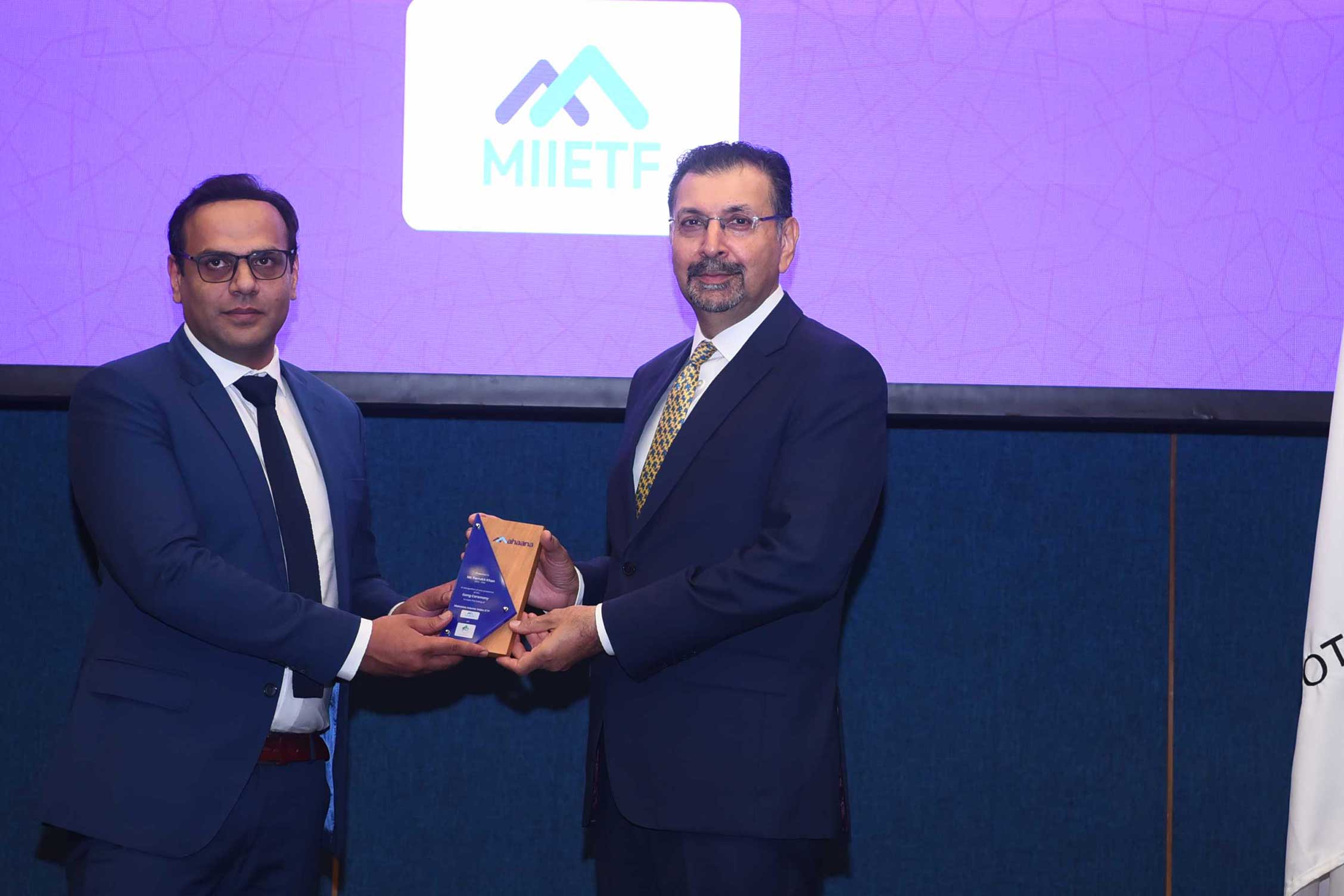
The product sequence tells the strategy. Mahaana Save+ gives customers access to the Mahaana Islamic Cash Fund, aimed at the low-risk end of the spectrum. The Mahaana Islamic Index ETF, or MIIETF, packages 30 liquid Shariah-compliant companies selected from Pakistan’s market into a listed fund. It began trading on March 11, 2024. By late August 2026, the PSX data portal reported assets near PKR 1.95 billion.
Then came retirement. In 2025, Mahaana and IGI Life introduced a paperless Shariah-compliant retirement proposition under Pakistan’s voluntary pension framework. Customers can receive a portfolio recommendation based on goals and risk, see their account online and, subject to the applicable rules, claim a tax credit for contributions. Custody sits with CDC. The arrangement sounds institutional because it is. The novelty is letting an individual enter it without making a day of the forms.
The name holds the quieter insight. Tariq has explained that “Mahaana” means monthly in Urdu. Monthly is an unshowy word. It declines the founder’s temptation to promise overnight transformation. It says that wealth is built by a contribution, followed by another contribution, while markets and time perform their uneven duet.
04 / The behavior problemInfrastructure is only the beginning
Once the rails work, the problem becomes human. People who have never owned a fund do not wake up longing for an ETF ticker. They worry about losing savings, being trapped in paperwork, choosing the wrong product or discovering that the person who sold it has vanished. Digital speed helps with friction. It does not automatically create trust.
Mahaana has therefore become a publisher as well as a product company. Its investor-education library covers market moves, taxes, compounding and the mechanics of saving. Tariq appears in long conversations about mutual funds, Islamic finance, custody and retirement. The tone is less about stock tips than about building a mental model. A new investing culture needs a classroom attached to the account-opening button.
Watch / 75 minutesHow to grow your wealthTariq discusses his Tundra years, the regulatory path to Mahaana, ETFs, mutual funds and what keeps Pakistanis from investing.His own definition of the next phase is admirably plain: “The infrastructure is built. Now comes the hard part - changing behavior and building trust.” It is the sentence of an operator who has discovered that completing the technical challenge merely earns permission to attempt the cultural one.
That cultural brief extends beyond customers. Tariq serves as vice president of the Swedish Business Council in Pakistan and has remained connected to professional education through the Institute of Financial Markets of Pakistan. In 2026, after judging the CFA Research Challenge’s Asia-Pacific semifinals, he reflected that artificial intelligence could accelerate synthesis, screening and pattern recognition. Judgment, he argued, would become more valuable: the ability to form a view, defend it and know when to change it.
The observation applies neatly to Mahaana. Software can remove forms and automate recommendations. It cannot decide what kind of financial culture a country ought to have. Tariq’s bet is that Pakistan’s working population can be brought into regulated saving if access is simple, products fit local preferences and institutions make trust visible.
05 / The monthly testWhat success would look like
Mahaana’s progress is measurable in funds launched, assets gathered and accounts opened. Tariq’s larger objective is more stubborn. Success means investing becoming ordinary enough to be dull: a payroll contribution, a monthly transfer, a retirement balance checked without ceremony. It means the next generation treating diversified ownership less like an exotic financial maneuver and more like a household utility.
There are no shortcuts concealed in that vision. Markets fall. New investors panic. Regulations evolve. Service failures can spend trust faster than advertising earns it. A platform asking people to move cash from the familiar to the financial must be reliable on the least photogenic Tuesday of the year.
That may be why Tariq’s path makes sense. He did not arrive from a world where money was frictionless. Frontier markets taught him to notice the friction. Sweden showed him what routine saving can become. Pakistan gave him the larger assignment: build the door, explain the room and persuade people to return every month.