Monty Hamilton’s prospective investors had seen the Alabama development center. Then the flights were delayed, and the meeting acquired an unscheduled second venue: a rental car. Five hours together. A spreadsheet can introduce a business. A long drive introduces the people who will have to live with the deal.
Hamilton later counted the Bain Capital investment among his proudest business development moments. What pleased him was his ability to remain himself around people who might have intimidated him. He had wanted them to experience the company beyond its numbers. Travel disruption supplied rather more experience than anyone had booked.
That is a useful entrance to Hamilton’s career. The financial milestones matter, but his recurring subject is the person inside the transaction: the investor getting to know a founder, the client explaining a problem, the developer who would rather build a career near home. He has spent years making a commercial argument for taking those preferences seriously.
A career should not require a forwarding address
Hamilton is now executive chairman of Sparq, the Atlanta engineering company previously called Rural Sourcing. He became its CEO in 2009, following Clarkston Consulting’s acquisition of the business. Sparq describes him as a co-founder; the predecessor company already existed when he took its helm. His contribution was to develop and expand a particular proposition: good software careers could be built in places the technology industry too readily passed over.
Consider Jonesboro, Arkansas. In 2010, a young computer science graduate named Zachariah Carlson was working at Rural Sourcing after expecting that a technology career would send him to California. He and his girlfriend wanted to remain near the place they knew. A local job let him customize corporate software without exchanging his whole life for a new address.
Carlson’s story gives Hamilton’s proposition a human scale. The employee received meaningful work. The customer received software expertise. The community kept someone it had helped educate. A moving van would have been an expensive way to connect those three interests.
The economics were straightforward enough to explain without a new management vocabulary. Smaller cities could offer lower living costs, making domestic software development competitive with alternatives elsewhere. Proximity in working hours made conversation easier. People with strong local ties had reasons to stay. Hamilton’s case included the cost of repeatedly teaching replacements a client’s business, a bill that an hourly rate can politely conceal.
Move the work.
Let people stay.
A conceptual view of Hamilton’s domestic sourcing argument.
Mississippi, then the consulting circuit
Hamilton came to that argument with roots in a smaller place himself. A native of Blue Mountain, Mississippi, he attended Ripley High School and completed an associate’s degree at Northeast Mississippi Junior College. He transferred to Millsaps College, studied business administration and played varsity football. He graduated magna cum laude in 1984, then earned an MBA at Southern Methodist University’s Cox School of Business.
Those are two educations: the classroom and the practice field. Hamilton has described competitive team sports as an influence on his approach to business. Football assigns much of the labor to people who will never carry the ball. The scoreboard still depends on them. There is a lesson there for any company inclined to confuse the person making the announcement with everyone who made it possible.
His technology career began in 1988 at the consulting business associated with Accenture. In 1995, he left with colleagues to build Clarkston Consulting. He helped develop a strategic consulting and systems integration firm with offices in the United States and Europe. By the time he took charge of Rural Sourcing, he had experience both inside a large consulting organization and in the work of constructing a smaller one.
The second venture also brought a different question. Consulting helps companies decide how to operate. Rural Sourcing asked where the people doing the work should be able to live. Hamilton brought a consultant’s familiarity with corporate purchasing to a proposition whose beneficiaries also included towns and employees.
The question he almost did not ask
Hamilton’s confidence was acquired, rather than supplied as standard equipment. At an early Outsourcing World Summit, he sat in a crowded conference hall listening to experts discuss the industry’s future. He wanted to ask whether the methods that sent work overseas could also bring it to smaller American communities. He remembered being nervous enough to feel it in his hands, stomach and knees.
He asked anyway. Silence came first. Support followed. Industry figures including Atul Vashistha and IAOP chief executive Debi Hamill helped him explore and develop the idea. Hamilton later worked with the association on a domestic and rural sourcing chapter. His alternative to doing everything internally or sending it offshore needed a professional community as well as a customer list.
“Work hard and be nice to people.”
Monty Hamilton’s favorite advice
The advice Hamilton likes has the advantage of fitting on a band T-shirt. It also sets a fairly demanding daily standard. Working hard can be scheduled. Being pleasant when the schedule collapses is a more revealing examination. The rental-car episode suggests why he treats relationships as part of operating a business, rather than a decorative activity between sales calls.
Five hours beyond the pitch deck
In conversations about business development, Hamilton emphasizes curiosity about another person’s story. Titles and industries tell you something, but they are poor substitutes for understanding what someone wants to accomplish. He encourages preparing specific questions and putting effort into helping a prospective client before knowing whether the effort will produce a sale.
This is patient work. A first conversation has a modest immediate purpose: earn another conversation. Offering useful attention takes more preparation than introducing a list of services. It asks the seller to learn enough about a business to be worth inviting back. Hamilton’s approach gives the customer a way to judge the relationship while the stakes are still relatively small.
Bain Capital Double Impact took a controlling interest in Rural Sourcing in 2019. The capital helped support expansion, people development and a broader commercial operation. The investment gave Hamilton a partner interested in the connection between business growth and economic opportunity. The trip through Alabama had made room for a more ordinary test of partnership: could these people spend time together comfortably?
By 2023, another investment chapter had arrived. Harvest Partners Ascend acquired a majority stake, while Bain reinvested. The business had also acquired a new name. Rural Sourcing became Sparq in March that year. A company built around an unfamiliar purchasing choice had grown into one requiring a broader description.
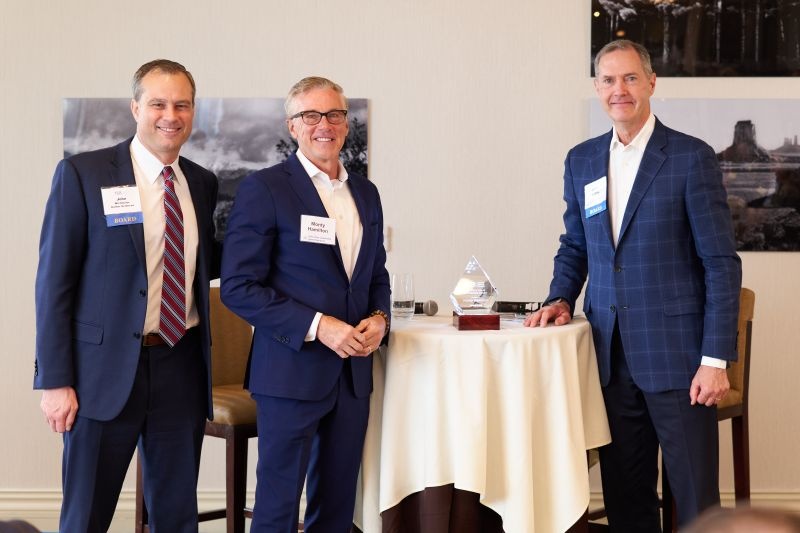
An award with an Atlanta memory attached
In 2023, the Technology Executives Roundtable selected Hamilton for its John Imlay Leadership Award. The recognition connected his own work with an earlier generation of Atlanta technology leadership. When Hamilton arrived in Atlanta after business school in 1988, Management Science America was among the companies that caught his attention.
What stayed with him was the pride people took in belonging to it. Imlay’s legacy, for Hamilton, included that sense of camaraderie. A company can be remembered through its transactions and products; it can also be remembered through the way its former colleagues talk about having worked there. He had encountered that second kind of reputation early.
His connection to education continued beyond graduation. Millsaps welcomed him to its board of trustees in 2020. The college that had given him a business education and a football uniform was now asking for his judgment. The path back to campus had taken him through consulting, entrepreneurship and the effort to widen access to technology careers.
- 2009Hamilton becomes CEO of Rural Sourcing.
- 2019Bain Capital Double Impact invests.
- 2023The Sparq name arrives; Harvest takes a majority stake.
- 2024Octobot adds a Latin American delivery network.
- 2026Hamilton moves from CEO to chairman.
A wider map, and a different chair
Sparq’s map eventually extended beyond the domestic model Hamilton had spent years explaining. In February 2024, the company acquired Octobot, based in Montevideo, Uruguay, with colleagues across Uruguay, Argentina and Colombia. The deal added product development capabilities and more capacity for clients with large projects. The company now combined U.S. leadership with a wider delivery network.
That development complicates a tidy account of Hamilton as an advocate only for keeping work within one country. His business evolved. The new arrangement still valued collaboration across nearby working hours, while expanding where talent could be found. The useful continuity is attention to how teams work together, even as the geography changes.
In July 2024, Sparq also acquired Seattle-based Amplify Consulting Partners, adding data engineering and analytics expertise. These purchases broadened the technical work the company could undertake. A client buying a software project increasingly needed help with the information underneath it, alongside the application people would actually use.
The leadership changed, too. Sparq announced its succession plan in October 2025: Ingrid Curtis would become CEO, and Hamilton would retire from that role effective January 1, 2026, continuing as chairman. Curtis had spent more than 17 years in executive leadership at the company, most recently as president and chief operating officer. The handoff gave the next phase to someone who had helped build the previous one.
Hamilton has said that, given the chance to advise his younger self, he would encourage more risk, less settling and greater enjoyment of the journey. That last point suits a career measured partly in other people’s choices: the graduate who can stay near home, the colleague who can develop new skills, the executive ready to take responsibility for what comes next.
The chairman’s title records a change in duties. The earlier question remains useful. Before asking a capable person to leave, what would happen if the work came to them?