On Mohammed Razem's Drupal profile, beneath the respectable evidence of modules maintained and conferences attended, sits a three-word biography: “An alien anthropologist.” It is a small joke with unusually good aim. Razem has spent much of his working life studying a peculiar civilization - the people who build, buy, edit, govern, and occasionally curse at websites - then turning his observations into systems they can share.
He is the founder and CEO of Vardot, a digital agency built around Drupal and open-source technology. The company now describes a global team of more than 70 professionals. Razem's own public trail begins in 2007, with Drupal 5 and the unglamorous craft of making web software behave. Before the chief-executive title, there were jobs in IT management, web administration, technical operations, development, evangelism, and theming. The route to the boardroom went through the issue queue.
That chronology matters because Vardot's central idea is not really about a particular content management system. It is about accumulated judgment. Build something. Watch people use it. Notice what repeats. Package the useful parts. Improve them in public. Then begin the next project with more than an empty folder and a heroic deadline. The habit sounds simple. Practicing it for years is the difficult part.
The proof is in public
Open source gave Razem a technology stack, but it also gave him a public ledger. His profile records maintained modules, themes, distributions, documentation, translations, reviews, mentoring, security work, and years of event attendance. The list ranges from useful little conveniences - a language switcher, Ajax tabs, a YouTube feed parser - to the much larger family of Varbase projects.
For a service business, that ledger does work a brochure cannot. A brochure says an agency knows Drupal. A contribution history lets a client inspect how it behaves around Drupal. Does the team maintain what it releases? Does it review other people's work? Does it stay for the dull years after the launch party? Contribution is not sainthood, and badges cannot replace due diligence. Razem has said as much while discussing Vardot's partner credentials: understand what a signal measures, and where it stops.
“I would rather you weigh the credential on what it measures than take it on my word.”Mohammed Razem, on evaluating Drupal partner status
It is a revealing sentence from a founder. The salesmanship remains, but it arrives with its own warning label. In enterprise technology, where every vendor promises transformation and every slide deck contains at least one glowing cloud, precise restraint is refreshing. Razem's argument is that proof should be inspectable. Persuasive evidence often exists before the buyer arrives.
Stop rebuilding the plumbing
The practical expression of that philosophy is Varbase, Vardot's Drupal distribution. A distribution collects a tested starting set of features, configuration, and conventions. The proposition is admirably unsentimental: many enterprise websites need the same plumbing, so stop charging talented people to rediscover where the pipes go.
The reusable-platform wager
shared core
The reward is compounding attention. If authentication, media handling, search, editorial permissions, and common page patterns begin from maintained foundations, the project team can spend more of its energy on what is actually specific. The risk is equally clear: reusable infrastructure becomes valuable only when somebody keeps maintaining it. A productized service trades the drama of reinvention for the responsibility of stewardship.
Razem was making this case more than a decade ago, arguing that productizing Drupal services could reduce duplicated effort and improve consistency. It remains a useful agency lesson. Expertise trapped in a senior developer's memory is fragile. Expertise turned into a maintained system can teach the next hire, support the next customer, and reveal where the old assumptions no longer fit.
A constraint becomes an advantage
Multilingual publishing is where Vardot's geography and its product thinking meet. Arabic-and-English websites force questions that monolingual teams can postpone. Does the layout work from right to left? Are translated URLs discoverable? Can editors see which version is current? Do approval workflows survive multiple languages, time zones, and legal responsibilities? Translation may begin with words, but it quickly reaches the architecture.
Razem has taught those concerns as a system: content versions, translation workflows, search indexing, and the practical work of making a CMS comfortable for the people responsible for it. Vardot's portfolio moved through schools, universities, media organizations, public institutions, and nonprofits. A constraint that could have been treated as regional inconvenience became a portable specialty.
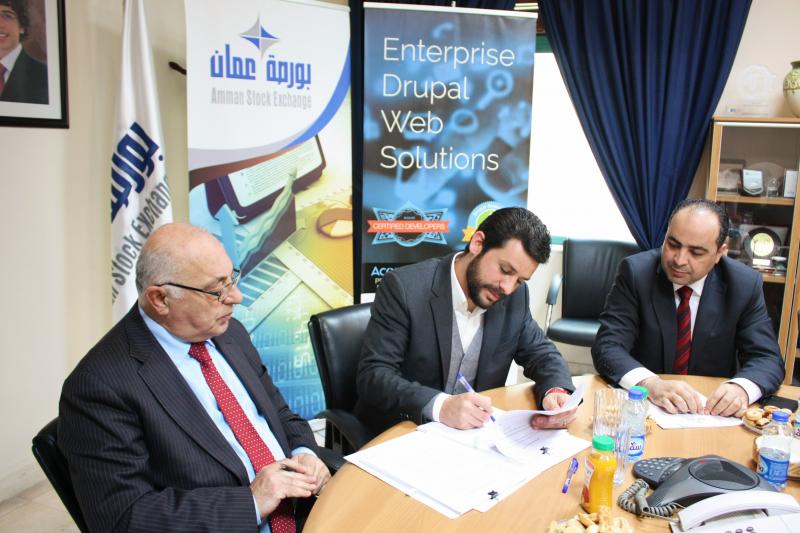
The Amman Stock Exchange agreement captured the idea neatly. The assignment was not simply to make a fresher website. It was to redesign and update an investor-facing platform in Arabic and English. Razem expressed gratitude for being selected and framed the project as a long-term partnership. The photograph shows a conventional signing table, bottled water, paperwork, dark suits. Behind it sits the less photogenic challenge: two languages, one institution, many kinds of user, and no tolerance for improvisation in production.
Software for consequential work
At DrupalCon Pittsburgh in 2023, Razem presented a project with a more complicated set of coordinates. The fundraising platform built with UNHCR had to support a global operation spanning nine countries, four regions, 56 currencies, and 10 languages. In its first period after launch, the platform processed $11.5 million in donations in under 12 months.
Numbers give the project scale, but governance gives it shape. A multinational platform needs shared administration without flattening local requirements. It must be fast enough for a donor on a phone, controlled enough for many editors, and flexible enough to manage different markets. These are not decorative web problems. They concern whether an institution can reliably receive support.
Razem's career repeatedly returns to this territory: the website as working infrastructure. Vardoc organizes documentation and knowledge. Drupal CMS publishing work tries to make drafting, review, scheduling, and moderation more humane for editors. SEO, in his telling, starts in architecture and content practice rather than as glitter scattered over a launch. The common thread is operational usefulness.
The ultramarathon test
Away from work, Razem runs long distances, particularly ultramarathons. He describes the lesson plainly: endurance requires stamina, persistence, and a steady pace, and business goals do too. Founder biographies regularly raid sport for metaphor, but this one fits the evidence better than most. He has stayed with the same open-source ecosystem since 2007. The valuable unit is not the launch. It is the maintained year.
Long-distance running also makes a useful test for software claims. How does the system behave after the starting adrenaline disappears? Can another person operate it? Can it absorb a new language, policy, or channel? Does the team still understand the choices after the original architect leaves? Enterprise platforms live in the miles after the ribbon cutting.
That does not make Razem nostalgic. His recent writing has turned toward AI-assisted development and the changing build-versus-buy equation. Tools that reduce the cost of prototypes and maintenance can make custom software reasonable in cases where a merely adequate subscription once won by default. Yet the old concern remains: systems must be understandable and governable. Faster code does not repeal consequences.
The valuable unit is not the launch. It is the maintained year.The operating lesson in Razem's public work
There is a temptation to read an 18-year contribution history as devotion to one tool. A better reading is devotion to a method: learn in public, reuse what survives, disclose the limits of the signal, and keep the system legible to the people who inherit it. Drupal happens to be the landscape where that method became visible. The practice travels farther than the name of the platform.
And perhaps “alien anthropologist” is the right job title after all. Enterprise software needs someone willing to observe the tribe without accepting every ritual. Why does this approval take nine clicks? Why is the Arabic version always late? Why does every project rebuild the same feature? Why does the polished badge mean less than the boring maintenance record?
Razem's answers are rarely theatrical. Put the repeated knowledge into the platform. Make the evidence public. Design for more languages than your own. Pace the work so the team can still improve it years later. Then, like any sensible ultrarunner, keep enough in reserve for the hill nobody mentioned at the starting line.
Follow the work
- Vardot - company work, writing, resources, and webinars
- Mohammed Razem on LinkedIn
- @moerazem on X
- Drupal.org contributor profile
- Talks and speaker profile
- Vardot videos on YouTube
- Published technology commentary