In the beginning, there was a rather beautiful string of numbers. Mingxing Xu, who goes by Star, had spent his education studying applied physics and his early career making machines for the Chinese internet. When he encountered Bitcoin in 2011, and bought some the following year, he admired the design before he understood the size of the business. Confidence could be established by mathematics, in public, without belonging to anyone. For an engineer, it was an elegant machine. For an entrepreneur, it was a slightly alarming invitation.
By Xu's telling, alarm was the prevailing response. Venture investors thought the idea of a Bitcoin company was absurd. Colleagues were teased for working on it. Xu and a small group began Okcoin in 2013 anyway, initially without making much noise about it. The timing soon made discretion impossible. Bitcoin's price and public profile surged, trading followed, and the company found itself growing inside a market that seemed to have skipped childhood.
Thirteen years later, the little experiment has become OKX, a global exchange, wallet and financial-technology company. It says it serves more than 120 million customers. In March 2026, Intercontinental Exchange, the operator of the New York Stock Exchange and a collection of regulated markets and clearing houses, bought a minority stake at a $25 billion valuation. A founder once laughed out of financing meetings was now discussing how two high-performance matching engines might connect crypto, equities and futures.
The apprenticeship before the wager
Xu's origin story contains less destiny than repetition. He completed a bachelor's degree in applied physics at the University of Science and Technology Beijing in 2006, entered postgraduate study at Renmin University, then left. He worked at Yahoo China. In 2007 he joined the small team building Docin, a document-sharing platform, and stayed for five years as its technology leader.
Docin was his practical curriculum. He later described watching a handful of people become a company of hundreds, with the complications arriving in orderly disorder: no users, then users; technical problems, then product and market problems; management, financing and conversations with investors. Xu had to experience the whole creature rather than inspect a single organ. When Bitcoin came along, he already knew how a platform behaves when strangers arrive by the thousands.
“I especially believed in Bitcoin at the beginning; I just didn't expect it to develop so fast.”Star Xu, recalling the early Okcoin years
The attraction was philosophical, though Xu expressed it like a builder. He liked a form of confidence that was shared, inspectable and beyond any one owner's control. He also understood that belief could not be manufactured by advertising. The product had to solve an actual need. It is an unfashionably plain idea, which may explain its durability.
The expensive education of scale
Platforms do not become infrastructure merely by becoming large. They inherit duties, often before their founders have finished admiring the growth chart. OKX's history supplies a severe example. In February 2025, its Seychelles entity pleaded guilty in the United States to operating an unlicensed money-transmitting business. It agreed to forfeit $420.3 million and pay a fine of about $84.4 million.
The admitted conduct was serious. Although OKX formally barred U.S. customers, users could circumvent its location controls, and for years customers could trade without supplying basic identifying information. The agreement required continued work with an outside compliance consultant through February 2027. The episode belongs in Xu's story because it changes the meaning of everything that follows. Reliability is no longer a pleasant engineering metric. Rules are no longer somebody else's department.
Xu's public language now dwells on verification, market integrity and controls. In his account of 2025, he defined financial freedom through systems that remain online under stress, assets that can be verified, markets that remove abuse and self-custody that ordinary people can use. The poetry of mathematical trust has acquired a compliance manual. It is less romantic and much more consequential.
“Transparency is not achieved through announcements. It is achieved through repeatable verification.”Star Xu, 2025 year-end letter
This change invites skepticism. Every financial company discovers the word trust when regulation becomes expensive. Yet Xu's version is unusually mechanical. He cites reserve ratios, transaction capacity, order latency, surveillance and custody architecture. His preferred nouns have bolts in them. Even his cultural principles for OKX are terse commands: stay objective, use data, take ownership, get things done.
The custodian who prefers an exit
Here is the productive contradiction in Xu's plan. He runs a centralized exchange, a business that becomes useful when customers deposit assets. He also insists that self-custody is the future, a future in which customers can remove those assets and control the keys themselves. A careless exchange founder might treat that as cannibalism. Xu treats it as product design.
His argument is that freedom requires usable choices. Centralized venues can offer liquidity, rapid execution and familiar account recovery. Onchain wallets can offer direct ownership and access to open protocols. If either side is unsafe or bewildering, the choice is theatrical. OKX has consequently built both: the exchange and the door out of it, with passkeys and wallet interfaces intended to make that door less frightening.
The ICE relationship extends the same bridge in another direction. ICE will license OKX spot prices for regulated U.S. futures, while the companies plan to explore routes for OKX users to reach futures and tokenized equities. ICE receives distribution and blockchain infrastructure. OKX receives a partner whose entire reputation rests on regulated plumbing. One began with internet money, the other with energy markets. They meet at the matching engine, which is perhaps the least glamorous place a revolution can end up.
Xu has continued pushing outward. In 2026, OKX announced European payment and card products, an infrastructure stack called Exchange OS and a new version of OKX Pay. The names differ, but the strategy repeats: make the crypto layer less visible, connect it to assets people already recognize, and let software handle more of the awkwardness.
A founder who talks in operating instructions
For much of OKX's growth, Xu was less conspicuous in English-language media than the business he had created. His recent public presence is more regular and more revealing. On LinkedIn and X, he comments on system migrations, product architecture, hiring and compliance with the clipped enthusiasm of a chief technology officer who happens to run the company. A successful migration of a core trading system between countries becomes a lesson in latency. A new finance leader becomes evidence that digital assets and conventional institutions are converging. Even a Formula One partnership is praised through trust, technology and execution, as though a racing car were an especially loud distributed system.
His stated culture is equally spare: be open, remain objective, use data, do the right thing and get things done. He celebrates employees who have stayed for five, eight or ten years, the quiet specialists hidden inside a global operation. Bureaucracy and internal politics receive less affection. None of this proves that a company of OKX's size behaves exactly as its founder wishes. It does show what Xu chooses to reward in public: competence without theatre, expertise attached to delivery.
The industry's small early circle also keeps resurfacing. Xu hired Changpeng Zhao in 2014, before Zhao founded Binance and became a direct competitor. In a 2026 recollection of an early Hong Kong Bitcoin conference, Xu responded with good humor to a photograph from that period and marveled at how much had changed. The relationship later accumulated disputes, as relationships between ambitious founders often do. The old image remains useful. Before global exchanges became institutions with national licenses and stadium sponsorships, their future leaders stood in the same rooms, trying to persuade a skeptical public that internet money was worth taking seriously.
What survives the manifesto
Xu's early faith was in a system without an owner. His adult responsibility is a company with customers, regulators, employees and failures that possess very clear addresses. The journey from one to the other is the interesting part. It explains why his aspirations sound broader while his language has grown stricter.
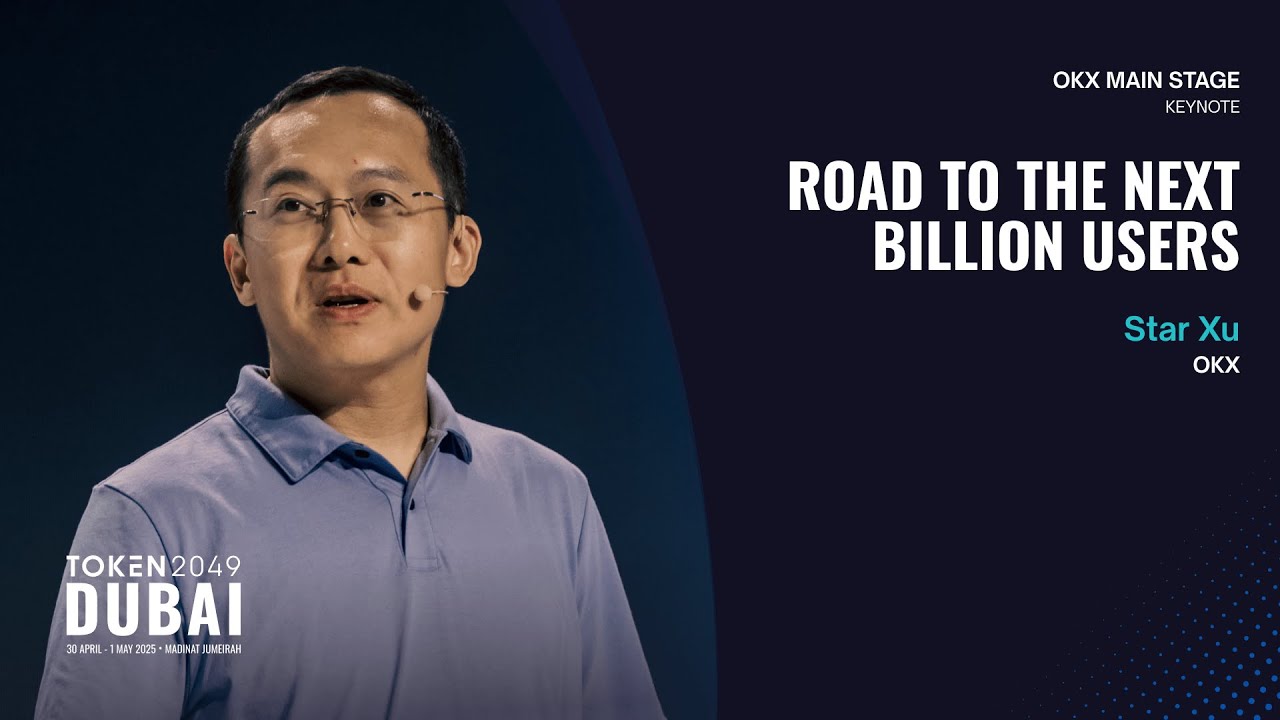
The next billion users are unlikely to arrive because they have developed a sudden fondness for private keys. They will arrive if payments are quicker, markets stay open, ownership travels easily and mistakes do not become catastrophes. They may never know which chain settled a transaction. This is good news for builders and disappointing news for people who enjoy manifestos.
Xu still writes that everything will move onchain and that crypto will consume the world. The more revealing promise is quieter: systems should work when tested. After the exuberance, the investigations and the reinvention, he is back where an engineer is comfortable, arguing about load, verification and failure modes.
His wager is no longer simply that Bitcoin will matter. It is that open networks and regulated institutions can be joined without making the user choose between competence and control. OKX has not resolved that contradiction. It has made a business out of trying. Somewhere inside the $25 billion valuation is the beautiful little machine Xu noticed in 2011, still asking who must be trusted, and how little.