In 2002, a Rochester software company had an interesting arrangement with a school district. East Rochester would get a web-accessible system connecting its two school buildings. Mindex would give the district a discount. In return, Mindex would keep the rights to the product. The customer bought useful software; the developer kept something it could sell again. For a company accustomed to selling its expertise by the engagement, that was a consequential little clause.
- Mindex runs two businesses together: enterprise software services and its own education products.
- SchoolTool is built around New York school administration; analytics and MTSS products reach further.
- Its own legacy software supplied a practical test of its cloud modernization expertise.
- The repeatable lesson: preserve useful product rights, then budget for the years of maintenance that follow.
The contemporary report is refreshingly plain. SchoolTool handled attendance, grades, scheduling, census reporting, and communications. Mindex’s familiar customers included Kodak and Paychex. Selling a reusable school product was a different proposition from delivering a client’s project. It meant taking responsibility for tomorrow’s needs as well as today’s specification.
“We were looking for a market that needed a Web-enabled enterprise system.”
Marc Fiore, on the early SchoolTool opportunity, 2002
A consultancy with homework of its own
Mindex began in 1994. Its early menu included dial-up internet access and website work, the sort of services that date a technology company more precisely than any anniversary cake. In 1999, according to its company history, it concentrated on software development and organized around Professional Services and SchoolTool.
The two sides remain central to understanding the business. Enterprise customers can buy engineering capacity, a custom application, integration work, or help moving existing systems into the cloud. Education customers buy products that must remain useful through changing school years, reporting requirements, and staff turnover. A project ends. A student information system gets another September.
That arrangement gives Mindex a credible point of difference among software consultancies: it has a long-lived product to maintain itself. Among education vendors, it also has access to engineers working on business applications outside schools. Neither arrangement guarantees good software. Together they create opportunities to reuse experience rather than learn every painful lesson twice.

The dashboard worked. Changing it hurt.
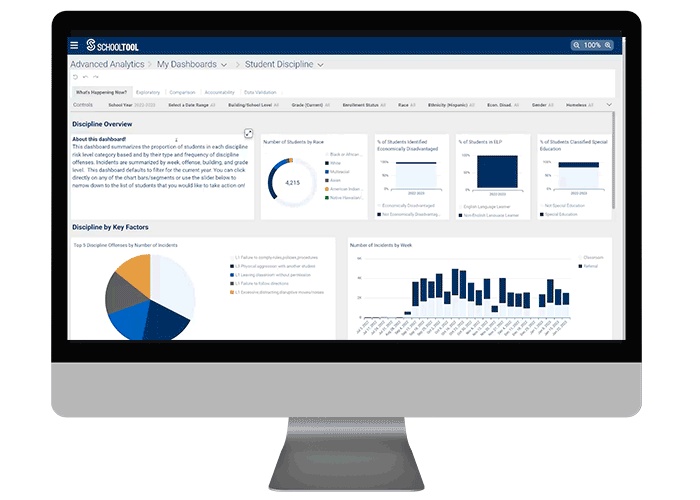
SchoolTool’s early dashboards arrived in 2009. Over time, the custom interface aged, and new visualizations required changes across the data warehouse, application layer, and front end. Mindex describes updates taking months. The bottleneck was the machinery required to produce another useful view of the data.
Its dashboard rebuild replaced that custom work with Amazon QuickSight and a serverless data pipeline. Users could author dashboards themselves. Mindex reports deploying new insights three times faster and a 10% annual cost reduction across districts from retiring old dashboard databases. That figure concerns this change, rather than the entire price of running a school.
The practical lesson is easy to miss amid the cloud vocabulary. Mindex changed who could make the next improvement. A district’s need for a new chart no longer had to become a bespoke front-end programming assignment. Buying an established analytics engine allowed the company to spend more attention on the educational problem.
Twelve regions do not share one calendar
Modernizing the application also meant dealing with its surroundings. SchoolTool ran across more than 400 districts served by twelve Regional Information Centers, or RICs. Those centers had different hosting practices, integrations, and custom reports. Treating them as identical would have made a tidy diagram and a troublesome migration.
Mindex’s migration account describes questionnaires, individual assessments, tailored plans, and regular conversations. School breaks helped determine when to move systems. The company reports completing a planned three-year migration in two years. The people already supporting districts remained part of the process.
districts moved to cloud hosting
A school database has obligations that do not pause for an infrastructure project. Mindex’s method suggests something other organizations can copy: inventory the local exceptions before standardizing the platform. The migration plan must accommodate how customers actually work, including the dates on which they can tolerate disruption.
The value of an empty seat
The most appealing analytics example involves finding a class. A student might need a course offered in another district. A counselor must discover whether a suitable seat exists. Course availability scattered across files and systems makes that ordinary question laborious.
In a 2025 AWS case study, NERIC and Mindex describe a shared scheduling dashboard. SchoolTool data feeds the system; other districts can submit structured exports. Crucially, a district need not replace its student system merely to participate. The reported lookup time fell from roughly thirty minutes per student to five.
25 minutes potentially returned to a counselor, per student.
Approximate times reported by NERIC and Mindex. This measures information lookup, not the whole enrollment process.Permissions matter here. The course-capacity dashboard contains no personally identifiable information, while other student dashboards require restrictions on rows and columns. A shared view is useful only when its audience is allowed to see what it contains. The clever part is making collaboration possible without treating every piece of student data as public property.
A school has more than one kind of record
Today, SchoolTool covers the administrative backbone: student information, attendance, grades, scheduling, and reporting. Its New York focus gives buyers a specific reason to consider it. The product is designed around the state’s schools and their requirements, rather than asking those schools to adapt to an entirely generic system.
Mindex expanded the portfolio by acquiring ClearTrack and RTI Edge from Broome-Tioga BOCES in October 2024. ClearTrack addresses special education management, including individualized education programs and Medicaid-related documentation. RTI Edge is now MTSS Edge, which helps organize academic, behavioral, and social-emotional support and monitor progress.
The distinction matters to a buyer. Student administration, analytics, special education, and intervention planning are related jobs with different users. Connected products can reduce re-entry and make relevant information easier to find. Mindex markets Analytics and MTSS nationwide; SchoolTool and ClearTrack remain focused on New York.
The business behind the school bell
Outside education, Mindex sells custom development, cloud modernization, AI work, managed services, analytics, and integrations. Its public customer roster includes Xerox and Paychex. Weehawken Township offers a particularly concrete example: integration work automates employee health-benefit deduction calculations within its payroll process. The glamour is modest; getting the deduction right is the point.
The commercial model combines software subscriptions or licensing and related delivery services with contracted engineering and continuing cloud support. Customers need a scoped proposal. The useful cost comparison includes implementation, migration, integrations, training, and ongoing operation, rather than merely comparing a software fee with an engineer’s hourly rate.
A district evaluating SchoolTool can compare it with other student information systems such as PowerSchool, Infinite Campus, or Skyward. An enterprise considering Mindex can compare other development firms, cloud partners, and its own engineering team. Those are different buying decisions. Mindex’s appeal rests on domain knowledge and delivery experience; a buyer still needs to establish which particular problem the engagement will solve.
The percentage deserves a second look
The recent services work includes AI-assisted engineering. In September 2026, Mindex published a reporting-team case study showing average cycle time declining from eight days to five. It also reported higher development and pull-request throughput. The explanation beneath the figures matters: improved story readiness and end-of-project cleanup influenced the results alongside AI.
These are engagement results, not a promise that installing an assistant will reproduce them. The approach depends on experienced engineers checking output, useful development tasks, and working processes. For a reader considering the same experiment, the sensible move is to measure a defined workflow before and after changing it, then distinguish coding assistance from the other improvements made at the same time.

Mindex describes leadership coaching, regular individual feedback, and employee-nominated charitable work as part of its culture. The company reached number eighty on Rochester’s 2025 Top 100 growth list. Its story, however, is more useful than a ranking: keeping the rights to a product created an asset, and keeping that asset useful created decades of work.
The discount in East Rochester was the beginning. Every subsequent school year supplied the harder question: could the software continue to earn its place? That is a question worth putting to any vendor, including the one offering to modernize everybody else.