The dot-matrix printer had acquired an unusual skill. Mike Vaughan had trained its moving head to balance a pole, shuttling back and forth to keep it upright. Here was artificial intelligence doing something observable, rather endearing, and commercially awkward. The market for printers that could moonlight as circus performers proved elusive. Vaughan’s company would later recount the experiment with the dry observation that nobody needed one.
It makes a useful opening to a career spent asking what learning is actually for. A machine could learn to correct its movement. Could a person learn to correct a decision? Could an organization help someone practice that correction before the consequences arrived in a customer account, a team meeting, or a business plan? Those questions have given Vaughan considerably more work than the printer did.
Two companies, then a harder question
Vaughan’s route into simulations included a learning management business started in 1995 and a learning content management business in 1998. Both belonged to the infrastructure of workplace education: the machinery through which companies organize and deliver learning. His eventual dissatisfaction was specific. In his account of that period, the businesses were failing to improve thinking or behavior.
That is an uncomfortable conclusion for someone selling learning technology. The delivery system can function beautifully while the person at the other end keeps making the same mistakes. A course can arrive on schedule. A certificate can appear. Monday morning can remain stubbornly familiar.
In 2003, Vaughan co-founded The Regis Company in Golden, Colorado. Simulations became the medium for pursuing the problem. They allowed people to make decisions inside a constructed situation, encounter consequences, and try again. The business would spend years creating custom experiences for large organizations. Its founder had moved closer to the moment he wanted to change: the point at which someone has to choose.
His education crossed disciplines that often occupy separate rooms. He studied cognitive science and computer science at Colorado State University, and earned a master’s in cognitive neuroscience from Middlesex University in London. Software, thinking, and learning became parts of the same professional problem. A learning platform needed to do more than carry information efficiently; it needed to create circumstances in which a person’s thinking could become visible.
A book with an awkward request
His 2013 book, The Thinking Effect: Rethinking Thinking to Create Great Leaders and the New Value Worker, put a demanding proposition into print. Critical, creative, and systems thinking develop through a repeated cycle of trying, reflecting, learning, and trying again. Organizations hoping to teach those abilities through a tidy procession of information were asking the wrong kind of learning to do the job.
The book’s concern reaches beyond the executive suite. Vaughan’s “value worker” is someone whose contribution includes examining assumptions and understanding consequences. The distinction matters because following a procedure can be an accomplishment in a stable situation. When the situation changes, a faithful performance of yesterday’s instructions can become a surprisingly efficient way to get into trouble.
Vaughan also wrote The End of Training, a title unlikely to flatter every conference organizer in his industry. Across these books, his subject has remained the relationship between what a learning experience asks people to do and the capabilities they take away. The interesting test comes after the explanation, when the explanation has to survive contact with a decision.
The question under the question
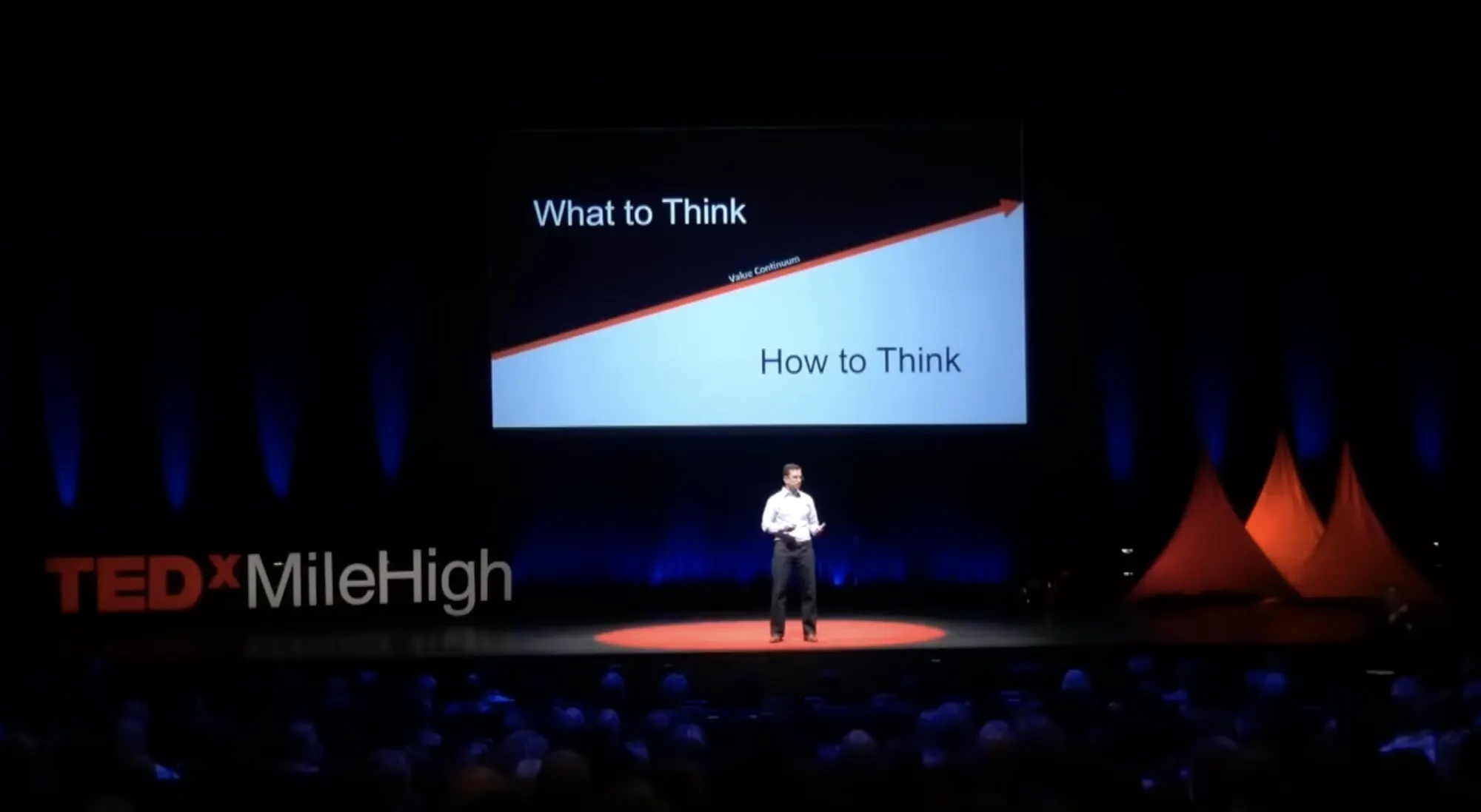
In his TEDxMileHigh talk, published in July 2015, Vaughan asked why decision-making remained so difficult despite the growing supply of information and tools. The presentation gave his professional preoccupation a public form. Its title, How to Ask Better Questions, promised a skill people could carry into an ordinary conversation.
The central distinction was between learning what to think and learning how to think. The first gives people procedures, methods, and information. Vaughan acknowledged the need for that foundation. His objection was to treating it as sufficient. An organization can supply an answer without helping anyone examine the assumptions that made that answer seem sensible.
There is a quietly inconvenient quality to this argument. It deprives the person with the neatest slide of an automatic victory. A question can interrupt a polished explanation and expose the piece nobody has checked. For a leader, that means curiosity has practical work to do. It changes the conversation before the conversation becomes a commitment.
“I think I have more questions than I do answers.”
Mike Vaughan, TEDxMileHigh
The classroom that impressed the executive trainer
One of Vaughan’s more revealing stories takes place away from a corporate boardroom. Writing in January 2018, he described visiting six Arizona elementary schools involved in a Waters Foundation initiative to bring systems thinking into academic subjects. At one school, he observed a group of 11 students who had spent six months learning habits of systems thinkers with a consultant.
What caught his attention was their conversation. The students discussed school problems while recognizing their own contribution to them. They considered environmental planning and consequences reaching years into the future. Vaughan wrote that they would be the envy of many executive leadership programs.
The anecdote helps explain his ambition to make simulation learning available in schools. It also gives his definition of ability a useful looseness. The people capable of discussing a complicated system may be sitting somewhere quite different from the room reserved for experienced leaders. The opportunity to practice matters.
In Vaughan’s account of systems thinking, the central work is tracing relationships, feedback, delays, and unintended consequences. A decision belongs to a larger situation. Understanding that situation requires looking beyond the immediate result, including the consequences that take their time arriving.
When learning briefly looks like getting worse
Vaughan has also written about an awkward problem for anyone measuring development. In a simulation’s early rounds, participants can appear confident and capable. Add information and show the consequences of earlier decisions, and the same people may begin missing apparently straightforward choices.
His February 2018 explanation was that participants could be reconstructing their mental models. An expected outcome had failed to appear; something in their understanding needed revision. A test administered at that moment might catch the uncertainty and mistake it for the whole story.
That observation gives his work some patience. Learning can include an untidy interval between losing confidence in an old explanation and forming a better one. Vaughan argued for feedback that helps participants through that interval, and for observing their thinking over time. A satisfaction questionnaire offers little help with that task. Enjoying a course and changing a decision remain different measurements.
Another attempt makes the feedback useful.
The settings can be consequential. In another 2018 account, Vaughan described work supporting critical and systems thinking at the U.S. Air Force’s Air Command and Staff College. The learning design used missions, decisions, and reflection to help participants generate their own insights. For his purposes, a realistic storyline mattered because it gave thinking somewhere to happen.
A custom business learns to scale
By 2023, the commercial question had become how to make these experiences easier to create. Bespoke simulations require design work. That expense limits who can commission them. For Vaughan, wider access meant changing the production process as well as defending the educational idea.
In September that year, Regis announced SimGate and a $3.5 million seed round led by Access Venture Partners, with Firebrand Ventures, FirstMile Ventures, and Management Concepts participating. The platform brought no-code authoring and AI assistance to simulation creation. Learning designers could use an organization’s existing material to construct experiences, then observe the choices participants made.
Here the founder’s own company became an example of revision. Years of custom delivery had produced experience; software offered a way to distribute the method more widely. The question was how much of the useful complexity could survive that move. A scenario still needed decisions worth making, consequences worth examining, and feedback that changed the next attempt. Faster production alone could not settle that educational question.
Vaughan received recognition as a 2024 Colorado Titan 100 honoree. His advice to developing leaders was appropriately social: seek help from a variety of mentors. The executive selling better thinking was willing to recommend borrowing other people’s perspectives.
The polished answer gets an examination
His public conversations have continued into the AI era. In May 2023, he joined Paul Ashcroft, Simon Brown, and Garrick Jones on The Curious Advantage podcast to discuss AI, learning, mental models, and questions. In November 2025, he appeared alongside Kearney learning leader Bronwyn Kelly and Tata Consultancy Services adviser Bill Quinn in a discussion of upskilling in professional services.
By July 2026, his webinar on judgment under pressure was examining the hazards of confident, AI-assisted work. Its program described a finance-firm example in which polished output looked less convincing once someone examined it closely. Vaughan’s framework considered sense-making, calibration, and orchestration, alongside the influence of mindset, lens, and frame.
The familiar concern has acquired a faster delivery system. When an answer arrives almost immediately, the ability to judge its fit becomes a substantial part of the work. Vaughan’s emphasis on practice gives that concern a concrete direction: put people in situations where they must notice omissions, explain trade-offs, and reconsider.
His personal publication, The Thinking Effect, now opens with an illustrative launch decision. A sponsor wants to proceed on Monday. The pilot looks promising. One customer group was left out. Readers must consider launching, delaying, or limiting the release, and explain why. No printer tricks are required. The balancing act is between a plausible answer and the evidence that might change it.