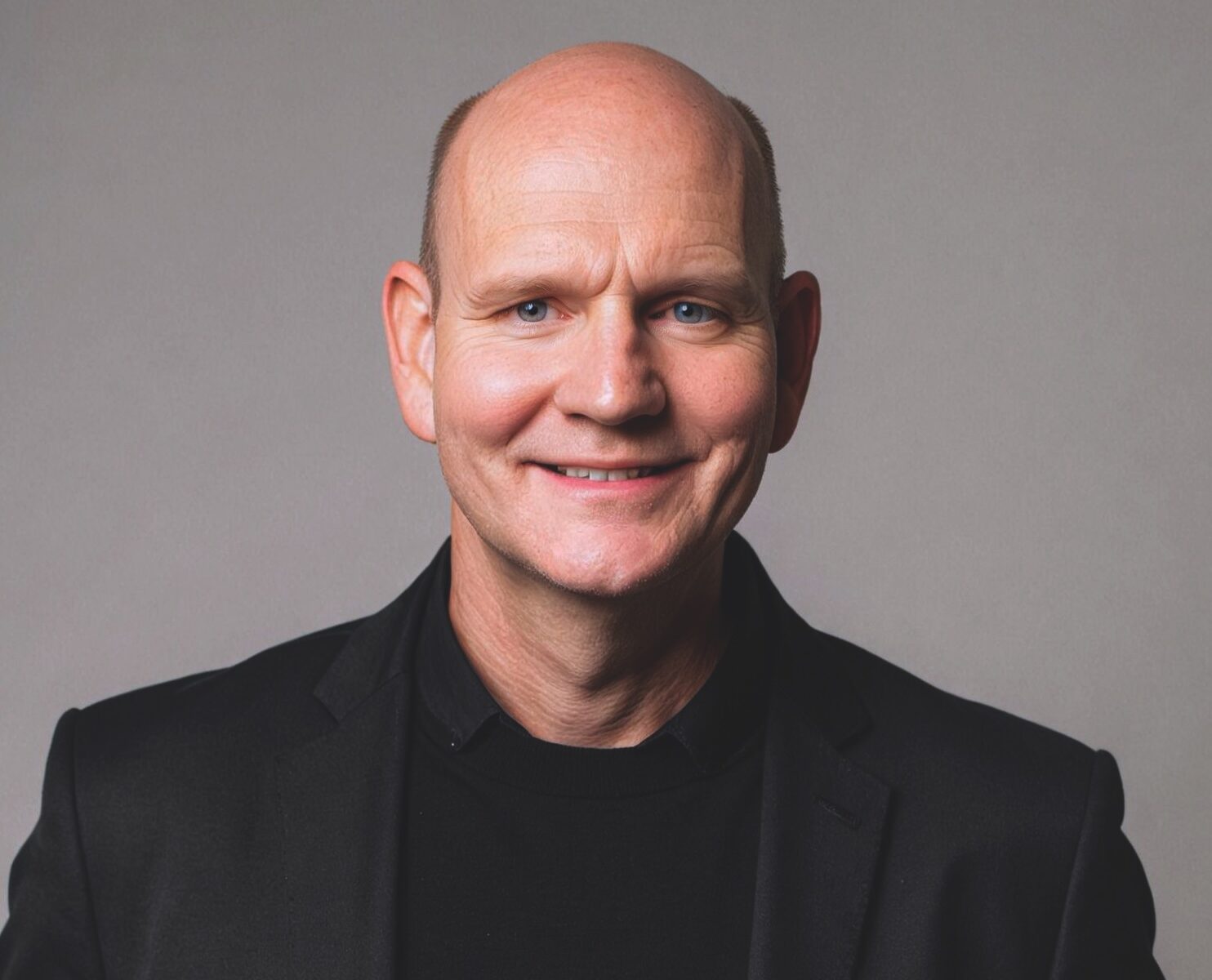
Folding a whole machine onto one chip
In April 2026, a Santa Clara startup called HYFIX Spatial Intelligence raised $15 million led by Craft Ventures. The pitch was not modest: build an American-made system-on-chip that carries a drone's flight control, high-accuracy positioning, secure radio, and onboard compute - all on one low-power piece of silicon. HYFIX calls the idea "stack compression." The chip is called the H1.
Most small aircraft scatter those jobs across separate modules that talk over slow serial buses. Horton's bet is that fusing them lets the estimator touch raw satellite measurements - code, Doppler, carrier phase - instead of swallowing pre-cooked position fixes. The H1 runs the PX4 flight stack natively on NuttX. It is less a part and more a worldview about how robots should think.
The signature trick is heading without a compass. Two antennas sit just 0.2 meters apart - tight enough to fit a sub-250-gram drone - and the H1 reads direction from the geometry between them. That same fixed baseline doubles as a lie detector: if multipath or jamming bends the signals, the measured distance between antennas drifts from its known value, and the chip knows its position fix can no longer be trusted.
The word "American-made" is doing real work in the pitch, too. The drone supply chain runs through one dominant overseas player, and a domestically designed and built SoC for flight, positioning, and secure communications reads as much like industrial policy as it does like a product spec. Horton is selling resilience as a feature: a chip whose corrections, radios, and integrity checks are all under control when the environment gets hostile. When GNSS gets jammed, the H1 is supposed to degrade gracefully instead of going blind - leaning on its IMU, its cameras, whatever sensor fusion has left to work with.
"Dual antenna can replace the compass - going to be better, way better and way more repeatable than a compass."
The press has not handed him a coronation. HYFIX is openly aiming at the sub-250-gram category that DJI's Mini line owns, and the reviews are blunt: $15 million is a fine seed, not a DJI killer, when a single chip tape-out can run $10-50 million. Horton has heard the math. He has built hard silicon before, and he has out-engineered incumbents who looked unbeatable. The hard part, as one headline put it, comes now.
He is not building it alone. HYFIX co-founder Udan Ercan cut his teeth on high-precision positioning systems at Topcon, the survey-grade GNSS heavyweight - the kind of pedigree you want when your entire premise is centimeters. The roadmap is just as concrete as the team: production chips in 2026, a reference drone to prove the part, and marquee design wins from American manufacturers like Skydio and Teal to show the SoC belongs in real airframes. Miss those and the round is a science project. Hit them and HYFIX becomes infrastructure.
Horton is also watching the sky change above his chip. He points to low-Earth-orbit PNT players like Xona, whose signals can land 40 to 100 times stronger than traditional GNSS. A precision timing service expected in 2027, he argues, could let a drone and its controller share nanosecond-accurate time even while GPS is being jammed - turning a data link into a ranging tool in GPS-denied air. The H1 is being designed for a navigation world that does not fully exist yet.
"Stack compression," visualized
21,000 stations, owned by nobody
Before the chip, there was the map underneath it. Around 2021 Horton created GEODNET, a decentralized physical infrastructure network - a DePIN, in the jargon - that pays people in tokens to run small GNSS reference stations on their rooftops. Each one streams real-time corrections that sharpen satellite positioning from "good enough for a phone" down to centimeters.
The incentive design did what venture capital alone rarely manages: it grew to roughly 21,000 stations and became, by station count, the world's largest decentralized RTK network. In May 2025 it surfaced in the U.S. Congress, cited as an example of how decentralized infrastructure can feed innovation, national competitiveness, and regulatory clarity. A rooftop side-hustle, name-checked on Capitol Hill.
That network is also HYFIX's moat. Jam-resistant, spoof-aware positioning needs trustworthy corrections, and Horton already built the firehose. The chip and the network are two halves of the same sentence.
"A system may be operating under the influence of multipath without any clear indication that its position solution has been compromised."
Most positioning startups chase accuracy. Horton chases trust. The corrections GEODNET pushes out are not only about shaving error down to centimeters; they double as a way to verify that the satellite signals a robot is hearing have not been spoofed. In a world where cheap jammers and fake GPS are real threats to drones, framing corrections as an integrity layer - a second opinion the machine can cross-check against - is the kind of move that comes from someone who has lived in safety-critical aviation hardware. The same instinct shows up in the dual-antenna trick: it is not a feature, it is a built-in way for the machine to catch itself being wrong.
What makes the network unusual is who pays for it. A traditional reference network is a capital expense someone has to fund, deploy, and babysit. GEODNET flipped the model: thousands of individuals buy and host small mining stations because the token rewards make it worth their while, and the network densifies itself. Horton effectively crowdsourced a piece of national positioning infrastructure - and then pointed his chip company straight at the firehose it produces.
From smartdust to a $50M exit
Horton was born in Austin, Texas, in 1973, and went west to UC Berkeley for both his bachelor's and master's in electrical engineering. In 1995 he co-founded Crossbow Technology with his advisor, the legendary chip designer A. Richard Newton, to turn silicon MEMS sensors into products. Some of the early motion-sensing work pointed toward the kind of input that later showed up in things like the Nintendo Wii.
Crossbow's real fingerprint is on the plumbing of modern sensing. Working with Berkeley professors Kris Pister and David Culler, the company built the commercial "motes" - Mica2, MicaZ, IRIS, TelosB - that powered the Smartdust and TinyOS research behind today's wireless sensor networks. Crossbow also became the first holder of an FAA-approved TSO for a silicon MEMS attitude and heading reference system, putting tiny chips where bulky aviation gyros used to live.
The company grew to about $23 million in revenue and sold in two pieces - to Moog Inc. and MEMSIC - for roughly $50 million around 2011. Horton kept moving: as a chief technology officer at ACEINNA and Anello Photonics, he pushed inertial navigation forward, helping develop what was described as the world's first silicon photonic optical gyroscope paired with MEMS. Four eras of sensing - MEMS, photonics, decentralized infrastructure, edge silicon - and one question running through all of them.
Between the building, he has also been an investor in the same waters, an active angel through groups like Sand Hill Angels and the Band of Angels, writing checks into sensors, robotics, photonics, and autonomy. It is a tidy loop: the founder who learned to commercialize hard physics now helps fund the next people trying to do it. Across navigation, MEMS, photonics, and decentralized networks, his name sits on more than twenty patents - a paper trail of someone who tends to ship the idea, not just describe it.
Positioning as national plumbing
There is a reason a sensor entrepreneur ended up in front of Washington. As drones and robots move from novelty to infrastructure, the question of where they are - reliably, securely, on American-controlled hardware - stops being a hobby and starts being policy. GEODNET's appearance in 2025 congressional discussion of decentralized infrastructure put Horton's work into exactly that frame: not gadgets, but the dependable substrate that autonomous systems will stand on.
That is the through-thread of a thirty-year career. Crossbow put MEMS where aviation gyros used to be. The photonics work chased navigation that holds up when satellites cannot be trusted. GEODNET built the correction layer the open market would not. HYFIX is trying to fold all of it - position, time, comms, control - into one resilient American chip. Horton keeps changing the technology and the altitude, but the job description has been constant: make sure the machine always knows, with confidence, where it actually is.
Watch & listen
Horton is a generous explainer - the kind of founder who will whiteboard carrier-phase ambiguity for anyone who asks. A few of his longer conversations:
Receipts
Recognition
- MIT Technology Review - Innovator Under 35 (2003)
- Sensors Magazine - Top 50 Sensor Technology Experts (2019)
- Institute of Navigation GNSS+ - Best Presentation (2021 & 2022)
- GEODNET cited in U.S. congressional hearings (2025)
- First FAA-approved silicon MEMS AHRS (TSO)