The image looks finished. The film has a title, the title has a treatment, and everyone in the picture appears to be standing in the right place. Then comes the question that makes the production team reach for its calendar: finished for which market, which platform, and which version of the brief? Michelle Mikesell has built a career around the distance between an image that looks ready and a file that actually is.
She is the co-founder and CEO of 360 Solutions, the artwork and motion localization business she started with Tami Luckie in 2010. Both had worked inside studios. Their starting material included something less glamorous than a movie campaign: experience of managing the arrangements around one. An agency could make the artwork and still leave its customer with considerable work to do.
Mikesell’s story takes place in those arrangements. It runs through programming, marketing production, company ownership and public discussions about artificial intelligence. The recurring concern is practical. Someone has promised that the work will arrive, in usable form, by a particular date.
The deadline before the company
Before her name appeared on an agency’s founding story, it appeared among studio executives. In 2009, Mikesell was Sony’s vice president of worldwide programming and marketing production. Luckie was also at Sony, as vice president of worldwide marketing production. The future partners were already working in the territory their company would later serve.
Before Sony, Mikesell worked in programming at DIRECTV Latin America. Her education included time at UCLA from 1989 to 1992. Programming, studio production and later agency ownership became the coordinates of a career closely concerned with entertainment moving between audiences and markets.
The Sony job title deserves a moment. “Worldwide” is a small word that creates a large assignment. Programming and marketing production have to account for what is being released and how it will be presented. Add different markets, and the approved creative becomes the beginning of a series of decisions rather than the end of one.
Two people who had sat in the client’s chair
Mikesell and Luckie founded 360 Solutions after seeing how creative delivery worked from inside the customer’s organization. Their company’s origin account describes a familiar accumulation: multiple suppliers, repeated handoffs, and responsibility becoming less clear as deadlines drew nearer. Each additional participant could bring useful expertise and another person to chase.
That is an awkward feature of buying help. The buyer may acquire a finished task together with a fresh management assignment. Mikesell and Luckie’s response was to build a business that accepted more responsibility for the route through production. Their studio experience gave them a view of the time the customer spent around the deliverable.
The division of work at 360 makes that response concrete. Designers and production artists create and adapt the material. Project managers coordinate the work. Quality-control managers review it against the relevant requirements. Account directors handle the client relationship. It is an arrangement designed to answer a question that becomes rather pressing near release: who is following this all the way through?
For Mikesell, the move into ownership meant turning knowledge of a client’s working day into a service other clients could buy. Luckie brought her own production experience to the partnership. Their founding story has the appeal of a complaint that was eventually given an operating structure.
The artwork has to travel
Consider what the business handles. A title treatment needs to work in another language without losing its relationship to the original campaign. A piece of key art needs a shape suitable for a particular screen or storefront. A motion asset brings its own requirements. Each adaptation has to belong to the same release while doing a different job.
360’s published account of its Netflix work describes regional imagery, different writing systems and hand-drawn local logos. It also describes the scheduling and review needed to keep volume manageable. The combination matters: design decisions and production decisions arrive together. A visually convincing solution still has to fit the intended use.
The company’s current website reports more than four million delivered assets, spanning more than 35 languages and 50-plus countries. Those are its own figures. They give a sense of the working environment Mikesell now leads, where repetition makes an organized process valuable and makes an overlooked detail more expensive to repeat.
Free, ad-supported streaming television adds another set of destinations. In its account of this work, 360 says it delivered over 10,000 FAST banners during 2024. Different hardware and platform specifications sit alongside language, licensing and brand requirements. For the person buying the service, every additional variation is another item that needs to be ready.
A microphone, and some awkward questions for AI
On February 7, 2024, Mikesell joined a discussion at DEG EnTech Fest at Los Angeles’s Skirball Cultural Center. The subject was AI in the digital media supply chain. Alongside her were Deluxe’s Andrey Marchuk and Plex co-founder Scott Olechowski, with Lionsgate’s Mark Sgriccia moderating. The agenda put artwork, metadata and other commercialization uses on the table.
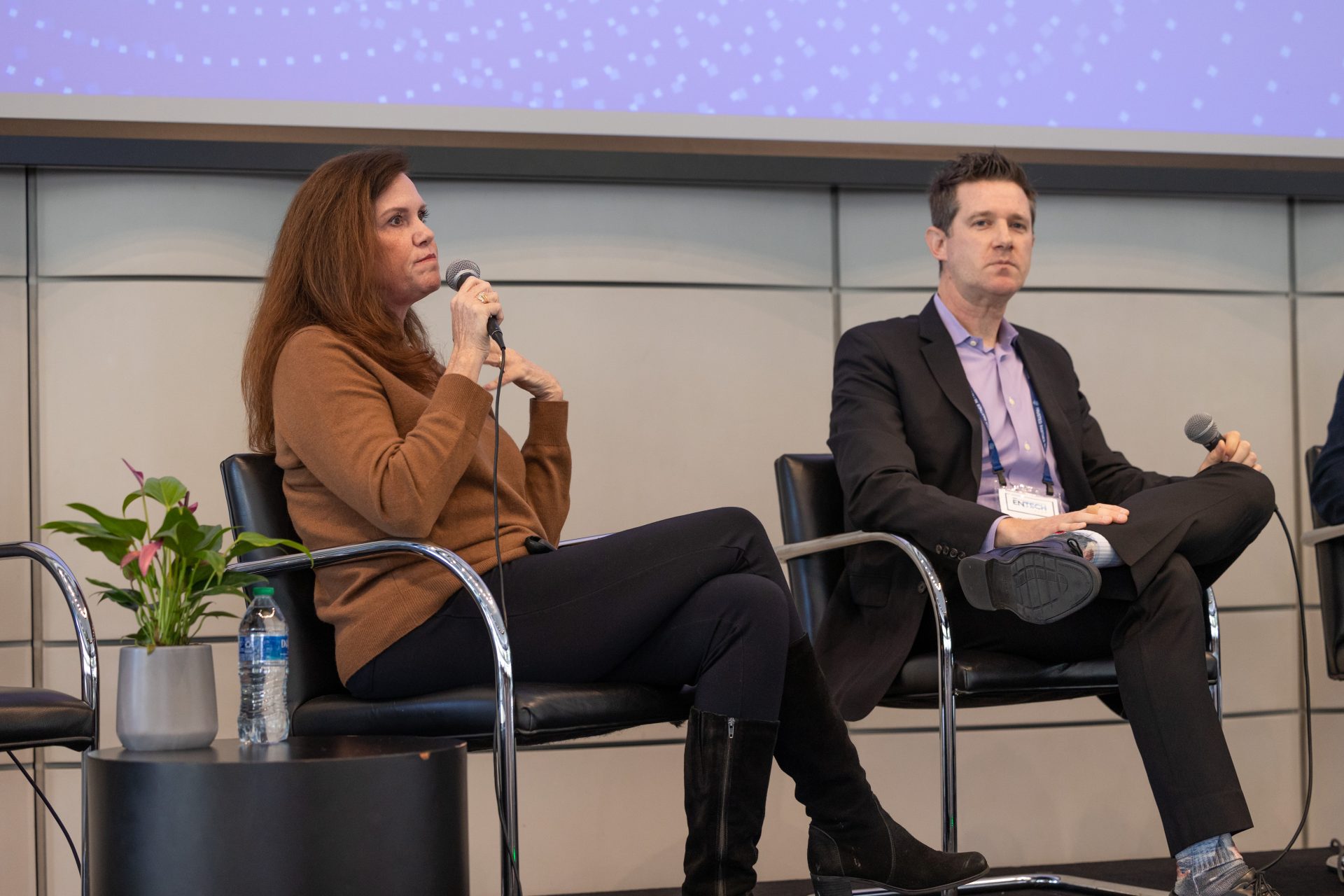
360 Solutions had another assignment at the event: sponsoring the coffee cart. The agenda placed that service across much of the working day, while Mikesell’s panel occupied an early afternoon slot. It is a pleasing detail for a company concerned with the arrangements around creative work. At the same gathering, its name appeared beside both an industry discussion and the place attendees could get a cup of coffee between sessions.
The discussion had room for the technology’s less polished moments. Mikesell shared examples of useful applications along with humorous shortcomings. That detail gives the appearance some texture: an executive whose work depends on usable results discussing both the promise and the occasions when the promise needs checking.
In July, she was listed for another AI conversation, this time with SMPTE Hollywood. The panel included Lionsgate technical operations executive Gray Ainsworth and technologist Alan Lasky. Former Sony Pictures chief technology officer Bill Baggelaar was the moderator. Its subject covered machine learning and AI in global distribution, visual effects and localization.
The event’s framing included budgets and concerns about jobs, as well as the technology’s capabilities. Mikesell’s presence in these settings places her agency work within a wider industry discussion. The production question remains unusually resistant to fashionable language: what can this tool do reliably enough for the work being delivered?
Learning the other side of the table
Agency ownership also requires skills that are less visible in a production title. A founder has to meet prospective clients, explain the offer and make the beginning of a working relationship function. Knowing how to deliver the service is one part of getting someone to buy it.
Mikesell has spoken publicly about working with business coach Simona Ksoll. She describes bringing on new clients while improving her networking, relationship building, pitch meetings and onboarding. The account is a modest but revealing addition to the executive biography. Her own account allows room for learning the commercial work of running the business.
Her description of coaching stays close to particular activities. A meeting can be conducted better. A new client can be brought into the business more smoothly. Those are recognizable assignments for someone whose earlier career involved keeping production organized. They also place the founder on a different side of the conversation: she is explaining why her own company should be trusted with the next brief.
There is a useful connection between pitching and onboarding here. A pitch describes what the relationship could be; onboarding establishes how it will actually operate. For a company built around reducing coordination trouble, that first passage from conversation to assignment deserves care. The relationship has a production process of its own.
The file and the release date
In January 2026, 360 announced The Artwork Localization Playbook, an operational brief about delivery risks in international entertainment marketing. Mikesell’s accompanying statement put reliability at the center of execution. The brief addresses the consequences of late corrections, rejected assets and work that returns for another round just when time is running short.
“At global scale, reliability becomes inseparable from execution.”
Michelle Mikesell · January 2026
The practical advice in the company’s writing includes agreeing on core source files and checking platform requirements early. These decisions are easy to overlook from outside production. Inside it, they determine whether a team is adapting the right material in the first place. A correction is much cheaper before it acquires several international relatives.
That is the line connecting Mikesell’s studio career with the agency she co-founded. She had worked where the deadline was felt, then helped build a business around the work needed to meet it. The visible result may be a banner, a title treatment or a small image on a streaming screen. Behind it sits a series of people who need clear information and a workable next step.
The experience of the person commissioning the artwork remains central to that connection. A client needs a clear view of progress while still having time for the rest of the campaign. Mikesell and Luckie had occupied that position themselves. Their business gives that experience a continuing place in the brief.
Viewers are free to scroll past the result in a second. Mikesell’s business has to care about everything that happened before that second arrived.