A quarter is usually three months. In Michael Zamagias’s business vocabulary, it can last 25 years. Christopher Johnson, his fellow chief executive at TeleTracking, has recalled Zamagias calling the first quarter-century of the company his “best quarter.” An accountant might request clarification. An entrepreneur who began investing in the business in 1991 can probably afford the joke.
It is a useful entrance into a career that otherwise looks crowded on the page. There is a property company, a bank, an energy venture, a software business and a university trusteeship. Read those entries quickly and they resemble a collection of unrelated bets. Put dates beside them and a different picture appears: businesses started years apart, with involvement stretching across decades.
Zamagias is chairman and co-CEO of TeleTracking and founder, chairman and CEO of Zamagias Properties. Pittsburgh is the base connecting those roles. His working life began elsewhere in western Pennsylvania, in residential property sales in Johnstown, while he was in his early twenties. Before the portfolio acquired its several industries, there was the practical business of selling a home.
The change in scale came in stages. He moved to Pittsburgh in 1984 and started his own company. The Zamagias Properties name followed in 1987. By the next year, he was involved in a development whose proposed footprint was 766 acres. The distance between a house listing and a development of that size is considerable, even before anyone starts measuring the roads.
The airport was part of the property
Robinson Town Centre, launched in 1988, was a three-phase, mixed-use development with a stated project value of $500 million. That figure describes the development, rather than Zamagias’s personal fortune. The scale matters because the proposition reached beyond any individual shop or office: it depended on the usefulness of a whole location.
West of Pittsburgh, the airport corridor was changing. Construction of a new terminal helped encourage nearby development. Robinson’s combination of retail and office space belonged to that larger story of roads, connections and anticipated demand. A shopping destination needs tenants, certainly. It also needs people who can reach it without treating the journey as an expedition.
Zamagias explained the calculation in terms of the road system and the growth expected around the new terminal. The language was practical. Access helped make the project viable. It is a reminder that a developer’s product includes the surroundings: a building can be immaculate and still sit on the wrong side of an inconvenient journey.
There is an interesting contrast with his later work in Lancaster. At Robinson, the opportunity involved creating a substantial new destination. In Lancaster, it involved returning existing buildings to use. Both are development, but they ask different questions of the person signing the checks. One begins with what a place might become; the other must contend with what is already there.
A banker, an investor, an operator
In 1991, Zamagias co-founded Pennsylvania Capital Bank. The same year, he co-invested in TeleTracking while the company was still in its earliest stage. Banking and software entered the career alongside property, rather than replacing it. The chronology is worth keeping straight: the real estate enterprise continued while the other commitments developed.
The bank was sold to Three Rivers Bank in 2001. Zamagias’s involvement in TeleTracking continued. Those two outcomes give the portfolio a little more texture than a simple story of permanent ownership would allow. One venture reached a sale; another remained part of his working life more than three decades after his initial investment.
A further venture followed in 2002 with the development of more than 150 oil and gas wells in Pennsylvania. The range is broad, but the geographic thread is persistent. Residential sales, commercial development, banking and energy all had Pennsylvania connections. His career expanded across industries while retaining a substantial connection to the same state.
The present TeleTracking leadership arrangement pairs him with Johnson as co-CEO. In 2018, Zamagias announced Johnson’s promotion to president, assigning responsibility for operational business units, including sales, marketing, strategy, technology and delivery services. It was a concrete redistribution of responsibilities inside a company where Zamagias remained chief executive.
An old building gets another assignment
Zamagias Properties began focusing on downtown Lancaster in 2012. Its projects there have included the former Bulova building, the Keppel Candy Factory and the former headquarters of the Lancaster Intelligencer Journal. These were buildings with previous occupations. Giving them new ones required more than replacing the name over the entrance.
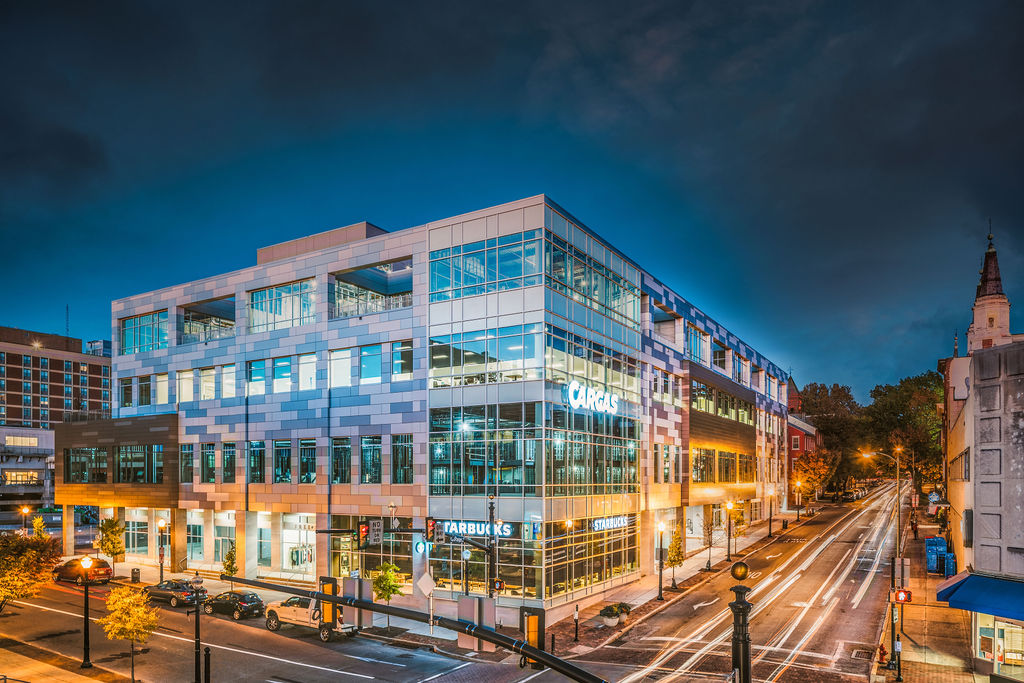
At 101 North Queen Street, the former Bulova building became 101NQ, combining commercial, office and residential space. Its earlier windowless exterior was removed and replaced, while the steel and concrete skeleton of the department-store structure survived. The old frame remained useful even when the face presented to the street had to change.
The redevelopment brought together Zamagias Properties, LeFevre Funk Architects, RGS Associates and Warfel Construction. That list matters. A founder’s biography tends to compress a building into a single name. The building itself is an accumulation of design, engineering, construction and financing decisions made by several organizations.
Today, 101NQ includes ground-floor retail opportunities as well as offices and residences. Its public tenant list includes Cargas Systems and Orrstown Bank. Different uses share the address, making the building part of several daily routines. Someone’s workplace, someone else’s home and a customer’s destination can occupy different floors of the same investment.
The appeal of this part of Zamagias’s career is its physical legibility. A software company can be difficult to see from the pavement. A building with windows where there used to be a blank exterior makes its change rather easier to inspect. Lancaster offers a street-level view of what a long-running investment business actually does.
The candy factory kept its character
The Keppel Building supplies another version of the idea. Its origins extend into Lancaster’s tobacco trade, with northern buildings dating to 1885. A southern building designed by local architect C. Emlen Urban followed in 1913 and 1914. The complex became associated with confectionery manufacturing and wholesale distribution. Buildings, like businesspeople, sometimes have more than one career.
After the confectionery business, the property accommodated a succession of uses, including studios, galleries, storage and offices. By 2014, much of it was empty. Zamagias Properties purchased it in 2015, and the redevelopment was completed in March 2017. The project provided commercial uses on the lower levels and 38 apartments above.
The design retained historic material where possible and followed rehabilitation standards associated with historic preservation. State and federal historic preservation tax credits helped support the project. This was a renovation with financial and architectural constraints operating together. Keeping the brickwork is an appealing phrase; arranging the work so the building can function again is the harder assignment.
High ceilings and exposed brick remain part of the apartments’ character. The candy has left the factory, but the factory has not entirely left the rooms. That is the charm of reuse when it works: the previous purpose supplies something the new purpose would struggle to manufacture convincingly from scratch.
- 1885 Tobacco warehouse & cigar manufacturing
- 1910s Confectionery manufacturing
- 2015 Acquired by Zamagias Properties
- 2017 Redevelopment completed: 38 apartments + commercial space
The people who stay in the picture
The property company is privately held and family-owned. Its leadership includes Zamagias’s brother Marcus, who directs operations and has worked in the business for more than 35 years. His responsibilities include construction, maintenance, repairs and tenant buildouts. Behind the ceremonial language of development lies the recurring work of keeping properties usable.
Michael Caffrey provides a connection between the two principal businesses. He joined Zamagias Properties in 2009, later spent several years at TeleTracking, and returned to the property company in 2019. Vince Zappa, its general counsel, joined in 2004. These overlapping tenures give the organization a history extending beyond the founder’s own biography.
Johnson’s recollection of the 25-year quarter belongs in this company. It is an account from a colleague about how Zamagias talks about time, rather than a slogan invented for a campaign. Johnson has also described the company’s continued private ownership as an expression of Zamagias’s commitment to its mission. That is his colleague’s assessment, and it helps explain the joke’s affectionate tone.
The current property portfolio totals approximately two million square feet. Its business includes development, leasing and management across retail, office, residential and student housing. Such a portfolio carries a calendar full of renewals, repairs and decisions about existing places. Opening day is one date among many. Ownership keeps sending invitations long after the ribbon has been put away.
A “best quarter” that lasted 25 years.Zamagias’s description, recalled by Christopher Johnson
In Doha, a different kind of investment
In May 2019, Zamagias delivered the keynote address at Carnegie Mellon University in Qatar’s graduation ceremony. He was there as a member of the university’s board of trustees. The graduating class numbered 78 and represented 16 countries. The setting put a Pittsburgh entrepreneur in front of people preparing to carry their education into rather different places.
“Education City is an investment that Qatar has made in each of you,” he told them. The sentence brought the language of his business life into the ceremony. Here, the investment was in people, and the expected return involved what those people could contribute to their communities.
His address encouraged the graduates to put their knowledge and skills to use and to keep drawing inspiration from their university experience. It makes a fitting companion to the commercial chronology. The speech looks forward from an education; the career shows what a sequence of commitments can look like when viewed across many years.
TeleTracking continued adding new business relationships, announcing a partnership with Palantir in June 2025. Zamagias Properties continues operating its portfolio, including the Lancaster projects. The career remains attached to active organizations and occupied buildings. The quarter-century joke leaves a final, pleasantly awkward question for the calendar: when your unit of progress is 25 years, how much of the working day is still ahead?